Accounting Basics for Non Commerce Students
Last Updated On -08 Aug 2026
By IIC Lakshya
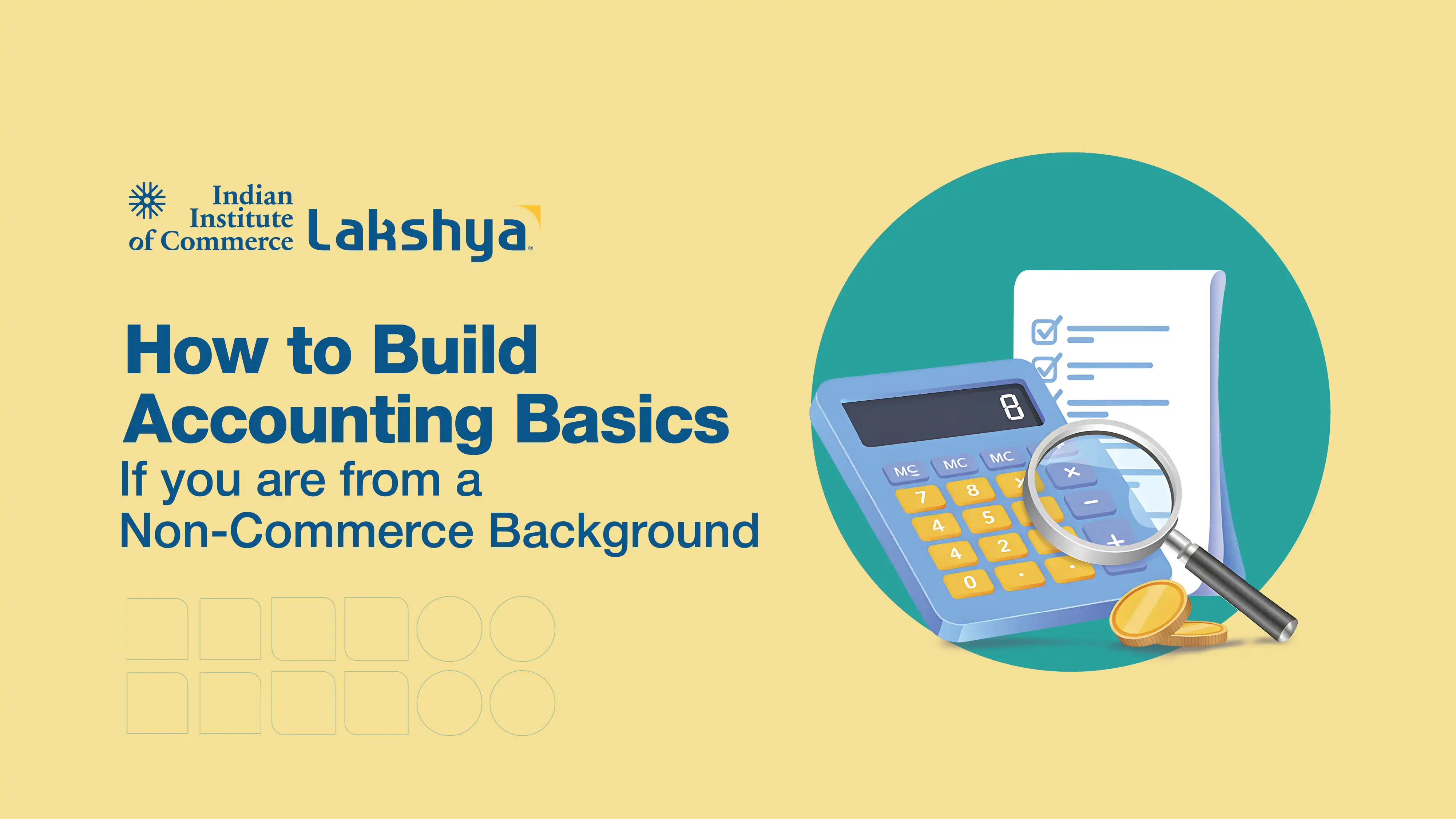
Nobody teaches you accounting in a physics lab or a history classroom.
So when a science or arts student decides to pursue CA, they walk into their first accounting chapter carrying zero prior exposure—no journal entries. No ledgers. No idea what a trial balance even is, just a registration number from ICAI, and the quiet hope that they can figure it out.
Here is the good news: you can figure it out. Accounting is a learnable skill, not an inherited talent that commerce students are born with. Every concept you need to know has a logical structure behind it. Once that structure clicks, the subject stops feeling foreign and starts feeling like a system you can actually navigate.
This article gives you a step-by-step process to build your accounting foundation from scratch with a practical, sequenced, and designed specifically for students who are starting with no background in financial accounting at all.
Why Non-Commerce Students Struggle With Accounting Early On?
Before diving into the process, it helps to understand why accounting feels harder for non-commerce students in the first place — because the reason is specific, and fixing it is straightforward once you know what it is.
Commerce students spent two years watching accounting unfold in a structured school syllabus. They made mistakes, got corrected by teachers, and absorbed the logic gradually. By the time they reach CA Foundation, accounting feels intuitive — not because they are smarter, but because they have had repeated exposure.
Non-commerce students encounter accounting as a completely new language with its own grammar, vocabulary, and logic. The challenge is not intelligence. It is the absence of that foundational exposure. You are not starting from the same chapter; you are starting from a different book entirely.
The fix is deliberate: you need a structured sequence of learning that builds accounting knowledge from first principles, the way a good Class 11 commerce teacher would, except compressed, focused, and targeted at CA Foundation requirements.
Step 1 — Start With the Concept Before the Calculation
Most students make one early mistake when self-studying accounting: they open a textbook and start trying to learn journal entries without understanding why journal entries exist in the first place.
Accounting is a record-keeping system built on one central idea: every business transaction has two sides. Something comes in, something goes out. A company buys equipment with cash: equipment comes in, cash goes out. A company provides a service and receives payment: money comes in, a service obligation goes out.
This two-sided nature of every transaction is the foundation of double-entry bookkeeping — the system that all of modern accounting runs on. Before you touch a single journal entry, spend one full day understanding this concept at the conceptual level.
Ask yourself: What does a business actually do? It buys things, sells things, pays people, earns money, owes money, and owns things. Accounting tracks all of that — methodically, in a format that anyone trained in the system can read and verify.
Once that mental model sits clearly in your head, journal entries stop being arbitrary rules and start being logical records of what actually happened in a business.
Step 2 — Learn the Language of Accounting Before the Rules
Accounting has its own vocabulary. Trying to learn journal entries before you understand the terminology is like trying to read a novel in a language where you only know twenty words.
Spend a dedicated week building your accounting vocabulary. These are the terms you need to understand — not just memorise — before anything else:
|
Term |
What It Actually Means |
|
Assets |
Things a business owns or owes cash, equipment, debtors |
|
Liabilities |
Things a business owes to others, such as loans, creditors, and unpaid bills |
|
Capital / Equity |
The owner's stake in the business is what is left after debts |
|
Revenue |
Money earned from business activities, sales, fees, and services |
|
Expenses |
Money spent to run the business, rent, salaries, and utilities |
|
Debit |
An entry on the left side of an account |
|
Credit |
An entry on the right side of an account |
|
Ledger |
A book (or system) that records all accounts separately |
|
Trial Balance |
A summary of all ledger balances to check arithmetic accuracy |
|
Financial Statements |
The formal reports, such as Profit & Loss, Balance Sheet, Cash Flow |
Do not move to journal entries until you can explain each of these terms in your own words without looking at a reference. That self-test is your readiness check.
Step 3 — Master the Accounting Equation First
The entire structure of financial accounting rests on one equation:
Assets = Liabilities + Capital
This equation never breaks. Every transaction, every journal entry, every balance sheet you will ever encounter in CA Foundation and beyond balances back to this equation.
Spend two to three days working through this equation with simple, real-world examples before you open a formal textbook.
Start here: A business owner puts ₹5,00,000 of their own money into a new company.
- Assets go up by ₹5,00,000 (cash is now in the business)
- Capital goes up by ₹5,00,000 (the owner's stake increases)
- Equation: ₹5,00,000 = ₹0 + ₹5,00,000
Now the business buys a computer for ₹50,000 in cash.
- Assets change: Cash goes down by ₹50,000. Computer (asset) goes up by ₹50,000.
- Net asset change: Zero. One asset replaced another.
- Equation still holds.
Build ten to fifteen examples like this yourself before you read any textbook explanation. The equation becomes instinctive through active construction — not passive reading.
Step 4 — Learn Journal Entries Through Stories, Not Rules
Here is where most accounting textbooks lose non-commerce students: they present journal entries as a set of rules to memorise.
Debit what comes in, credit what goes out. Debit the receiver, credit the giver.
These rules work — but they mean nothing without context. Non-commerce students who memorise rules without understanding the underlying logic apply them correctly in familiar situations and freeze completely in unfamiliar ones.
A better approach: learn journal entries through stories.
Take a simple business scenario — a small stationery shop — and walk every transaction through from start to finish. The owner buys stock on credit. The owner sells pens for cash. The owner pays the electricity bill. The owner takes a salary.
For each transaction, ask: What happened? What came in? What went out? Who benefited? Who gave something? Then write the journal entry as a record of that story — not as a rule applied mechanically.
This approach takes slightly longer in the first two weeks. But it builds the conceptual foundation that makes everything after it — ledgers, trial balance, final accounts — logical rather than arbitrary.
Step 5 — Follow This Exact Learning Sequence
Non-commerce students who build accounting basics successfully follow a deliberate sequence. Jumping ahead in this sequence — even when you feel ready — creates gaps that surface painfully in practice exams.
Follow this order without skipping:
Week 1–2 — Concept and Vocabulary: Accounting equation, terminology, double-entry concept. No journal entries yet.
Week 3–4 — Journal Entries: Simple transactions first. Cash transactions only. No credit transactions until cash entries feel natural.
Week 5–6 — Ledger Posting: Take your journal entries and post them to individual ledger accounts. Understand how every transaction flows from journal to ledger.
Week 7 — Trial Balance Extract balances from ledger accounts and compile a trial balance. Understand what it proves and what it does not prove.
Week 8–9 — Final Accounts (Trading, P&L, Balance Sheet): Prepare simple final accounts from a trial balance. This is where everything you have learned connects into a complete financial picture.
Week 10 onwards — ICAI Study Material. Only after completing this sequence should you open ICAI's CA Foundation Paper 1 study material. By this point, the material reads like a review — not an introduction.
The Resources That Build Accounting Basics Most Effectively
Not every resource suits every learning style, but these three work consistently for non-commerce students at the CA Foundation level:
- T.S. Grewal's Double Entry Book Keeping (Class 11 volume), written for students encountering accounting for the first time. Plain language. Progressive difficulty. Solve the exercises — do not just read the examples. This book builds the foundational muscle memory that ICAI material later reinforces.
- ICAI BoS Learning Media: — YouTube Channel ICAI's official video library covers every Foundation topic. For non-commerce students, accounting video explanations bridge the gap between text and understanding faster than reading alone. Watch the relevant video, then return to the textbook.
- ICAI Foundation Study Material and Practice Manual: The primary exam resource. Use it after building basics, not before. The Practice Manual problems align directly with exam question patterns — solve every problem, check against suggested answers, and understand where your reasoning differed.
The Practice Habit That Makes the Difference
Accounting is a skill subject, not a knowledge subject. You do not learn accounting by understanding it — you learn it by doing it repeatedly until it becomes reflexive.
Set a non-negotiable daily practice rule: solve a minimum of ten accounting problems every day, regardless of what else you study that day.
Ten problems seem very small. Over sixty days of preparation, that is six hundred problems worked through independently. By the time your Foundation exam arrives, journal entries, ledger posting, and trial balance preparation feel automatic — because they are.
Students who read extensively and practice minimally feel confident until the exam begins. Students who practice daily feel uncertain until the exam begins — and then perform accurately, because their hands know what their brain has rehearsed.
Build the daily practice habit in week one. Protect it through every week that follows.
What to Do When Concepts Simply Will Not Click?
Every non-commerce student hits a moment — usually around ledger posting or adjusting entries — where something stops making sense. Reading it again produces the same confusion. Solving problems produces the same errors.
When this happens, do three things in sequence:
First, watch the ICAI BoS video explanation for that specific topic. A different presentation of the same concept often shifts the understanding.
Second, return to a simpler version of the same concept. If adjusting entries confuse you, return to basic journal entries for a day and rebuild confidence before attempting adjustments again.
Third, ask specific questions in CA student communities — Reddit's r/CharteredAccountants, Telegram groups for Foundation batches, or ICAI's own student forum. Describe exactly what you do not understand. Specific questions get specific answers.
What does not work: sitting with the confusion and hoping it resolves through repeated reading. It rarely does. Active intervention — a different resource, a simpler starting point, a direct question — breaks the block faster than patience alone.
Conclusion: How IIC Lakshya Helps Non-Commerce Students Build the Right Foundation
Building accounting basics from scratch is completely achievable but the sequence matters enormously. Non-commerce students who rush to ICAI material without building conceptual foundations first spend weeks feeling confused and falling behind. Students who follow a deliberate sequence, concept, vocabulary, equation, journal entries, ledger, trial balance, and final accounts build a foundation that carries them through Foundation, Intermediate, and Final level accounting with a genuine understanding.
The challenge is that most students do not know which sequence to follow, which resources to use at which stage, or how much time to allocate to accounting before their coaching or self-study plan begins.
That is exactly where IIC Lakshya makes the difference.
Our academic counsellors work specifically with non-commerce students entering CA preparation. We assess your current subject knowledge, identify where your accounting gap actually starts, and build a personalised preparation roadmap that sequences your learning correctly from day one. We help you choose between self-study, structured coaching, or a hybrid approach — based on your specific background, learning style, and timeline.
We have guided science and arts students through CA Foundation accounting who had never seen a journal entry in their lives. The ones who qualified did not do it by accident. They did it with a clear plan, the right resources in the right order, and guidance that understood exactly where they were starting from.
Book your free counselling session with IIC Lakshya today. Walk away with a concrete, personalised accounting study plan, and the confidence that you are starting your CA journey from exactly the right place.
Book your free session at IIC Lakshya that is built for non-commerce students who are serious about CA.
Related Blogs