Is ACCA difficult or easy to crack?
Last Updated On -21 Sep 2026
By IIC Lakshya
The Association of Chartered Certified Accountants (ACCA) is a leading international accountancy body that offers the prestigious designation. With over a century of history, ACCA has grown to over 241,000 members and 542,000 students worldwide.
The course of ACCA provides a strong foundation in accounting, finance, and management, and is recognized in many countries. In India, ACCA is considered equivalent to CA, and ACCA professionals are often hired at similar salary packages in many top international companies.
After knowing about the ACCA salary, questions like “Is ACCA easy to crack?” or “How hard is it to pass the ACCA exam?” come to mind. The ACCA course is usually thought to be moderately difficult, however, if you’d like to know more about the difficulty level of the ACCA, here’s a detailed overview of how to become an ACCA.
Is ACCA really tough to crack? Find out for yourself in this video.
Guide to ACCA Eligibility Criteria
Students who have completed higher secondary, +2, and are looking to embrace global opportunities in Finance. Graduates and postgraduates aspiring for a career in Accounting and Finance are also eligible. Given below is a detailed ACCA course eligibility criteria.
ACCA after 12th
Students who have completed higher secondary, +2, and are at least 18 years old. Apart from that, you must have obtained a minimum score of 65% in Math or Accounting as well as English, and a minimum overall score of 50% in your other disciplines. Various high school certificates, such as 10+2, ISC, Intermediate Certificate, etc., are considered valid.
ACCA after Graduation
Individuals who have obtained commerce degrees such as B.Com, BBA, or BMS are eligible to pursue the ACCA exams. Individuals who possess a Bachelor of Arts (BA) or Bachelor of Science (B.Sc.) degree from an accredited university are also eligible to pursue the Association of Chartered Certified Accountants (ACCA) qualification. However, they must first fulfil the requirement of obtaining the ACCA Foundation diploma.
ACCA after 10th
If you choose to pursue ACCA immediately after completing 10th grade, there is a designated program called the Foundation in Accountancy that is tailored for you. This course is designed for individuals who do not have a background in accounting and is primarily targeted towards those who have recently completed 10th grade. The three levels are Knowledge, Skill, and Professional. To obtain certification, it is necessary to complete a total of 13 examinations spanning several levels.
ACCA during and after CA
CA India and CMA India students who are midway through their journey, and Qualified professionals holding CA India, and CMA India certifications are also eligible to do ACCA with varied degrees of exemptions.
ACCA Syllabus and Papers
The ACCA encompasses various aspects of Chartered Accountancy, including Accounting, Financial Reporting, Auditing, Taxation, Business Finance, and Financial Management.
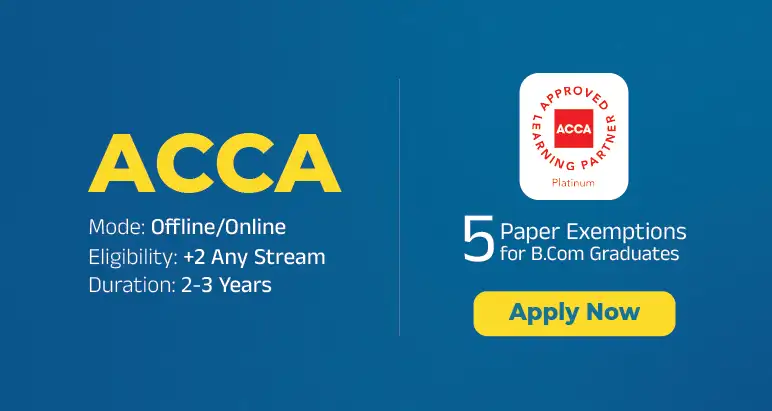
The ACCA Syllabus comprises a total of 13 examinations that candidates must undertake. These 13 exams are divided into 3 levels – Applied Knowledge, Applied Skills, and Strategic Professional. There are varied degrees of exemptions ranging from 4 - 9 subjects for aspirations who have qualifications like B.Com and CA, etc.
Applied Knowledge
The Applied Knowledge exams provide students with a broad introduction to the world of finance and develop their essential understanding and skills in accounting. These exams are:
-
F1 - Business and Technology (BT)
-
F2 - Management Accounting (MA)
-
F3 - Financial Accounting (FA)
Applied Skills
The Applied Skills exams build upon existing knowledge and understanding and develop strong, broad, and practical finance skills required of future strategic professional accountants in any sector or industry. These exams include:
-
F4 - Corporate and Business Law (LW)
-
F5 - Performance Management (PM)
-
F6 - Taxation (TX)
-
F7 - Financial Reporting (FR)
-
F8 - Audit and Assurance (AA)
-
F9 - Financial Management (FM)
Strategic Professional
The Strategic Professional exams prepare students for future leadership positions, developing a strategic vision through a unique blend of technical, ethical, and professional skills. Additionally, you can specialize in areas that best suit your career ambitions.
Students must complete both Essentials exams (P1 - P3) and choose two of the Options from P4 - P7. P1 - P7 consists of four papers. These exams are:
-
P1 and P3 - Strategic Business Leadership (SBL)
-
P2 - Strategic Business Reporting (SBR)
-
P4 - Advanced Financial Management (AFM)
-
P5 - Advanced Performance Management (APM)
-
P6 - Advanced Taxation (ATX)
-
P7 - Advanced Audit and Assurance (AAA)
ACCA Pass Rates For Different Subjects
Pass rates of ACCA (the Association of Chartered Certified Accountants) for students who sat their exams in June 2023. Given below are the subject names and their Pass rates:
- BT - Business & Technology 83%
- FA - Financial Accounting 72%
- MA - Management Accounting 63%
- LW - Corporate and Business Law 80%
- TX – Taxation 56%
- FR - Financial Reporting 49%
- PM - Performance Management 40%
- FM - Financial Management 52%
- AA - Audit and Assurance 45%
- SBL - Strategic Business Leader 51%
- SBR - Strategic Business Reporting 51%
- AAA - Advanced Audit and Assurance 34%
- AFM - Advanced Financial Management 47%
- APM - Advanced Performance Management 34%
- ATX - Advanced Taxation 43%
Looking at the passing percentage for all three levels, one can figure out and easily tell that the skill level and professional level papers of ACCA are more difficult to clear than the knowledge level papers of ACCA. Hence, the answer to the question of whether is ACCA easy to crack is yes, it is easy to crack, but only for those who take time to understand the syllabus and study well.
Furthermore, to the question of whether ACCA be cracked by self-studying? Yes, it can be. Yet, we will say that having a partner in learning can make it easier, and what better than joining the top commerce coaching class for better navigation.
Navigating ACCA Syllabus Levels, Eligibility, and Subject Pass Rates
Navigating the 13-paper ACCA syllabus demands a clear understanding of eligibility rules, paper-wise pass percentages, and progressive exam difficulty. While Applied Knowledge subjects maintain high pass rates above 60%, the Applied Skills and Strategic Professional levels introduce complex IFRS applications, real-world case scenarios, and lower pass percentages (such as 34% in Advanced Audit and Assurance). Succeeding across these advanced stages requires moving beyond passive reading toward active scenario analysis, mock evaluation, and disciplined time management. Whether entering after 10th via Foundations in Accountancy (FIA), directly after 12th, or claiming up to 9 paper exemptions with a B.Com or CA qualification, a structured preparation strategy ensures a smooth transition to qualified status. As an ACCA Approved Platinum Learning Partner, IIC Lakshya empowers finance aspirants across India and Dubai with tailored study plans, paper-specific coaching, CBE mock assessments, and dedicated placement support.
Related Reads:
Explore more on related ACCA topics by checking out these additional resources.
- ACCA vs CA
- ACCA Salary in Dubai
- ACCA vs CIMA
- ACCA vs CPA
- ACCA Course Duration After 12th, Graduation and CA
Frequently Asked Questions (FAQs)
How difficult are the ACCA exams?
The difficulty of ACCA exams varies across different levels and subjects. Generally, the skill and professional-level papers are considered more challenging to clear compared to the knowledge-level papers, as indicated by pass rates.
Are there any exemptions for ACCA exams?
Yes, candidates with qualifications such as B.Com and CA may receive exemptions from certain ACCA exams, ranging from 4 to 9 subjects, based on their prior education and qualifications.
Is ACCA tough to pass?
ACCA is moderately tough but highly achievable with structured preparation. The exams test conceptual understanding, application skills, and professional judgement rather than rote learning. Students who follow a disciplined study plan, practice past papers, and revise consistently can pass ACCA successfully.
Is ACCA tougher than CA in India?
ACCA and CA differ in structure and flexibility. CA generally has lower pass percentages and fewer exam attempts per year, making it statistically tougher. ACCA offers quarterly exams and flexible attempts, but it remains academically rigorous and concept-driven.
Why do students think ACCA is tough?
Students consider ACCA tough because it includes 13 papers, strategic-level case studies, and application-based questions. The difficulty often arises from weak fundamentals, poor time management, and lack of mock exam practice rather than the syllabus itself.
Which ACCA paper is the toughest?
Most students find Strategic Business Leader (SBL) and Strategic Business Reporting (SBR) the toughest ACCA papers. These exams require analytical thinking, case study evaluation, IFRS application, and structured written answers under strict time constraints.
Is ACCA tough for average students?
ACCA is not only for toppers. Even average students can clear ACCA with consistent preparation, conceptual clarity, and regular practice. The qualification rewards discipline and smart study strategies more than exceptional academic brilliance.
Is ACCA tough without a commerce background?
ACCA can be challenging initially for non-commerce students, especially in Financial Accounting and Management Accounting. However, with foundation-level preparation and structured coaching, students from any background can manage the syllabus effectively.
How difficult is the ACCA Strategic Professional level?
The Strategic Professional level is the most demanding stage of ACCA. It tests leadership, governance, risk analysis, financial reporting, and real-world business decision-making. Students must develop strong analytical and professional writing skills to succeed.
What is the ACCA pass percentage?
ACCA global pass rates typically range between 45% and 55% for most papers. This indicates moderate difficulty. The exams are challenging but not impossible when approached with proper planning and consistent revision.
Is ACCA difficult compared to CMA or CPA?
ACCA focuses heavily on IFRS and global accounting standards. CMA emphasizes management accounting, while CPA focuses on US regulations and GAAP. The difficulty depends on career goals and subject preference rather than overall toughness.
How can I make ACCA easier to crack?
To make ACCA easier study consistently for 2–4 hours daily, Attempt past exam papers, Take mock tests under timed conditions, Revise regularlyFocus on conceptual clarity. A Smart preparation significantly reduces ACCA difficulty.
How long does it take to complete ACCA?
ACCA typically takes 2–3 years to complete. Graduates with exemptions may finish sooner. Completion time depends on exam attempts, study discipline, and whether the student is studying full-time or working simultaneously.
Is ACCA worth it despite being tough?
Yes, ACCA is worth the effort because it provides global recognition, strong career opportunities, and competitive salary potential. The moderate difficulty ensures professional credibility and industry respect.
Related Blogs