

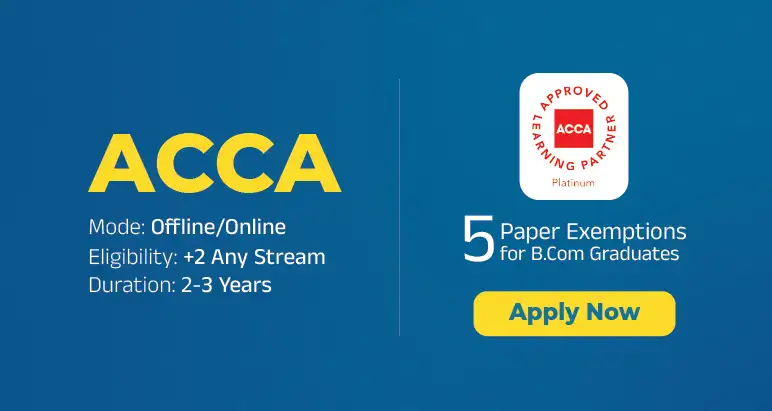
ACCA vs CIMA: What is the difference?
Last Updated On -30 Sep 2026
By IIC Lakshya

ACCA course (Association of Certified Chartered Accountants) equips students with skills in account handling, management accounting, taxation, auditing, and so on, whereas the CIMA certification (Chartered Institute of Management Accountants) provides adequate training and a degree in management accounting and other related subjects.
In the ACCA vs CIMA debate, there are a few things you need to know first. Both are well-known accounting and financial qualifications. However, CIMA is more than simply accounting; it also aids in the development of decision-making skills because it combines accounting and business management. As a result, both certification programs target certain job profiles, and candidates must make an informed decision depending on their career goals.
What is the difference between ACCA and CIMA?
The question of which certification to study in the CIMA vs ACCA debate is a common one, but both qualifications are highly respected in the accountancy world, leading to exciting careers. Understanding the key differences between the two is important:
ACCA vs CIMA - Skills acquired:
- After earning an ACCA, a candidate acquires a better understanding of the technical aspects of financial accounting.
- A CIMA-certified individual, on the other hand, develops exceptional strategic and business management abilities.
ACCA vs CIMA - Duration:
- Both courses require similar amounts of time to complete. ACCA applicants must pass 14 professional tests and have three years of supervised accounting experience.
- If candidates can balance their career and education, they can complete their ACCA certifications in three years.
- To successfully earn the CIMA qualification, students must pass 16 papers and three years of relevant professional experience.
- So, even in CIMA, students can complete the course in three years if they maintain a good work-study balance.
ACCA vs CIMA - Eligibility:
- To take the ACCA examination, a candidate must have completed high school.
- In contrast, the CIMA tests require candidates to have a degree in any discipline from a recognized university.
- In addition, both the ACCA and CIMA credentials require three years of relevant work experience.
- Finally, candidates are eligible for exemption from papers based on their educational background.
ACCA vs CIMA - Syllabus:
- Aside from the main subjects of accounting, auditing, and taxation, the ACCA course includes business studies, financial reporting, financial management, legislation, and ethical and professional standards.
- In contrast, the CIMA qualification focuses on the development of business abilities.
- It covers topics such as finance management, business accounting, information management, management accounting, and strategic marketing management, among others.
- The ACCA syllabus has 13 exams, whereas the CIMA syllabus contains 16 tests.
CIMA or ACCA - What Should You Pursue?
“CIMA or ACCA, which is better?” is a very common question, and unfortunately, there is no simple answer. There is no doubt that both qualifications help you get some of the most sought-after careers in finance and accounting. ACCA focuses on advanced taxation principles and external auditing, preparing candidates to operate independently or for finance-specific private firms.
CIMA, on the other hand, helps candidates prepare for the business aspect of accounting while also providing managerial knowledge. To make it easier for you to decide if CIMA or ACCA is better, the table below compares the two credentials:
Feature |
ACCA |
CIMA |
|
Organizing body |
Association of Chartered Certified Accountants (ACCA) |
Chartered Institute of Management Accountants (CIMA) |
|
Pattern |
Divided into three levels
|
Divided into four levels
|
|
Course Duration |
3 years |
3 years |
|
Syllabus |
|
|
|
Job |
|
|
|
Difficulty |
Moderate |
Moderate |
Global Career Path in Corporate Finance and Management
Choosing between ACCA and CIMA hinges on whether your career trajectory favors core financial accounting, external auditing, and global tax compliance, or management accounting, operational strategy, and corporate decision-making. While CIMA equips professionals to drive internal strategy and business performance, ACCA offers a universally versatile qualification spanning international financial reporting, auditing, and corporate finance across 180+ countries. As an ACCA Approved Platinum Learning Partner, IIC Lakshya helps candidates navigate their professional journey with structured coaching, exemption guidance, and dedicated mentoring to ensure success in the global financial landscape.
CIMA vs ACCA - Conclusion
With so much to take into consideration, it might be tough to choose between CIMA and ACCA. It all relies on your career goals to pick the one that would provide you with the best credentials and a competitive advantage in the workplace.
- In a nutshell, ACCA is more varied in the accounting and finance industry, whereas CIMA focuses primarily on management accounting and finance. However, both certifications have a lot to offer, so take the time to investigate the courses and lessons to ensure you make an informed decision.
- Talk to industry professionals who have been through the process and listen to their recommendations.
- Both have a well-respected reputation in the accounting industry, so whichever you choose will eventually lead to success. All that counts is that you use a method that is tailored to your specific objectives.
Read More:
- Can you finish ACCA in Two Years?
- ACCA Scope and Job Opportunities in India and Abroad
- Why is ACCA getting Popular in India?
- Which degree is the best with ACCA? - B.Com, M.Com, or BBA
Every concept explained in detail—check out our Commerce Blogs page for a thorough analysis of commerce-related subjects!
Frequently Asked Questions (FAQs)
What is the primary difference between ACCA and CIMA?
ACCA focuses on accounting, auditing, and finance, whereas CIMA specializes in management accounting and company strategy.
How long does it take to complete the ACCA and CIMA?
Both take approximately 3-4 years, depending on prior qualifications and study rate.
Are the ACCA and CIMA courses equally good?
Yes, despite differences in syllabus and final purpose, each is a career-focused, job-driven professional qualification sought after by the industry.
Is CIMA harder than ACCA?
The pass rate for ACCA is 30% to 40%, while that for CIMA is 50% to 60%. Based on the pass rates, it can be concluded that ACCA is slightly more difficult than CIMA. Nonetheless, both credentials have unique characteristics and require hard work, discipline, and drive to pass.
Can I do ACCA after CIMA? If so, what benefits do I receive?
Yes, you can complete ACCA following CIMA. In that instance, you stand to benefit from an exemption from 11 papers.
Which qualification costs more, ACCA or CIMA?
The fees are comparable, with ACCA about INR 2,30,000 and CIMA ranging from INR 2,00,000 to 3,00,000 in India.
Is CIMA in demand?
Yes, it is a highly sought-after professional qualification.
Related Blogs