
14 Principles of Henri Fayol's Management
Last Updated On -15 Sep 2026
By Nishtha Singh

Henri Fayol was a French mining engineer with a degree in management theory and is believed to be the earliest thinker to preach the actual practice of management. Rather than relying on abstract theory, Fayol synthesized these concepts from his extensive career revitalizing a major mining and metallurgical operation.
According to him, good management can be taught, and thus, he developed the 14 management principles. Even though they were developed a century ago, they continue to influence modern practices, making them much more effective. Let’s learn more about the engineer.
Who is Henri Fayol?
Henri Fayol, born in 1841, was a French mining engineer and author who laid the groundwork for management theories and modern practices. He firmly believed in a systematic approach to conducting work at formal places, and his theories are an effort towards that. The 14 principles of management are the guidelines for effective organizational management.
Under his leadership, the company recovered and grew into a financially stable operation. Fayol wrote down what he had learned from running that company and organized it into a set of principles he believed applied to any organization - industrial, military, religious, political, or otherwise. This claim of universal applicability is why Fayol is often called the “father of modern management theory.”
Fayol separated managerial activities into five functions:
- Planning
- Organizing
- Commanding
- Coordinating
- Controlling
Origin of the 14 Principles by Henri Fayol
Fayol worked in Comambault, where he became the director of a French mine. He was born in Constantinople amidst the great eruption of the Industrial Revolution. Fayol published “General and Industrial Administration” in 1949, making him popular. He wrote several articles about mining engineering in the 1870s and a few administrative papers.
He graduated as a mining engineer from the École Nationale Supérieure des Mines de Saint-Étienne, France. His concept and understanding of administration were derived from his management experiences. After his retirement, he became the director of the Centre of Administrative Studies in Paris.
While Henri Fayol's principles were a pioneer in reforming management, other key management principles are equally important in understanding the administrative theory:
- Taylor's Scientific Management Principles
- Drucker's Management Principles
- Weber's Bureaucratic Theory
- Maslow's Hierarchy of Needs
- Kaizen Theory of Management
What are the 14 Principles of Henri Fayol’s Management?
Management is hectic work as we know it; however, these 14 functions have come up with an easier way of dealing with the work: systematically organizing it. These principles are based on real-world experience, and they offer practical guidance on how to manage work and ensure operations are smooth. Functions of management encompassing several measures of getting work done are guided by Henri Fayol’s management principles.
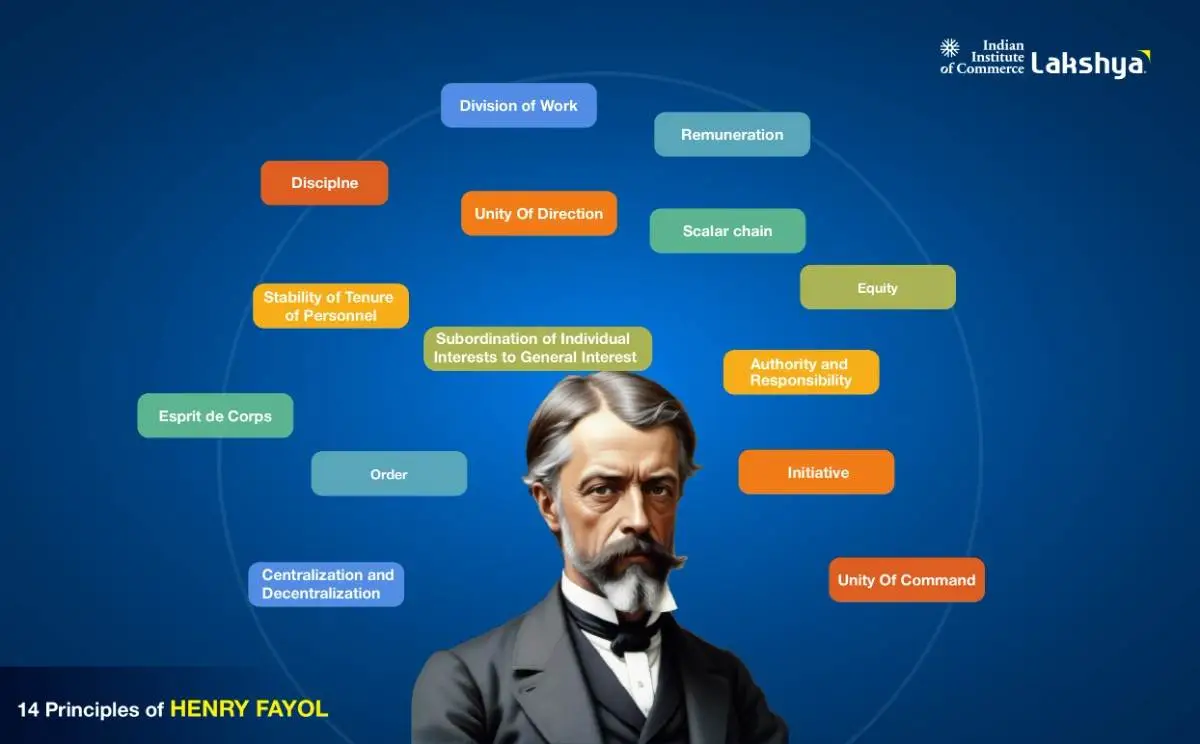
The 14 principles of management by Henri Fayol are mentioned below:
Division of Work
This increases efficiency by assigning tasks among employees based on their skills and specializations, allowing them to be efficient. The division of functions ensures the completion of tasks in a well-regulated manner. Work can be performed more efficiently in business if divided into specialized tasks performed by a specialist-trained employee. This results in efficient and effective output. Thus, a company has separate departments for finance, marketing, production, human resource development, etc.
Authority and Responsibility
All managers must have the authority to give orders and make changes to ensure the tasks are accomplished. With authority comes responsibility, so the authoritative person should be well-versed in the rules. There should be a balance between authority and responsibility. An organization should build safeguards against the abuse of managerial power. At the same time, a manager should have the authority to carry out their responsibility.
Discipline
These points towards the rules and policies to ensure fewer conflicts among employees. A well-disciplined workplace ensures smooth operations. Here, discipline means that the workers and management both honor their commitments without any prejudice towards one another.
Unity of Command
Employees should receive instructions from only one superior to avoid confusion and conflicting orders. The principle of unity of command states that each participant in a formal organization should receive orders from and be responsible to only one superior. Fayol gave a lot of importance to this principle. He felt that if this principle is violated, “authority is undermined, discipline is in jeopardy, order disturbed, and stability is threatened”.
Unity of Direction
A single manager should direct all organizational activities with the same objective using one plan. This ensures coordination and clarity in operations. Each group of activities having the same objective must have one head and one plan. This ensures unity of action and coordination. For example, if a company manufactures motorcycles and cars, it should have two separate divisions.
Subordination of Individual Interests to General Interest
The organization's interests should always come first over group interests to maintain harmony. This ensures equality among the workers. Every worker has some individual interest in working in a company. The company has its objectives.
Remuneration
All the employees should be fairly compensated for the work that has been done. This ensures that the employees are well-motivated and are satisfied with the workplace. This will ensure a congenial atmosphere and good relations between workers and management. Consequently, the company's work would be smooth.
Centralization and Decentralization
The degree of centralization or decentralization depends on the nature of the organization. Centralization refers to decision-making by top management, while decentralization allows lower levels to make decisions. Fayol states, “There is a need to balance subordinate involvement through decentralization with managers’ retention of final authority through centralization.”
Scalar Chain
The scalar chain refers to an organization's clear line of authority, from the top to the lowest. Communication should follow this chain, but can be bypassed in emergencies (Gang Plank). Fayol states, “Organizations should have a chain of authority and communication that runs from top to bottom and should be followed by managers and subordinates.”
The scalar chain is the formal line of authority from the highest to the lowest rank in an organization. Fayol believed communication should normally follow this chain step by step. He also introduced an important exception, later called “Fayol's Bridge”:
When two employees at the same level in different departments need to coordinate urgently, they can communicate directly rather than routing every message up and down the full chain, as long as their respective managers stay informed.
Order
A place for everything and everything in its place. Both material and human resources should be well-organized to ensure efficiency. Fayol says, “People and materials must be in suitable places at appropriate times for maximum efficiency.”
Fayol applied this principle to both material order (tools, equipment, and inventory kept in designated places) and social order (the right people placed in the right roles based on their skills). A well-run warehouse and a well-matched job assignment both reflect this principle in action.
Equity
Managers should be kind and fair to their subordinates. Equity fosters loyalty and commitment among employees. Good sense and experience are needed to ensure fairness to all employees, who should be treated as fairly as possible,” according to Fayol.
Equity combines fairness with kindness in how managers treat employees. Fayol distinguished equity from strict legal justice: following the rules exactly is not enough if the application feels unfair to employees. Managers build equity through consistent, considerate treatment, not just technical compliance with policy.
Stability of Tenure of Personnel
High employee turnover is detrimental to organizational efficiency. The stability of tenure allows employees to gain experience and improve performance. “Employee turnover should be minimized to maintain organizational efficiency,” according to Fayol.
Initiative
Employees should be encouraged to take initiative and contribute ideas. This improves engagement, innovation, and overall performance. Workers should be encouraged to develop and carry out their plans for improvements, according to Fayol.
Esprit de Corps
Esprit de corps means fostering team spirit and unity within the organization. Managers should promote harmony and cooperation among employees. To foster team spirit, a manager should replace ‘I’ with ‘We’ in all his worker conversations. This will create a spirit of mutual trust and belonging among team members. It will also minimize the need to use penalties.
Criticisms of Fayol’s Principles
Some principles of Fayol contradict modern organization structures, like matrix management, for example, Unity of Command. The concept of dual reporting lines can confuse the employees, along with interfering with management decisions.
On measurement or testing of projects or performance, Fayol’s principles are limited. However, in recent times, teams and employees use data-driven approaches to lead to organizational behavior.
Significance of Fayol’s Principles in Today’s Management Education
Even though Fayol’s principles are century-old, it is applicable to modern organizations, quite surprisingly. It can be used in flat hierarchies, remote work, and agile teams, reflecting how effective they are. For example, organizational culture implements Esprit de Corps in its HR practices even today to maintain team cohesion.
Wrapping Up!
Fayol’s work is quite valuable, especially because it contributes to the early foundational establishment of management. Though it is limited to some areas, it still guides organizations across the competitive market by integrating data-driven approaches. Additionally, it is quite beneficial for service industries, creative fields, small businesses, and others, even though it was designed based on Fayol’s experiences from a large industrial company.
Read More:
- Barriers to Effective Communications
- National Income
- Ledger In Accounting
- Carriage Inward vs Carriage Outward
- Liberalization
Frequently Asked Questions (FAQs) on 14 Principles of Henri Fayol’s Management
Why are Henri Fayol’s principles of management important?
Henri Fayol’s principles provide a structured framework for managers to plan, organize, and lead effectively. They offer guidelines on maintaining discipline, ensuring coordination, and promoting fairness in the workplace, which are crucial for long-term success.
How are Fayol’s principles used in modern management?
Fayol’s principles are applied in various ways, such as defining transparent chains of command, encouraging employee initiative, ensuring fair treatment, and balancing decision-making authority between top management and lower levels. These principles help organizations operate smoothly in a complex business environment.
What is the difference between authority and responsibility in Fayol’s framework?
Authority is the right to make decisions, supervise, and give instructions. However, responsibility is about the obligations to respond to the authoritative approach by following instructions, performing based on supervision, and following the established decisions.
Are Fayol’s 14 principles still relevant today?
The 14 principles by Fayol are still applicable and relevant, however, in a flexible way. In the modern business environment, certain principles like Equity, Esprit de Corps, and Unity of Direction are implemented to manage culture and structure teams in companies, even when the hierarchies are not followed strictly.
What is the difference between unity of command and direction in Fayol’s principles?
Unity of command means that each employee should receive instructions from only one superior, preventing confusion and conflict. Unity of direction means that a single manager should direct all activities with the same objective using one plan, ensuring proper coordination.
Related Articles