

What is Accomodation Bill Meaning?
Last Updated On -31 Jul 2026
By IIC Lakshya
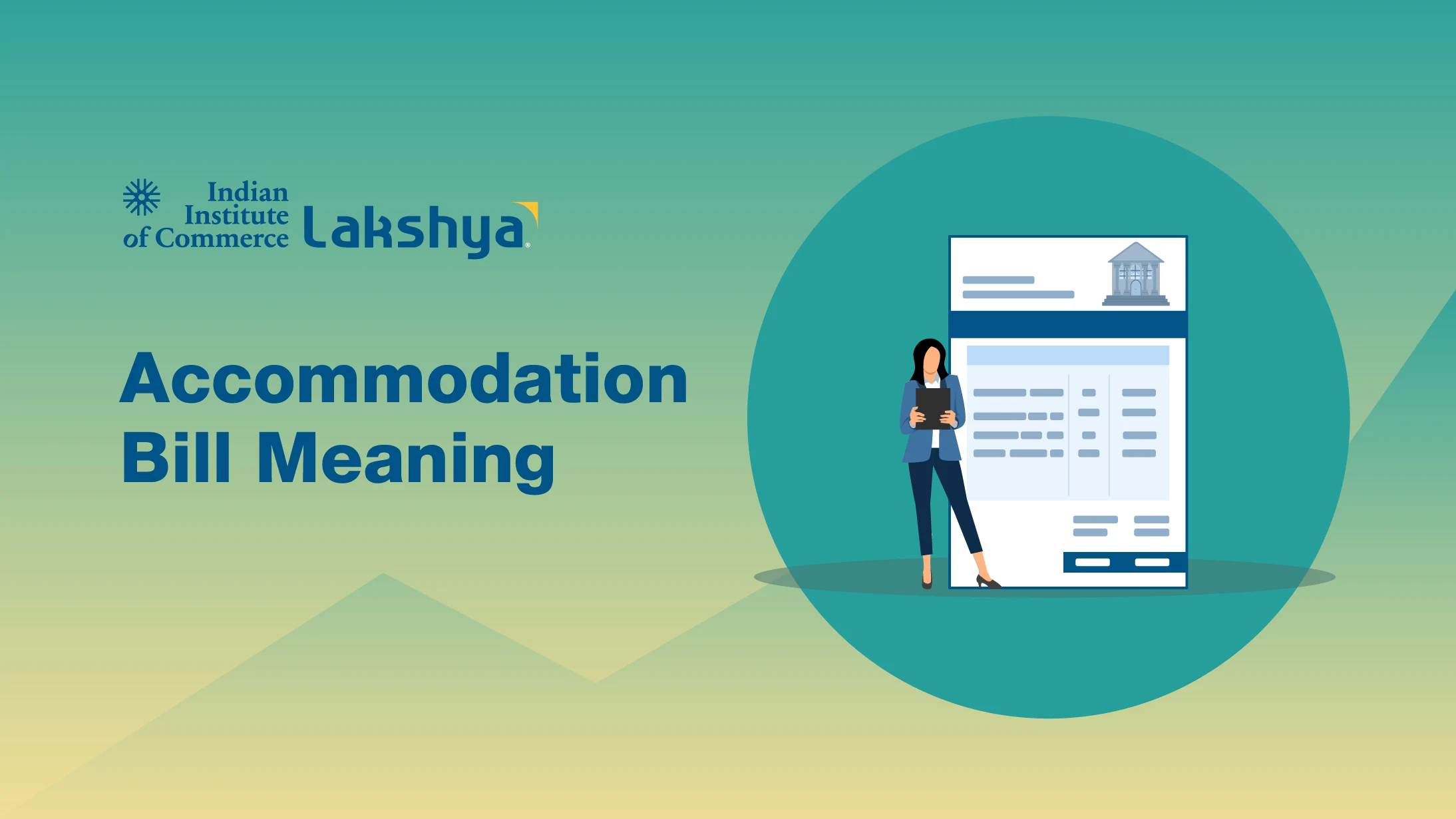
An accommodation bill refers to a type of bill of exchange drawn and accepted between parties without any underlying trade transaction or valuable consideration. It serves as a financial tool to provide temporary support, often to help one party raise funds or improve creditworthiness. Commerce students studying accountancy and bills of exchange encounter this concept in Class 11 and 12 curricula, particularly under negotiable instruments. This guide explains its meaning, features, and applications in simple terms.
Importance in Accounting and Business
Accommodation bills address short-term cash flow needs without actual sales of goods or services. They differ from standard trade bills, which arise from legitimate business deals. Businesses and friends use them mutually to discount bills at banks for immediate cash.
In India, these bills fall under the Negotiable Instruments Act, 1881. While not illegal, they lack enforceability between original parties due to no consideration. Banks treat them as valid if discounted in good faith. Students benefit from understanding them for exam questions on journal entries and distinctions from trade bills.
Key Features of Accommodation Bills
Accommodation bills have distinct characteristics:
-
No real trade or sale backs the bill.
-
Drawn for financial accommodation only.
-
Parties often share discount charges and proceeds.
-
Legal claim exists only against third parties, not originals.
-
Common among trusted associates or firms.
For example, if Party A draws a bill on Party B for ₹50,000, payable after 90 days, without any goods exchange, it becomes an accommodation bill once B accepts it.
How Accommodation Bills Work?
The process involves these steps:
-
Drawer creates the bill; drawee accepts it.
-
Drawer discounts the bill at a bank to get cash (minus discount).
-
At maturity, drawee pays the bank.
-
If mutual, both parties may draw bills on each other.
Banks advance 80-90% of face value after deducting interest. Accounting records it as a liability for the acceptor and asset for the drawer.
Example: X needs cash and asks Y to accept a ₹1,00,000 bill for 3 months. X discounts it at Bank A for ₹97,000. On due date, Y pays Bank A. Y may draw a similar bill on X for reciprocity.
Accounting Treatment
Books record accommodation bills differently based on roles.
For Drawer (Accommodated Party)
-
On drawing: No entry or bills receivable.
-
On discounting: Bank A/c Dr.; Discount A/c Dr.; To Bills Receivable.
-
On maturity payment by acceptor: No further entry.
For Acceptor (Accommodating Party)
-
On acceptance: No entry initially.
-
On honouring: Bank A/c Cr.; To Bills Payable.
If both parties accommodate mutually with same amount:
-
Each discounts their bill.
-
They settle inter-party dues post-maturity.
Students practice these entries for board exams.
Differences from Trade Bills
Accommodation bills provide flexible financial support without trade. Commerce students master them for accountancy exams and business awareness. Proper accounting ensures compliance. Explore Negotiable Instruments Act for deeper study.
| Aspect | Accommodation Bill | Trade Bill |
|---|---|---|
| Consideration | None | Exists (goods/services) |
| Purpose | Financial help | Settle trade debts |
| Legal Status | Not enforceable between parties | Fully enforceable |
| Backing | Trust between parties | Actual transaction |
| Risk | Higher, if default occurs | Lower, asset-backed |
Legal Status and Risks
Under Indian law, accommodation bills hold value for holders in due course (banks). Original parties cannot sue each other without consideration. Risks include default, where the drawer remains liable to the bank.
Courts view intent: If disguised as trade bills, penalties apply. Students note: "Kite flying" (frequent misuse) is illegal.
Practical Examples for Students
-
Scenario 1: Two firms, A and B, face cash crunch. A draws ₹2 lakh bill on B; B accepts. A gets ₹1.95 lakh from bank. B pays later.
-
Scenario 2: Friends in business: Student entrepreneur discounts bill accepted by mentor for startup funds.
In 2025, small businesses use them amid digital lending rise.
Role in Modern Commerce
Accommodation bills aid working capital without loans. Edtech firms or coaching institutes (like those preparing for CA/CMA) use similar arrangements. Digital platforms now track them via apps.
Challenges: RBI monitors misuse in MSME lending.
Tips for Commerce Students
-
Memorize distinctions for MCQs.
-
Practice journal entries with due dates.
-
Understand renewal/dishonour entries.
-
Relate to real bills like promissory notes.
Financial Flexibility: Mastering the Accommodation Bill
An accommodation bill is a specialized type of bill of exchange drawn and accepted by parties without any underlying trade transaction or valuable consideration. Unlike a standard trade bill, which facilitates the sale of goods, an accommodation bill acts as a financial tool to provide temporary support, helping one or both parties raise short-term funds or improve their immediate creditworthiness. For students at IIC Lakshya and aspiring accounting professionals, understanding this concept is vital for mastering journal entries and navigating the legal nuances of the Negotiable Instruments Act, 1881.
Frequently Asked Questions (FAQs)
What is the main difference between an accommodation bill and a trade bill?
An accommodation bill lacks consideration and serves financial aid, while a trade bill arises from actual goods or services sale.
Can parties sue over an accommodation bill default?
No, original parties cannot sue each other due to no consideration, but banks can recover from both.
How are accommodation bills recorded in accounts?
Drawer records as bills receivable on discounting; acceptor as bills payable on payment.
Are accommodation bills legal in India?
Yes, but not enforceable between parties without consideration; valid for third parties like banks.
Related Articles