
DipIFRS vs. IFRS Certificate: What's the Difference and Which Should You Pursue?
Last Updated On -29 Aug 2026
By Sajith R S

Every few weeks, a student walks into our counselling room with the same question. They have seen two IFRS credentials from ACCA, the DipIFR and the IFRS Certificate, mentioned in job listings, and cannot tell them apart.
The mix-up is understandable. Both are offered by ACCA, both provide IFRS knowledge, and both are often described loosely as an IFRS certification course. Even so, they are at different levels, involve different amounts of effort, and open different career doors.
This article explains the difference between DipIFRS and IFRS Certificate options in plain terms, helping you choose the global IFRS certification for finance professionals that matches your current stage. We will cover eligibility, format, effort, cost, and career value, then finish with the situations in which one clearly makes more sense than the other.
What does an IFRS certification course cover?
IFRS is the set of accounting standards required or permitted for publicly traded companies in more than 100 countries. In India, listed and large companies report under Ind AS, which is designed to remain closely aligned with IFRS.
That is why employers look for professionals who can understand and prepare financial statements under these standards. Much of the demand comes from the Big Four, multinational subsidiaries and global capability centres in cities such as Bengaluru, Gurugram and Hyderabad.
Both credentials discussed here are forms of IFRS certification by ACCA, so the main difference is depth rather than brand. Any ACCA IFRS certification shows that you understand the standards. The DipIFR goes further by testing whether you can apply them to practical reporting situations under exam conditions.
The IFRS Certificate (CertIFR): A starting point
The Certificate in International Financial Reporting is an introductory IFRS certificate program. It covers the principles behind IFRS, the role of the International Accounting Standards Board, and the requirements of the major accounting standards.
You study online and complete an online assessment at the end. The course is self-paced, and ACCA provides access to the learning materials and assessment for 12 months. ACCA estimates that the course itself typically takes around 20 hours to complete.
IFRS Certification eligibility for the certificate is open. ACCA does not set a strict academic entry requirement, although a background in accounting or financial reporting will make the content easier to follow.
The qualification is commonly taken by junior accountants, finance professionals moving into IFRS-based reporting, and ACCA members who qualified before IFRS became a central part of the syllabus.
The main IFRS Certification benefits here are speed and accessibility. You can build a working understanding of the standards without needing years of experience or committing to an intensive exam.
The trade-off is its professional weight. Because the assessment is online and multiple-choice, employers generally view CertIFR as evidence of IFRS familiarity rather than proof that you can independently handle complex reporting work.
The ACCA DipIFR: a deeper, exam-based qualification
The ACCA DipIFR works at a higher level, and its course requirements are more demanding. It is designed for professionals who already understand financial reporting and now need to develop stronger IFRS application skills.
The qualification is assessed through a three-hour-and-fifteen-minute computer-based examination. It contains four compulsory questions worth 25 marks each and requires both numerical calculations and written explanations. You need 50% to pass, and the examination is conducted twice a year, in June and December.
The first question generally focuses on consolidation and may cover areas such as group accounts, goodwill, and non-controlling interests. The remaining questions test your ability to identify the relevant accounting treatment and apply IFRS requirements to practical scenarios.
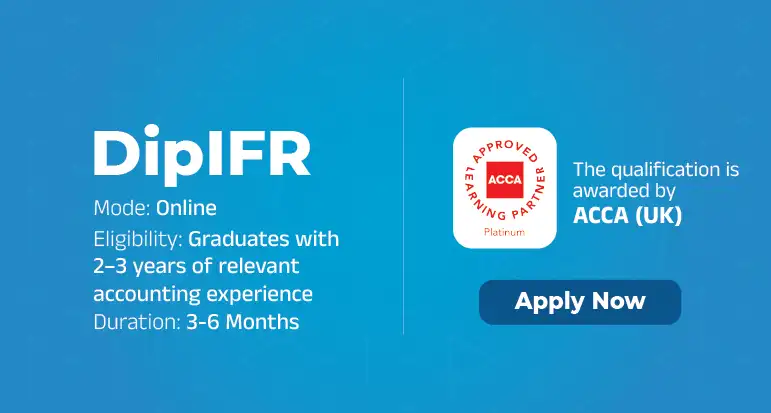
DipIFRS eligibility is stricter because the qualification assumes that you already work with, or have studied, financial statements in some depth. Eligibility may be established through professional membership, a relevant degree combined with accounting experience, or sufficient relevant professional experience.
Before registering, it is important to review the current DipIFR eligibility criteria and confirm that your qualifications and experience meet ACCA’s requirements.
Preparation for the ACCA DipIFR course usually takes 100 to 200 hours over three to four months. Past papers and reliable study materials matter more than wide reading because the examination rewards application, not the ability to recite definitions.
A structured DipIFR exam guide can also help you understand how each question is marked and how much time you should spend on different sections.
DipIFR vs IFRS Certificate: the main differences
|
Feature |
IFRS Certificate (CertIFR) |
Diploma (DipIFR) |
|
Level |
Introductory |
Advanced and applied |
|
Best for |
Professionals new to IFRS and junior accounting staff |
Experienced accountants, auditors, and finance professionals |
|
Eligibility |
Open, with no strict prerequisite |
Professional qualification, relevant education, or accounting experience |
|
Assessment |
Online, multiple-choice |
Computer-based, scenario-focused exam with a 50% pass mark |
|
Study time |
Around 20 hours for the ACCA course |
Approximately 100–200 hours |
|
Availability |
Flexible and available online |
June and December exam sessions |
|
What it signals |
Familiarity with IFRS |
Ability to apply IFRS to complex reporting situations |
ACCA DipIFR vs IFRS Certificate: Which should you choose?
The right answer depends on where you are now. The safest approach is to match the credential to your experience rather than choosing the one that simply sounds more advanced.
If you are a fresher, a final-year student or someone whose role only occasionally touches financial statements, the certificate is the more sensible starting point. It helps you build the foundation without assuming experience you do not yet have.
Attempting the diploma too early is a common mistake. Even when a learner understands individual standards, consolidation and scenario-based questions can be difficult without prior exposure to financial reporting.
If you are a qualified CA, CMA or ACCA member, or you already have meaningful experience in reporting, audit or controllership, the DipIFR is likely to offer greater professional value. It prepares you for practical IFRS discussions in interviews and for work that requires independent judgement.
A middle case comes up often. At IIC Lakshya, we meet BCom graduates with limited experience who are interested in the diploma but are not yet eligible. In such cases, we may suggest beginning with the certificate and moving to DipIFR after gaining the required experience. This way, the first qualification builds a useful foundation rather than becoming a disconnected credential.
Career opportunities and the salary reality
DipIFRS career opportunities are strongest in financial reporting and audit. Common roles include financial reporting analyst, consolidation specialist, reporting manager, and audit professional working on IFRS-based engagements.
The Big Four, multinational finance teams, global capability centres, and shared-service organisations regularly need professionals with these skills. IFRS knowledge is also valuable in Gulf countries, where many organisations follow international reporting standards.
IFRS Certificate career opportunities are more modest, as you would expect from an introductory qualification. It can help you join or support an IFRS-focused team and strengthen a fresher’s CV. On its own, however, it will rarely qualify you for a senior reporting position.
Be careful with the salary figures you find online. It is reasonable to say that professionals with relevant IFRS skills may be considered for more specialised work, but the qualification alone does not determine salary.
Your earning potential will depend on your city, years of experience, existing qualification, technical ability, and employer. A DipIFR holder with strong reporting experience will usually be considered for more complex work than someone who has only completed an introductory certificate.
Remember, too, that neither qualification replaces a complete professional route such as CA or ACCA. These credentials add specialist IFRS knowledge; they do not replace the broader technical and professional foundation of a full accountancy qualification.
Also Read
- Eligibility for IFRS Certification: Who Can Apply in 2026
- How ACCA Is Preparing DipIFRS Students for a Reporting World Driven by Technology?
- Implementing IFRS in India: Key Steps and Challenges
- Career Progression in Financial Reporting After DipIFRS
- Countries Using IFRS: Global Accounting Standards Explained
Making the decision
Choosing an IFRS certification course ultimately comes down to your current stage and the kind of work you want to do.
If you are new to the standards or do not yet have enough reporting experience, start with the certificate. It gives you a clear introduction without demanding an advanced technical background.
If you are already qualified or have several years of experience in reporting or audit and are aiming for international finance roles, the DipIFR is the stronger investment. For many working professionals, it is one of the most practical IFRS qualifications available in India because it develops specialised knowledge through a single, application-based examination.
Before paying any fees, confirm the current examination dates, registration deadlines and ACCA IFRS certification fees on the official ACCA Global website, as these details are reviewed periodically.
You should also check whether you meet the current eligibility conditions. Choosing the right qualification in the right order can save you time, reduce unnecessary exam pressure, and make the learning more useful for your career.
Related Blogs