
DipIFRS vs. CA India - Which Is Better for a Career in Global Financial Reporting?
Last Updated On -04 Aug 2026
By Sajith R S

DipIFRS and CA India are two distinct qualifications that support different career goals in accounting and financial reporting. The CA course, regulated by ICAI, is a comprehensive professional qualification, while DipIFR is ACCA’s single-exam Diploma in International Financial Reporting, commonly searched for as the DipIFRS course. Understanding the difference between them is important for anyone planning a career in IFRS, global accounting or financial reporting.
Students deciding on a full professional qualification and working accountants considering a specialist credential usually end up asking some version of the same question. Is DipIFR a substitute for CA? A companion to it? Or something else altogether? This article walks through what each qualification actually involves, how they compare on eligibility, cost and career scope, and where global financial reporting jobs in India tend to look for talent.
What the CA Course in India Actually Involves?
The CA course is under the Institute of Chartered Accountants of India, and it remains the country’s benchmark accounting qualification. ICAI reworked the structure in 2023, and the version in place through 2026 looks noticeably lighter than the one many working professionals completed. CA Foundation now has four papers. CA Intermediate and CA Final have six each, down from eight. Negative marking has been dropped from most papers, while multiple-choice questions now sit alongside the traditional descriptive ones.
Entry happens in one of two ways. School leavers enter through CA Foundation after Class 12, from any stream. Commerce graduates with 55% marks, or non-commerce graduates with 60%, can skip Foundation and enter directly at the Intermediate level. Either way, articleship the practical training component has been trimmed from three years to two. This shortens the overall timeline without cutting the on-the-job learning ICAI treats as non-negotiable.
On paper, a disciplined student can qualify in about four and a half years from Foundation to Final. In practice, many take longer. Multiple attempts at Intermediate or Final are common, and it is worth planning around that possibility rather than assuming the fastest route. Qualifying as a CA in India gives you something no add-on certificate can: ICAI membership, the right to sign statutory audit reports, and the standing to set up an independent practice. That is a ceiling other credentials, DipIFR included, do not reach.
What DipIFR Is and Who It’s Actually For?
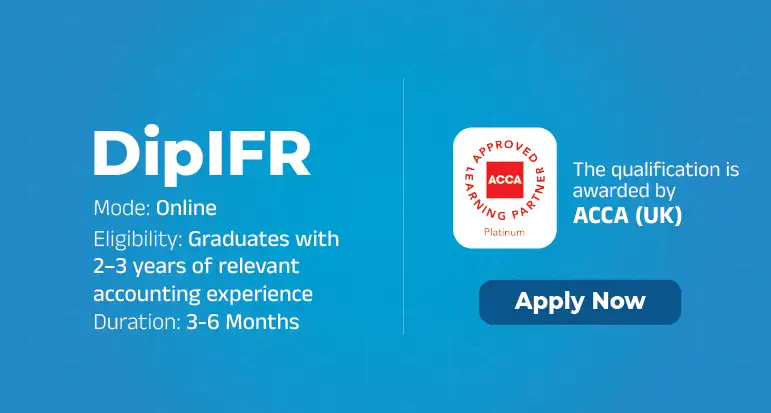
DipIFR is the Diploma in International Financial Reporting, sometimes written as DipIFRS is awarded by ACCA, the UK-headquartered body better known in India for its own multi-paper qualification. DipIFR is different. It involves a single, three-hour-and-fifteen-minute computer-based exam held twice a year, in June and December, testing how well a candidate can apply International Financial Reporting Standards to real financial statements. Most candidates put in somewhere between 100 and 200 hours of study, usually spread over three to four months.
Where DipIFR differs sharply from CA is eligibility. It is not built for someone starting from zero. ACCA generally accepts candidates through one of several routes:
- Qualified accountants or auditors, including eligible CAs, CMAs and CPAs
- Graduates with a relevant degree, such as B.Com, BBA Finance or MBA Finance, plus at least two years of relevant accounting or audit experience
- Candidates with three years of relevant accounting experience, even without a qualifying degree
- ACCA affiliates or candidates with two years of relevant experience and an ACCA Certificate in International Financial Reporting
CA articleship may count as relevant experience, provided it is properly documented through ACCA’s experience-confirmation process.
A first-year commerce graduate with no work experience typically does not qualify yet. That is the detail people often miss when they treat this as a straightforward either-or choice. For the full list of accepted routes and documents, our DipIFR eligibility guide breaks the requirements down in more depth.
For Indian CAs specifically, DipIFR tends to be a comparatively short lift. Listed Indian companies report under Ind AS, which is largely converged with IFRS, so much of the underlying logic is already familiar. That overlap is one reason DipIFR appears so often as a next step for CAs already working in audit or financial reporting, rather than as an alternative entry path into the profession.
CA vs DipIFR: Where the Comparison Actually Holds Up?
|
What matters |
CA (ICAI) |
DipIFR (ACCA) |
|
Governing body |
Institute of Chartered Accountants of India |
Association of Chartered Certified Accountants |
|
Structure |
Foundation, Intermediate and Final 16 papers combined, plus articleship |
One exam |
|
Typical timeline |
About 4.5 years, often longer |
3–4 months of preparation |
|
Who can start |
Class 12 pass-outs, or graduates through direct entry |
Qualified accountants or candidates who meet ACCA’s experience requirements |
|
What it confers |
Professional membership, audit signing rights and the right to practise |
A specialist IFRS competence certificate |
|
Where it is recognised |
India, with growing recognition abroad |
India through Ind AS overlap and internationally through ACCA |
The two are not really competing for the same decision. If you are a school leaver or fresh graduate looking for your first professional accounting qualification, CA or a comparable full qualification such as ACCA or CMA is the actual starting point. DipIFR’s eligibility rules generally rule it out at that stage.
DipIFR becomes relevant once you already hold a qualification or have gained enough accounting experience and want to formalise your IFRS knowledge. It is a certificate of technical competence, not a licence to practise, and it does not grant membership of any professional body in India.
Global Financial Reporting Jobs: Who Gets Hired?
A Chartered Accountant in India can move into statutory audit, direct and indirect tax, internal audit, corporate finance or, eventually, a CFO-track role inside a CA firm, a Big Four practice or industry. Job portals list CA vacancies in India by the thousands, and much of that demand sits within compliance, audit and tax work tied to Indian regulation.
DipIFR points somewhere narrower and, in the areas where IFRS reporting expertise matters most, can lead to better-paid specialist work. Multinational subsidiaries reporting to a foreign parent, global capability centres in Bengaluru, Chennai and Pune handling group consolidation, and Big Four technical accounting advisory teams all look for IFRS-specific competence. So do audit teams working with IFRS-reporting clients.
Most of these are not entry-level roles. They are positions where DipIFR adds a credible layer to the accounting experience someone already has, not a way to skip building that experience in the first place.
Mentors at accounting institutes tend to flag one recurring mistake here: students assume a certificate alone will open doors. Recruiters hiring for group reporting or IFRS conversion roles look for DipIFR alongside genuine exposure to consolidation, financial instruments or revenue recognition work not as a replacement for it.
Chartered Accountant Salary in India, and What DipIFR Adds
Chartered Accountant salary in India varies enormously by firm, city and specialisation, so any figure is best read as a range rather than a promise. Freshers joining through campus placements or Big Four firms typically start somewhere between ₹7 lakh and ₹12 lakh a year. Smaller firms may start lower, while income from independent practice varies widely.
With five or more years of experience, CA salary in India commonly moves into the ₹15–30 lakh band. Specialised roles in consulting, investment banking or international taxation can go well beyond that for the right combination of firm, skill set and city.
DipIFR does not function as a salary driver on its own in the way qualifying as a CA does; it is additive. A training-provider survey of roughly two hundred Indian DipIFR holders found average pay climbing by about a third after certification. The figure is worth noting, though it comes from a single vendor’s survey of its own certificate holders rather than an independent industry study. It is better read as a directional signal than a guarantee.
What recruiters describe more consistently is that DipIFR pays off fastest when it sits on top of real IFRS-adjacent work auditing multinational clients, group reporting or IFRS conversion projects rather than appearing as a standalone line on a CV.
Also Read
- ACCA vs CA: Which is the right Course for you?
- What is Diploma in IFRS Course?
- CA Course for Working Professionals: Key Challenges and Solutions
- 20 Tips to Handle Work-Life Balance While Preparing for DipIFRS
- Ultimate Guide to CA Course: Roadmap to become a Chartered Accountant
Which Path Should You Choose?
If your goal is to become a Chartered Accountant whether you are straight out of Class 12, midway through graduation or just starting to look for your first accounting role the CA course is where to begin. DipIFR is not built to be that starting point, and treating it as one often means discovering the eligibility gap too late. Academic counsellors at IIC Lakshya see this question often enough that it is worth stating plainly: sequence matters more than the individual credential.
If you are already a qualified accountant, or a graduate with a couple of years of audit or accounting experience, and IFRS-related work keeps appearing in your role, DipIFR is a relatively fast and affordable way to make that expertise official. If you are still weighing which path fits your current stage, a free counselling session with IIC Lakshya’s academic team is usually a faster way to get a clear answer than spending another hour reading forums.
Related Blogs