

DipIFRS Eligibility and Exam Format: Everything You Need to Know
Last Updated On -11 Aug 2026
By Parul Jain
If you work in finance or plan to, the words 'IFRS compliant' appear on almost every job description that matters. Auditors use it. CFOs depend on it. Finance managers in multinational companies cannot afford to be without it. The Diploma in International Financial Reporting Standards, called DipIFRS, is ACCA's specialist qualification that teaches you exactly how these global accounting standards work in practice.
This article gives you the full picture of who can appear for DipIFRS, what the exam actually tests, and whether this qualification makes sense for where you are right now in your career. We have written this for different kinds of people, from someone who just passed their 12th standard exams to a CA or CMA USA professional who already has significant accounting experience. Wherever you fall, read the section that applies to you.
What Is DipIFRS, and Why Does It Exist?
IFRS — International Financial Reporting Standards — is the accounting language used in over 140 countries. India moved to Ind AS, its version of IFRS, for listed companies and large corporates. The Middle East, the UK, Europe, and most of Southeast Asia follow IFRS directly. As capital flows across borders and Indian companies list on global exchanges, the accountants who understand IFRS are the ones who handle the work that actually matters.
ACCA created DipIFRS specifically for accountants who already hold a qualification — or have enough experience — but need structured knowledge of IFRS without starting a full degree from scratch. It sits at a professional level. You finish it in roughly six months of focused study. You walk out with a globally recognised credential that signals IFRS competence to employers in any IFRS-adopting country.
The qualification covers the theoretical framework, how individual standards apply to real transactions, and how financial statements get prepared and disclosed under IFRS. It is not a course that explains what a balance sheet is. It assumes you already know accounting. What it teaches is how IFRS rules change the way you apply that knowledge.
DipIFRS Eligibility: The Official Requirements
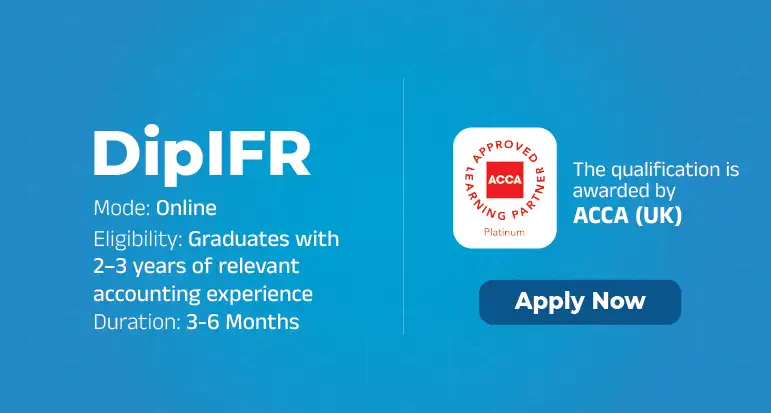
ACCA sets two main eligibility routes for DipIFRS. You need to meet one of them to register.
Route 1: Professional Accounting Qualification
You hold a relevant professional accounting qualification from a recognized body. This is the most common route for people who appear for DipIFRS. The following qualifications apply:
- CA (Chartered Accountant) — ICAI, India
- ACCA Affiliate or Member
- CMA India (Cost and Management Accountant) — ICMAI
- CPA USA (Certified Public Accountant)
- CMA USA (Institute of Management Accountants)
- CIMA (Chartered Institute of Management Accountants)
- Other recognised professional accounting bodies, subject to ACCA approval
Route 2: Relevant Work Experience
If you do not yet hold a full professional qualification, you can still register for DipIFRS if you have two years of relevant work experience in accounting or finance. ACCA defines 'relevant' broadly — it covers roles in financial reporting, audit, accounts management, or financial analysis.
This route exists because ACCA recognises that many finance professionals in developing markets — particularly in India — work at a high level without necessarily holding a formal qualification. Your experience does the work that the credential would otherwise do.
|
Important: ACCA does not specify a minimum academic requirement for DipIFRS separately from the routes above. However, if you come via the work experience route, your employer or institute may ask for evidence of your accounting background. Keep records of your experience and responsibilities ready before you register. |
Who Should Pursue DipIFRS?
The answer changes depending on where you are right now. Here is a breakdown for different audiences.
12th Standard Students
DipIFRS is not designed for students who have just finished school. The qualification assumes you already understand the fundamentals of accounting and have either formal qualifications or work experience to back that up. If you have just completed your 12th, your next step is to start a qualification, CA, ACCA, CMA, or a commerce degree, and return to DipIFRS once you have cleared the professional-level exams or accumulated a couple of years of relevant work.
That said, it is worth knowing about DipIFRS now because it changes how you think about your career path. If your goal is global finance, working with multinational companies, Big 4 firms, or finance roles in the Gulf or UK. DipIFRS sits naturally in your sequence after your first professional qualification.
Graduates and Commerce Degree Holders
A BCom or BBA does not automatically qualify you for DipIFRS under the Route 1. You need to have cleared a professional accounting body's exams. But if you graduated two or more years ago and have been working in a finance or accounting role since then, Route 2 is open to you.
For graduates who are currently pursuing CA or ACCA, the smarter play is to finish your professional exams first and then add DipIFRS. Attempting DipIFRS without the grounding that professional exams provide is harder than it needs to be the IFRS concepts connect much better once you have studied financial reporting at a professional level.
Freshers (Recent Graduates with No Work Experience)
If you graduated recently and have not yet cleared a professional accounting exam, wait. DipIFRS is not the starting credential — it is the specialisation you add to an existing accounting foundation. Use your early career years to clear CA, ACCA, or CMA and build some work experience. You will find DipIFRS significantly easier and more valuable once you have context for why each IFRS standard exists.
Professionals with 0 to 3 Years of Experience
This is where DipIFRS starts to make real sense. If you have cleared your professional accounting exams and are in your first few years of practice — whether in audit, accounts, or financial reporting such as DipIFRS adds a specialist layer that directly upgrades the work you do every day.
Many people in this group work on audit engagements or prepare financial statements for clients and companies that follow IFRS or Ind AS. DipIFRS gives you the depth to go beyond routine compliance. You understand the reasoning behind each standard, which lets you handle the judgement-heavy parts of IFRS reporting that seniors and managers deal with. Employers notice this. It distinguishes you from peers who know the surface of the standards but not the substance.
Professionals with 5 or More Years of Experience
For senior finance professionals, DipIFRS solves a specific problem: you know what you know from experience, but you have never systematically studied IFRS as a framework. DipIFRS fills that gap in a structured, examined way.
Finance controllers, senior auditors, finance managers, and CFOs in IFRS-reporting environments often pursue DipIFRS because it formalises knowledge they have built informally. It also signals to international employers — particularly in the UAE, UK, Singapore, or global MNCs — that you have been tested on IFRS standards, not just exposed to them. For people considering a move into a regional or global finance role, this credential removes the one common objection that hiring managers raise.
CA, CMA USA, and ACCA Professionals Looking to Upskill
If you already hold one of these qualifications, DipIFRS is one of the most efficient things you can add to your profile. You already meet the eligibility requirement under Route 1. You already understand accounting at a high level. What DipIFRS gives you is structured expertise in the specific language — IFRS — that international finance runs on.
For a CA, DipIFRS directly extends your Ind AS knowledge into the full IFRS framework, which matters for clients with international operations or for roles in IFRS-reporting companies. For a CMA USA, it adds financial reporting depth to your management accounting expertise, which is particularly valuable in global controllership roles. For an ACCA affiliate or member, DipIFRS provides a formal specialisation credential on your CV at a time when being a generalist accountant is less differentiated than it used to be.
The study time is manageable — around 150 to 200 hours depending on your existing knowledge. For someone with your level of background, large parts of the content will be familiar. The value is in the gaps it closes and the credential it puts on your professional profile.
The DipIFRS Exam Format: What You Actually Face
DipIFRS is a single-paper examination, but ACCA structures it across four tested areas. Understanding the format before you register matters because the exam does not just test recall — it tests your ability to apply IFRS standards to practical scenarios.
Overview of the Examination
The DipIFRS examination runs for three hours and fifteen minutes. It is a Computer-Based Examination (CBE) available through ACCA Approved Learning Partners and Prometric test centres. ACCA offers two exam sittings each year — in June and December — though you should confirm the current schedule with ACCA directly as dates shift slightly by year.
Exam Structure
The paper is divided into two sections:
Section A: This section contains 70 marks' worth of objective questions. These are multiple-choice questions and objective test questions that test your knowledge of IFRS standards, definitions, and standard-specific rules. Speed matters here — you need to know your standards well enough to answer confidently within the time available.
Section B: This section carries 30 marks and contains constructed response questions. You write longer answers that require you to apply IFRS principles to scenarios — preparing extracts of financial statements, explaining accounting treatment, or advising on how a standard applies to a particular transaction. This is where the examiners test judgment and depth, not just recall.
The Four Tested Areas
ACCA structures the DipIFRS syllabus around four main areas. The exam draws questions from all four:
|
Module |
Format |
Duration |
Marks |
|
P1 – Presentation of Financial Statements |
CBE – Objective + Constructed Response |
2 hours |
100 marks |
|
P2 – Measurement & Recognition |
CBE – Objective + Constructed Response |
2 hours |
100 marks |
|
P3 – Disclosure |
CBE – Objective + Constructed Response |
2 hours |
100 marks |
|
P4 – Financial Instruments |
CBE – Objective + Constructed Response |
2 hours |
100 marks |
The four areas map onto the practical work of IFRS reporting: how financial statements look (presentation), how you measure and recognise assets, liabilities, income and expenses (measurement and recognition), what you disclose and why (disclosure), and the IFRS standards that cover financial instruments — IFRS 9, IFRS 7, and related standards — which are the most technically demanding part of the syllabus.
Pass Mark
The pass mark for DipIFRS is 50 out of 100. This is consistent across all sittings. ACCA does not moderate results relative to other candidates — you pass by reaching 50, full stop.
What the Exam Actually Demands?
Students who underperform on DipIFRS usually make two mistakes. First, they treat it like a memorisation exercise. DipIFRS rewards understanding over memorisation. Section B in particular, requires you to reason through a scenario and explain your treatment — you cannot do that purely from bullet-pointed notes.
Second, they underestimate the financial instruments area. IFRS 9 and related standards involve classification, measurement, impairment under the expected credit loss model, and hedge accounting concepts that many accountants encounter infrequently in practice. Give this area more study time than it initially appears to need.
How to Register for DipIFRS?
Registration happens directly through ACCA's online portal. You create an ACCA account if you do not have one, select DipIFRS under specialist qualifications, and provide evidence of your eligibility — either your professional qualification certificate or documentation of your work experience.
ACCA charges a registration fee and an examination fee separately. The specific amounts change periodically, so check ACCA's official website for current pricing. ACCA also offers an IFRS Learning programme — a set of study materials available through ACCA's own platform — which complements but does not replace a structured study course if you prefer guided preparation.
|
Study Tip: Most candidates who pass DipIFRS on the first attempt dedicate 150 to 200 hours of study over three to five months. If you are a CA or ACCA professional, you may need closer to 120 hours because much of the financial reporting theory is familiar. If DipIFRS is your first formal IFRS exposure, budget the higher end of that range. |
What DipIFRS Does for Your Career?
The credential appears on your CV as a recognised ACCA specialist qualification. In practice, what it does depends on where you work and where you want to go.
In India, the relevance of DipIFRS has grown as more companies transition to Ind AS and as cross-border transactions increase. CA firms with international clients, Big 4 and mid-tier audit firms, and MNC finance teams all value demonstrated IFRS knowledge. DipIFRS gives you the formal proof of that knowledge.
For anyone targeting roles in the UAE, UK, Singapore, or other IFRS jurisdictions, DipIFRS removes a gap that international employers care about. Many of these employers see Indian professional qualifications and wonder about IFRS depth — DipIFRS answers that question directly.
For people already working in IFRS environments, DipIFRS tends to accelerate progression more than it opens new doors. It consolidates the knowledge you have built through experience into a tested, credentialled form that justifies the next step up in seniority or responsibility.
Summary
DipIFRS is a specialist qualification, not a stepping stone. You add it to an existing accounting foundation — it does not replace one. The eligibility routes reflect this: either a professional accounting qualification or two years of relevant experience.
The exam is three hours and fifteen minutes long, passes at 50%, and tests IFRS knowledge through both objective questions and applied scenarios. The four tested areas cover presentation, measurement and recognition, disclosure, and financial instruments. The financial instruments section demands the most preparation from most candidates.
Whether you are three years into your career or twenty, the question to ask is whether IFRS reporting is something you want to do well rather than adequately. If the answer is yes, DipIFRS is the most direct path to demonstrating that capability in a form that employers and clients recognise.
Ready to start your DipIFRS journey? Talk to our counsellors at IIC Lakshya to understand the right study pathway for your background.
Related Blogs