
CPA Australia Eligibility
Last Updated On -05 Oct 2026
By Sajith R S

Search for CPA Australia eligibility from India and you will run into two entirely different qualifications wearing the same three letters. One is the Certified Practising Accountant, awarded by the Australian body whose CPA Australia full form causes much of the confusion. The other is the CPA that most Indian students, employers and coaching institutes actually mean: the Certified Public Accountant, awarded through the AICPA and NASBA in the United States. This guide is about the second one, the US CPA and specifically about CPA eligibility for Indian candidates who want that credential to open doors in Australia and other global markets.
That distinction matters because the US CPA travels well. A mutual recognition agreement between the American bodies and CPA Australia means a qualified US CPA has a defined route into the Australian profession. So, instead of choosing between CPA for America and something separate for Australia, one qualification can cover both. Here’s who qualifies, what the exam involves, and what the road to Australia looks like after you pass.
Which CPA Are We Talking About?
Worth thirty seconds of clarity before anything else. The Certified Public Accountant (US CPA) is licensed by individual American state boards, with the Uniform CPA Exam administered by the AICPA and NASBA. The Certified Practising Accountant is a membership of CPA Australia, earned through the six-subject CPA Australia course, with its own CPA Australia fees and semester-based exam calendar.
Most searches for CPA Australia in India are really asking a career question, not a brand question: which CPA gets me hired internationally, including in Australia? For candidates targeting the Big Four, US-listed multinationals and Global Capability Centres with Australia as a possible destination rather than the only one the US CPA is usually the stronger answer. It’s the credential this guide covers from here on.
Is the US CPA Recognised in Australia?
Yes, through formal agreements rather than goodwill. In 2018, the NASBA/AICPA International Qualifications Appraisal Board signed a mutual recognition agreement with CPA Australia. Under it, US CPAs in good standing with their state board who earned the credential through the Uniform CPA Exam rather than another recognition agreement can apply for CPA Australia membership. This also provides a pathway towards audit rights in Australia and New Zealand. A separate, renewed MRA with Chartered Accountants Australia and New Zealand gives US CPAs another route into the Australian profession.
For migration specifically, accounting occupations in Australia require a skills assessment, and CPA Australia is one of the approved assessing bodies. A CPA Australia skill assessment evaluates your academic qualifications against Australian standards, so your degree will still be examined. However, holding the US CPA alongside a recognised degree strengthens the overall profile considerably. If permanent migration is your goal, read the current assessment criteria on the assessing body’s website before planning around it.
CPA Eligibility Criteria for the US CPA
There is no single national rulebook. Each of the 55 US state boards sets its own CPA requirements, though they follow a common pattern built around education, examination and experience.
-
The Education Requirement
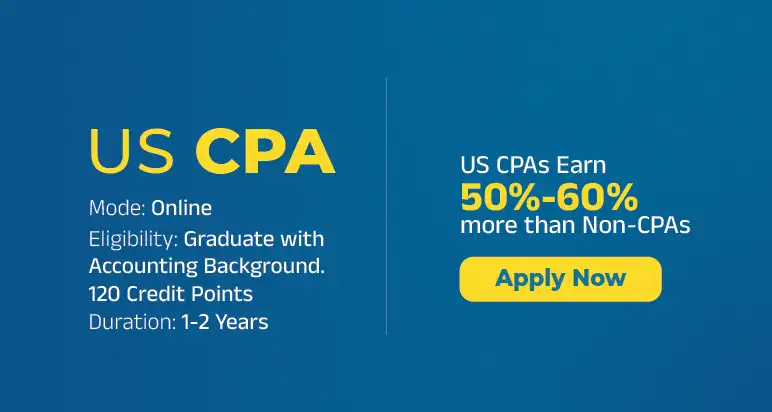
You need a recognised bachelor’s degree; there is no standalone CPA degree; the credential sits on top of your existing education plus a minimum number of credit hours. Most boards let you sit the exam with 120 credit hours and require more for the licence.
The traditional licence standard has been 150 hours, but that is the part changing fastest. Since 2025, US states have been adopting an alternative pathway involving a bachelor’s degree plus two years of professional experience in place of the additional 30 credits. By mid-2026, roughly two dozen jurisdictions had made it law. For candidates who found the 150-hour rule the single biggest barrier, this is the most useful development in years.
-
How Indian Students Meet the Credit Rules?
Here’s the arithmetic that decides most Indian applications. A three-year BCom converts to roughly 90 credit hours, which alone does not reach the 120-hour floor. Candidates bridge the gap in familiar ways: BCom plus MCom, BCom plus MBA, or BCom plus a professional qualification such as CA. Indian CAs typically clear the education requirement comfortably.
Your transcripts go through a credential evaluation by a NASBA-approved agency, which maps your Indian marksheets to US credit hours and tells you exactly where you stand. Get this evaluation done first. Every semester, we meet candidates who bought coaching before checking their credits, only to discover a shortfall later.
A side note for qualified CAs weighing their options: a separate ICAI agreement makes CPA Australia for Indian CA members a shortened programme too. That route leads specifically to the Australian credential. The US CPA leads to a licence recognised across markets, with Australia included through the MRA. They are different tools for different career maps.
-
CPA Course Eligibility in Practice
To summarise the working test for CPA course eligibility: you need a recognised bachelor’s degree, credit hours verified through evaluation, and a state board whose rules fit your profile.
State selection is a genuine strategic decision. Boards differ in their credit requirements, experience rules and policies for international candidates. It is one decision worth taking advice on rather than copying from a forum post.
CPA Exam Pattern and Duration
The Uniform CPA Exam distinct from the semester-based Australia CPA exam cycle run by CPA Australia follows the CPA Evolution model: three compulsory Core sections plus one Discipline section of your choice.
|
Core Sections (all three) |
Discipline (choose one) |
|
Auditing and Attestation (AUD) |
Business Analysis and Reporting (BAR) |
|
Financial Accounting and Reporting (FAR) |
Information Systems and Controls (ISC) |
|
Regulation (REG) |
Tax Compliance and Planning (TCP) |
Each section is a four-hour, computer-based paper that combines multiple-choice questions with task-based simulations. It is scored out of 99, with 75 required to pass.
Core sections run year-round, while Discipline sections have fixed testing windows. This is exactly the kind of detail that can derail a timeline if nobody checks the calendar. Once you pass your first section, current rules give you 30 months to clear the rest, an extension from the old 18-month window and a genuine relief for working candidates.
Two practical points matter here. First, the exam is administered at Prometric centres in Indian cities, so you do not need to travel abroad. Second, most serious candidates complete all four sections within 12 to 18 months. This makes the US CPA one of the faster global qualifications to complete. Choose your Discipline to pair with a related Core TCP with REG or BAR with FAR and the overlap can make revision more manageable.
CPA Licence Requirements and Fees
Passing the four papers earns exam credit, not the licence. Full CPA licence requirements also include verified education, one to two years of relevant work experience depending on your state and pathway, and, in many states, an ethics exam.
Experience gained in India under the supervision of a licensed CPA counts for many boards, though verification rules vary. Confirm your chosen board’s policy before making any assumptions.
On cost, budget for a credential evaluation fee, a state board application fee, four exam section fees and an international administration surcharge for testing in India. These charges are set in US dollars and revised periodically, so check NASBA’s current schedule rather than relying on any fixed figure. As a planning range, most Indian candidates spend between three and four lakh rupees on the complete journey, including training. Retakes and exchange-rate movements are the main variables.
How to Do CPA With Australia in Mind?
The sequence looks like this: get your transcripts evaluated, select a state board that fits your credits, clear all four sections within the 30-month window, complete the experience requirement, and obtain your licence.
From there, the CPA Australia MRA route or the CA ANZ route becomes available if Australia firms up as your destination. If it does not, the same CPA qualification remains valuable in the Gulf, the US and India’s GCC sector.
The genuinely tricky decisions come at the start: whether your credits are sufficient, which state you should file in, and which discipline best matches your career. IIC Lakshya’s counsellors conduct this eligibility check for free before you spend anything on evaluation or coaching, which is the right order in which to approach the process.
Also Read
- CPA Roles and Responsibilities
- CPA USA for Commerce Freshers - Building a Global Career Before Your First Job
- CPA USA for CFOs in the Making - Why the C-Suite Is Increasingly CPA USA Qualified?
- CPA Certification After Master’s: Requirements & Preparation
- ACCA vs CPA - Which is the better option for you?
Final Word
CPA eligibility for the US CPA comes down to three checkable things: a recognised degree, enough verified credit hours, and a state board whose rules match your profile. The 2026 pathway reforms are also creating additional options for candidates who fall short of the traditional 150-hour requirement.
Add the recognition agreements with the Australian bodies, and one qualification gives you both the American credential and a defined route into the Australian profession. Start with your credential evaluation. If you would like someone to sanity-check your state selection and timeline first, book a free session with IIC Lakshya’s mentors before committing a rupee.
Related Blogs