CMA USA After B.Sc: Eligibility, Exemptions and Career Paths
Last Updated On -09 Oct 2026
By Sajith R S

Many science graduates who develop an interest in finance wonder whether their academic background will hold them back. Since qualifications such as CA are commonly associated with commerce students, B.Sc graduates often assume that moving into accounting or financial management is no longer an option. Actually, that assumption is incorrect.
CMA USA eligibility does not depend on your stream. The Institute of Management Accountants (IMA), USA, asks for a bachelor’s degree. That is the main academic requirement. Whether your degree says Chemistry, Zoology, Statistics, or Commerce does not affect your application. What does change for a B.Sc holder is the amount of catching up needed during the first couple of months and the type of role that is likely to come first.
This guide covers CMA USA course eligibility for B.Sc graduates, settles the confusion around CMA USA exemptions, explains the 2026 exam format, and maps the CMA USA career paths science students can realistically enter.
Is a B.Sc Degree Enough for CMA USA?
Short answer: yes. Here is what that looks like in practice.
- Any bachelor’s degree from a recognised institution works. B.Sc, B.Tech, BA, BBA and B.Com sit on equal footing.
- The rules do not specify minimum marks. A pass is enough.
- There is no age limit and no entrance test before joining.
- You may register and write both papers before receiving your degree.
- The certificate itself is issued only after the degree and work experience requirements are complete.
Science and engineering graduates are common in CMA batches now. Global capability centres in Bengaluru, Hyderabad, Chennai and Kochi value analytical ability, and a physics graduate with strong quantitative and modelling skills is not necessarily at a disadvantage.
CMA USA Eligibility Criteria, Point by Point
Three conditions determine your US CMA eligibility. IMA awards the credential only when all three are satisfied.
The degree condition
- A bachelor’s degree in any subject from an accredited college or university.
- Degrees from UGC-recognised Indian universities generally pass through without additional equivalency steps.
- Some professional qualifications stand in place of the degree, including CA from ICAI, CS from ICSI, CMA from ICMAI and CFA.
- Transcripts are verified after you clear both papers.
The experience condition
- Two continuous years in management accounting or financial management.
- Qualifying work includes costing, budgeting, variance analysis, financial reporting, internal audit, treasury, pricing, and FP&A.
- Part-time roles count at half value, so four years of part-time work equals two years.
- You may complete this before the exams or at any time within seven years of passing.
That seven-year window matters, especially for freshers. You can clear the papers first and build the required experience on the job afterwards.
The membership condition
- Active IMA membership is compulsory, both to sit the exam and to hold the credential later.
- Student membership costs a fraction of the professional rate, so enrol while you still qualify.
- Certified members must renew annually and report their continuing education hours.
Fee amounts are revised periodically. Confirm the current figures on the IMA website or in our CMA USA fees breakdown before planning your budget.
Registering While Your Degree Is Still On
Final-year students often wait for convocation. There is no need.
- Registration and both exam parts are permitted during your final year.
- The degree certificate must reach IMA within seven years of passing.
- Many students finish Part 1 in their last semester and Part 2 within a few months of graduating.
There is an interview benefit too. Walking in with a global qualification already underway helps you stand apart from other graduates applying for the same analyst role.
The Truth About CMA USA Exemptions
More misinformation circulates on this point than on almost any other, so let us be clear.
IMA grants no paper exemptions to anybody. A CA, an MBA in Finance, a B.Com gold medallist and a B.Sc graduate all write the same two papers.
What people usually mean by CMA USA exemptions is this:
- Degree substitution. An approved professional qualification replaces the bachelor’s degree requirement.
- Delayed experience. The two years need not be completed before you appear for the exams.
- Teaching credit. Full-time college teaching in accounting or finance, at the required level, can count as qualifying experience.
Compare the alternatives for context. CMA India allows graduates to enter directly at Intermediate and skip Foundation. ACCA grants paper-level exemptions based on your degree. CMA USA has nothing to exempt because the entire qualification consists of two papers. A shorter route with zero exemptions can still be completed faster than a longer route with several.
Where Science Students Struggle and Where They Win?
Getting in is the easy part. The first six to eight weeks of study are where the gap usually becomes visible.
Expect to work harder on:
- Journal entries, ledgers and how a balance sheet is actually built
- Vocabulary such as accruals, provisions, deferred revenue and working capital
- Cost sheets, overhead absorption and standard costing
- Reading an annual report without getting lost in the notes
Expect to move faster than commerce classmates on:
- Variance maths, forecasting and other quantitative sections
- Ratio analysis and handling large data sets
- Excel, along with SQL or Python skills picked up during your degree
One mistake repeats in almost every batch. A science graduate skips the bridge module and jumps straight into the Part 1 syllabus. Spending two or three weeks on accounting fundamentals at the beginning can prevent a failed attempt six months later.
The Two Papers and the 2026 Format Shift
The CMA USA qualification requirements did not change in 2026. The exam format did.
- Part 1: Financial Planning, Performance and Analytics
- Part 2: Strategic Financial Management
- Four hours per part, beginning with 100 MCQs
- Essays were replaced by case-based questions from the September/October 2026 testing window, according to IMA’s exam-format guidance
- The pass mark remains 360 out of 500, and you still need 50% on the MCQ section to reach the second half
Case-based questions may suit analytical thinkers. They involve less long-form writing and more structured problem-solving, reducing a language hurdle that many Indian candidates found challenging.
CMA USA Career Paths After a Science Degree
Employers hire CMAs for planning, costing and decision support. That shapes the roles available to you.
Roles within reach:
- FP&A analyst or financial analyst in a GCC or shared services centre
- Cost analyst in manufacturing, pharma, textiles or FMCG
- Business finance analyst attached to a product or regional team
- Internal controls, risk and compliance roles
- Budgeting and management reporting positions
- Treasury and working capital analyst in larger finance functions
Hiring for CMA USA professionals in India is concentrated mainly in global capability centres, IT and SaaS finance teams, manufacturing groups, consulting firms and Big 4 advisory practices. Employers across the UAE, Saudi Arabia and Qatar also recognise the qualification.
Salary, realistically
Be sceptical of the numbers circulating on social media. Based on what we observe through placements:
- Freshers who have cleared both exam parts but have little or no prior experience: roughly ₹4.5 to ₹8 lakh a year
- Professionals with two to four years of relevant experience: roughly ₹9 to ₹16 lakh
- Senior GCC roles and overseas positions can pay considerably more
City, employer size, internships and interview performance will influence your first offer. The qualification can help you get shortlisted, but nobody can promise a package. Any institute doing so is selling you an unrealistic expectation.
Reasons to Pause Before Enrolling
Honest guidance is more useful than cheerleading:
- Statutory audit sign-off in India requires a CA. A CMA USA career does not include that right.
- If you do not plan to take up qualifying finance work, you cannot complete the certification because relevant experience is mandatory.
- Students with heavy laboratory and practical schedules may struggle to find consistent study hours.
- Research or teaching ambitions in science are likely to be served better by a different path.
A 12-Month Plan That Works
For anyone starting CMA USA after graduation:
- Begin with an accounting and costing bridge module, not the main syllabus.
- Take IMA student membership and pay the entrance fee.
- Give Part 1 three to four months of preparation, then book your exam window.
- Apply for analyst and costing roles while preparing for Part 2.
- Start documenting qualifying experience from your first working day.
Students who follow this order can often complete the certification within two to three years of finishing their B.Sc.
Also Read
- BCom with CMA USA - Integrated Global Finance Career
- CMA USA Exam Dates 2026
- CMA USA Careers in Profitability and Performance Management
- What is Strategic Financial Management? - CMA USA Guide
- CMA USA Salary in India
Is CMA USA Right for You After B.Sc?
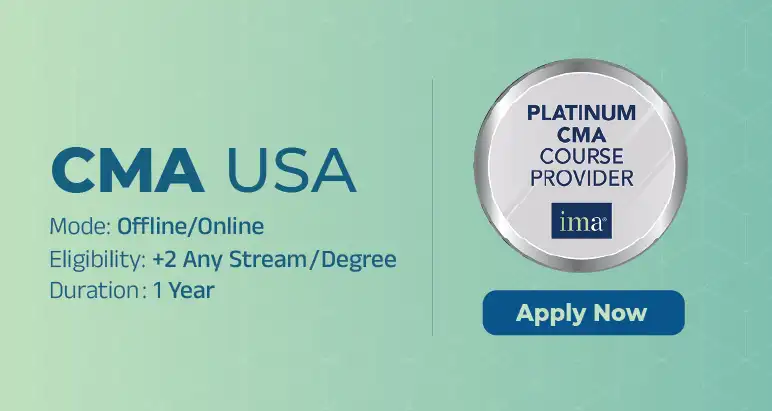
Still weighing CMA USA for graduates against ACCA, CPA or CMA India? A conversation with someone who regularly guides and places students may settle more doubts than a fortnight of browsing. Counsellors at IIC Lakshya, an IMA Platinum-Approved CMA Course Provider, offer free career guidance sessions to help you match the right course with your degree, strengths and work plans.
Related Blogs