DipIFRS vs. CIMA - Which Qualification Opens More Doors in Finance Leadership?
Last Updated On -04 Aug 2026
By Sajith R S

Working in accounts or finance and thinking about your next qualification? You have probably come across this exact comparison: CIMA against DipIFRS, both promising a path towards leadership roles. They show up in career forums, LinkedIn threads, and casual chats with colleagues weighing their next move. Much of that discussion treats them like rivals fighting for the same spot. They are not.
CIMA, the Chartered Institute of Management Accountants, is a complete professional qualification centred on management accounting: turning raw numbers into decisions a business can act on. DipIFRS is at a different scale. ACCA’s official term for it is DipIFR, the Diploma in International Financial Reporting; in India, most people add an ‘s’ and call it DipIFRS instead. Where CIMA is a multi-year programme, DipIFRS is one exam designed to prove that you can apply IFRS with confidence, not run an entire finance department. It is a long pathway versus a focused add-on for someone who already has an accounting base.
So, here is what this article covers: what each qualification involves, who it suits, the career doors it opens, and how to decide whether finance leadership not just another line on your CV is the actual target.
What CIMA and DipIFRS Cover?
CIMA Course Structure and Focus
CIMA operates within the AICPA-CIMA alliance, and candidates who complete the qualification and practical experience requirements earn the internationally recognised CGMA designation, Chartered Global Management Accountant. Curious about the CIMA full form? It is Chartered Institute of Management Accountants, nothing more exotic than that. Financial accounting looks at what has already happened. The CIMA qualification looks in the other direction, towards budgeting, performance management, business partnering, and the strategic decision support that keeps a CFO’s office running.
Without a relevant degree or exemption, the entry point is the Certificate in Business Accounting, which includes four foundation papers. From there, candidates move into the professional stage, three levels deep: Operational, Management, and Strategic. Each level closes with objective tests and an integrated case study exam. Through the examination route, candidates without exemptions complete four Certificate-level assessments, nine professional objective tests, and three case study exams.
Expect a CIMA course to take around three to four years, depending on exemptions, study pace, and prior qualifications. Earning the full CGMA designation also requires a minimum of three years of verified, relevant work experience. This is not a qualification you rush.
DipIFRS Course Structure and Focus
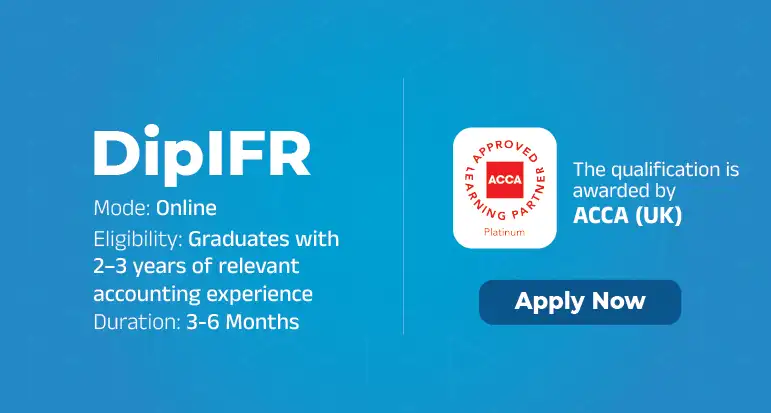
DipIFRS, or ACCA DipIFR as it is officially known, comes down to a single three-hour-and-15-minute computer-based exam. It is held twice yearly, in June and December, and focuses on applying IFRS to genuine financial reporting scenarios rather than studying accounting theory in the abstract.
Eligibility splits several ways. Professional accountants, auditors, members of an IFAC member body, and ACCA affiliates may qualify directly. Other applicants may be eligible with two years of relevant accounting experience alongside a relevant degree or ACCA’s Certificate in International Financial Reporting. Three years of relevant accounting experience may also meet the requirement.
The distinction worth holding onto is that DipIFRS is not a standalone qualification you begin from zero. It is a specialist layer over whatever you already hold. That is precisely why a DipIFRS course draws accountants, auditors, and finance managers already elbow-deep in financial statements who want a recognised IFRS certification. Given how many companies in India now report under Ind AS, which is largely converged with IFRS, that specialisation can carry real weight with employers.
CIMA vs DipIFRS: A Side-by-Side Comparison
|
Factor |
CIMA |
DipIFRS |
|
Full form |
Chartered Institute of Management Accountants |
Diploma in International Financial Reporting |
|
Awarding body |
AICPA & CIMA |
ACCA |
|
Nature |
Full, multi-level professional qualification |
Single-exam specialist certification |
|
Eligibility |
Open to graduates and non-graduates; a foundation route is available |
Requires a prior accounting qualification, professional status, or relevant experience |
|
Duration |
Typically three to four years |
A few months of preparation for one exam sitting |
|
Exam format |
Four Certificate-level assessments, nine professional objective tests, and three case study exams through the examination route |
One three-hour-and-15-minute computer-based exam |
|
Core focus |
Management accounting, strategy, and business partnering |
Application of IFRS in financial reporting |
|
Best suited for |
Building a broad, long-term finance leadership career |
Adding IFRS depth to an existing accounting career |
CIMA Career Opportunities vs DipIFRS Career Opportunities
Here is what you can check more detail about it.
-
Where CIMA Career Opportunities Lead
CIMA nudges you away from simply reporting numbers and towards shaping the decisions built on those numbers. As a result, CIMA career opportunities tend to cluster around strategy: financial planning and analysis, business partnering, financial controller roles, and, with enough experience, CFO-track positions.
Bengaluru’s global capability centres are a good example. Many of these organisations look for management accounting, analytical, and business-partnering skills alongside qualifications such as CIMA, CA, or ACCA. That is the kind of skill set the CIMA qualification is built to develop.
-
Where DipIFRS Career Opportunities Fit In
DipIFRS career opportunities look different. Instead of opening an entirely new track, the qualification reinforces the one you are already on. Audit and reporting professionals tend to get the most from it, particularly when demonstrating IFRS competence for Big Four firms, listed companies, or multinationals reporting under global accounting standards.
Think of it as a credibility booster for a specific finance manager career rather than a gateway into general management. It can strengthen your route into global financial reporting and IFRS-focused roles, but the value still depends on the accounting foundation and practical experience you bring with you.
Choosing Between Them for a Leadership Track
There is a lot of confusion baked into this comparison, and our counsellors hear the question repeatedly. Strip away the “CIMA vs DipIFRS, which is better?” framing, and what people are really asking is which qualification fits the role they want. Conflating the two is where career planning starts to wobble.
Picture the goal as running a finance function, leading a team, and having a real say in business strategy. CIMA is built with that outcome in mind; it simply asks for a longer runway. Now picture the goal differently: you are already settled into an accounting or audit role and want to work confidently with IFRS-based financial statements, especially for an MNC or listed-company employer. DipIFRS gets you there more quickly and at a fraction of the overall cost.
A mistake that comes up often at IIC Lakshya is assuming that the CIMA exams alone will carry an entire profile. CIMA is a complete professional qualification, but its value becomes much stronger when paired with relevant work experience and a clear career direction. The reverse mistake happens just as often: some expect DipIFRS alone to redirect an entire career when its real strength is narrower and more technical.
What matters is matching the qualification to the specific gap in your profile, not chasing whichever name sounds more impressive.
A Realistic Look at Salary and Return on Investment
CIMA is the heavier financial commitment of the two. CIMA course fees vary by country and pathway, and Indian candidates need to account for registration, annual subscription, and exam fees across the different levels. The total can add up to a considerable amount before exemptions, spread across several years.
Professionals who use the CGMA designation to move into finance business partnering, controller, or senior management roles may see meaningful salary growth over time. None of that is guaranteed. Outcomes still depend on the industry, location, experience, and how effectively someone applies the qualification on the job.
DipIFRS occupies the opposite end of that cost spectrum. For 2026, ACCA lists an initial registration fee of £89 and a DipIFR exam fee of £155. It remains one of the more focused ways to add a recognised credential to a profile already in motion.
The return looks different too: less like an immediate salary spike and more like stronger technical credibility, better appraisal conversations, and access to IFRS-heavy roles that a general accounting background alone might not open.
Both fee tables change from time to time, so double-check the latest figures directly on ACCA’s and CIMA’s official websites before committing to either route.
Also Read
- Top 10 Reasons Why CIMA is in Demand in India - 2025
- How ACCA Is Preparing DipIFRS Students for a Reporting World Driven by Technology?
- ACCA vs CIMA: What is the difference?
- Career Progression in Financial Reporting After DipIFRS
- Countries Using IFRS: Global Accounting Standards Explained
Making the Right Call for Your Career
Neither qualification wins outright, mostly because they were never designed to solve the same problem. CIMA builds the long game for finance leadership through management accounting and strategic thinking. DipIFRS sharpens one specific, in-demand technical skill for people already working in accounting or audit.
Still torn between the two? It helps to talk the decision through with someone who considers your background and goals rather than relying on a generic comparison chart. IIC Lakshya’s academic counsellors regularly work through this choice with commerce graduates and working professionals. A free counselling session at IIC Lakshya can help you understand whether CIMA, DipIFRS, or another qualification fits where you are headed next.
Related Blogs