

DipIFR Career Opportunities: Why It Matters for Global Finance Careers
Last Updated On -29 Sep 2026
By Sagnika Sinha

One of the well-known and recognized careers on a global scale in recent times is financial reporting. With the increasing need for a regulatory environment and reporting business practices for all businesses, starting from small businesses to multinational organizations, the financial reporting career is in demand.
With the knowledge and integration of the International Financial Reporting Standards (IFRS), professionals contribute to the application in real-world business scenarios. It helps in the improvement and enhancement of technical expertise, implementation, and overall growth in business operations.
As a DipIFRS professional, you will bridge the gap between global financial reporting and local accounting networking, leading to exciting global opportunities. These are the IFRS skills that Artificial Intelligence cannot replace in the long-term practices. Let’s explore more.
How DipIFRS Propels Your Career
DipIFRS is more than an additional certification. Professionals become equipped with knowledge of IFRS and solve complex financial reporting challenges often faced by multinational organizations in their everyday business dealings.
Global Portability
Recognition worldwide is one of the biggest benefits of the DipIFRS. It enhances the career options and salary after diploma in IFRS. With the recognition, Aspirants and professionals with DipIFRS can apply for opportunities in the following areas:
- Big Four accounting firms
- Multinational corporations (MNCs)
- Global Capability Centres (GCCs)
- Shared Service Centres (SSCs)
- International banks
- Insurance companies
- Consulting firms
- Regulatory organizations
Bridging Local GAAP/ Ind AS
As finance professionals, you get to learn and implement strategies for business operations as they have to work on the national level by implementing Generally Accepted Accounting Principles (GAAP). Additionally, they have to work on the domestic level by implementing local accounting standards such as Indian Accounting Standards (Ind AS). DipIFR helps professionals understand:
- Differences between local GAAP and IFRS
- International financial reporting principles
- Global accounting treatments
- Consolidated financial reporting
- Cross-border financial reporting requirements
This knowledge allows professionals to confidently transition from domestic accounting roles to international finance positions. Organizations undergoing IFRS implementation particularly value professionals who understand both local accounting standards and IFRS. You will also understand how to become an IFRS specialist in Big 4 firms through this process.
Strategic Value
With IFRS expertise, professionals are contributing to the modern business world way beyond compliance and bookkeeping. Companies employ IFRS professionals to contribute to decision-making in acquisitions, financial transparency, mergers, and investor confidence. DipIFRS develops expertise in areas such as:
- Financial reporting
- Technical accounting
- IFRS implementation
- Financial statement analysis
- Consolidation
- Business combinations
- Revenue recognition
- Lease accounting
- Financial instruments
Key Global Roles Unlocked
DipIFRS prepares professionals for several specialized finance roles that are increasingly in demand across industries. Let's explore some of the most popular career opportunities that will help you how to become an IFRS Consultant from an Accountant.
IFRS Implementation Lead
Organizations frequently update their accounting systems when new IFRS standards are introduced. The transition of businesses is managed effectively by ensuring appropriate financial reporting systems and complete compliance with all updated standards. Here are some of the significant responsibilities:
- Planning IFRS implementation projects
- Reviewing accounting policies
- Coordinating finance transformation initiatives
- Working with ERP implementation teams
- Training finance professionals
- Managing regulatory compliance
- Supporting external auditors
In these roles, professionals are combining technical knowledge in accounting, leadership skills, and project management. It also helps in understanding how to build an IFRS career in banking and insurance.
Financial Controller
As a financial controller, professionals have to oversee an organization’s financial reporting. They also must ensure that compliance is met across all accounting standards. Here are the responsibilities that this position brings in:
- Supervising financial reporting
- Coordinating audits
- Managing month-end and year-end closing
- Ensuring IFRS compliance
- Reviewing consolidated financial statements
- Supporting budgeting and forecasting
- Monitoring internal controls
Accounting Advisory Consultant
Companies need to organize their financial transactions and solve complex challenges in financial reporting. As an accounting advisory consultant, professionals have to work across industries with clients to offer guidance on IFRS implementation, interpretation, and solving challenges. Here are some common responsibilities:
- Assisting IFRS conversions
- Conducting technical accounting research
- Preparing accounting policy documentation
- Advising clients on new accounting standards
- Supporting finance transformation initiatives
- Reviewing financial statements
- Supporting mergers and acquisitions
Clearly, the implementation of data collection and information management is necessary for accounting and finance professionals. This is why data analytics is becoming one of the most critical skill for IFRS professionals with the evolving business market.
Why Employers Value DipIFR Professionals
Organizations increasingly prefer finance professionals who possess specialized IFRS knowledge. DipIFR-certified professionals bring several advantages:
- Strong technical accounting expertise
- Global financial reporting capability
- Knowledge of international accounting standards
- Better regulatory compliance
- Improved financial statement quality
- Support for finance transformation
Therefore, these capabilities guide IFRS professionals to help organizations improve their financial reporting accuracy. This leads to maintenance of investor confidence in their transactions and financial accuracy.
Wrapping Up!
In conclusion, the Diploma in International Financial Reporting (DipIFR) is one of the well-recognized and rewarding qualifications for all finance students and professionals. Globally, this qualification is recognized as it helps in business operations, bridging the gap between international practices and local accounting standards. It enhances the skills in managing complex reporting challenges, leading to enhancing interconnected financial world.
Read More
- IFRS Certification after BCom
- How to Move into Technical Accounting Roles with DipIFRS
- Career Progression in Financial Reporting After DipIFRS
- How to Become IFRS After 12th?
- How to Study for Diploma in IFRS in one month?
Frequently Asked Questions
Does DipIFR help with IFRS implementation projects?
Yes, DipIFR does help with IFRS implementation projects because it adds to the technical knowledge, accounting policy updates, regulatory reporting initiatives, and finance transformation projects.
Can DipIFR lead to leadership positions?
DipIFR can lead to leadership positions, as professionals with this qualification will gain experience and insights. It will guide them into positions such as Finance Director, IFRS Advisory Manager, Financial Controller, and finally, Chief Financial Officer (CFO).
Is DipIFR useful for financial reporting roles?
Definitely, DipIFR is useful for financial reporting roles as it is highly relevant in offering detailed knowledge about accounting policies, financial statement preparation, IFRS standards, and disclosures.
Can DipIFR help CA professionals?
DipIFR helps CA professionals because it adds deeper technical knowledge and demonstrates specialised skills and international financial reporting.
Is DipIFR recognized internationally?
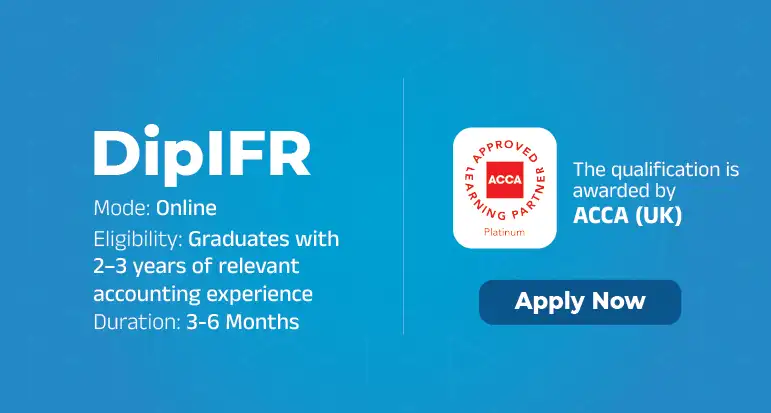
The DipIFR is globally and internationally recognized as it is awarded by the ACCA, which is one of the leading professional accounting bodies in the world. Employers recognize the qualification that will help prepare financial statements across the global accounting and finance industries.
Related Blogs