Tech to Finance Career Change: How CMA USA Can Help
Last Updated On -06 Oct 2026
By Sagnika Sinha
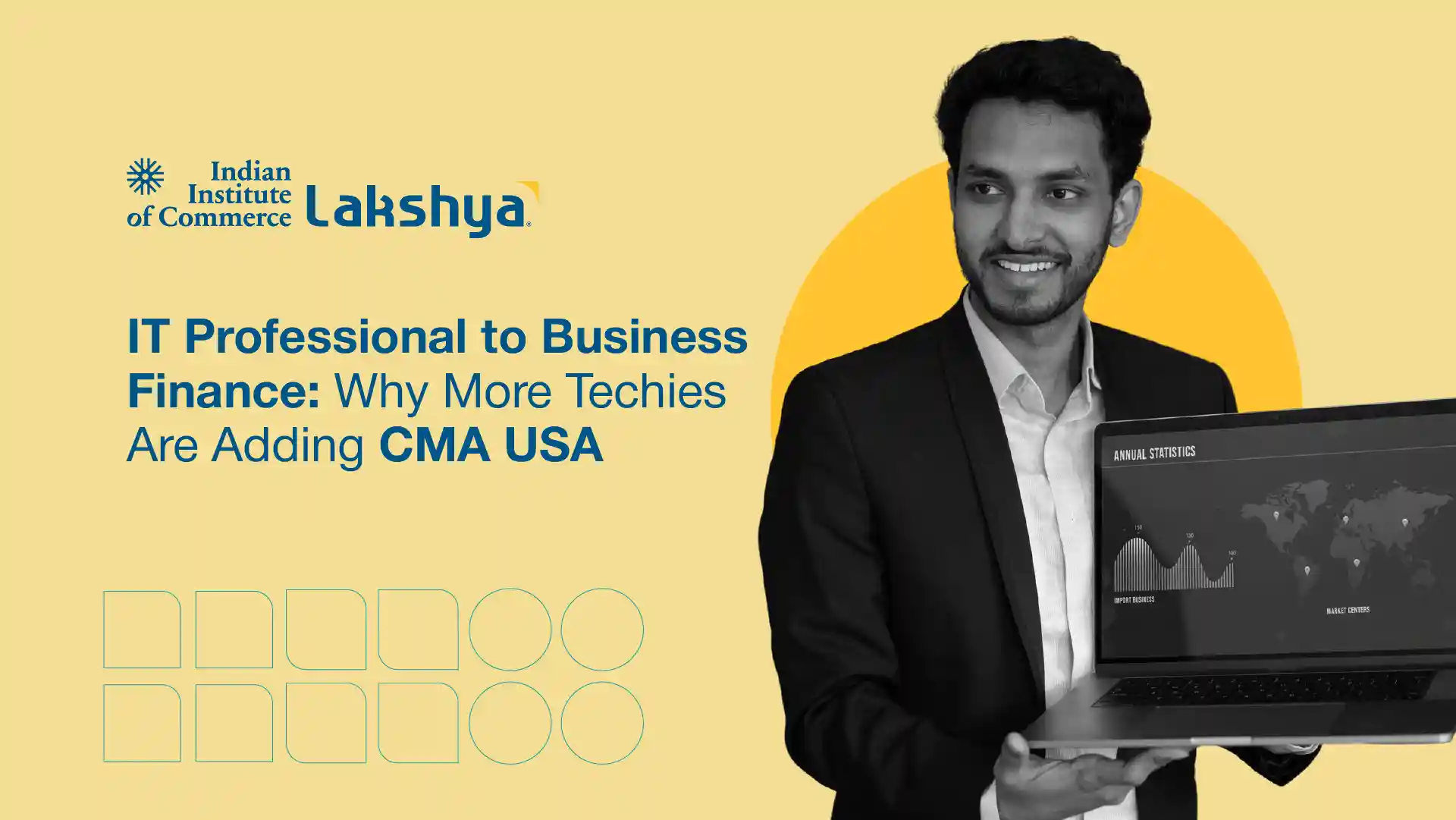
Can an IT professional move into business finance? At first, technology and finance may look like two separate career paths. One deals with systems, software, data, and digital infrastructure. The other focuses on budgets, financial performance, forecasts, costs, and business decisions.
However, modern businesses increasingly connect the two. Finance teams now work with ERP systems, dashboards, automation, data analytics, and digital planning tools. At the same time, technology decisions have major financial implications.
This creates interesting opportunities for professionals who understand both worlds. For an IT professional who wants to develop finance and business knowledge, CMA USA can be one possible route. You have to stay updated on the CMA USA work experience requirement to learn about the areas to cover.
The qualification covers areas such as planning, budgeting, performance management, cost management, technology and analytics, financial statement analysis, corporate finance, and business decision analysis. So, why might a technology professional consider adding finance skills to their career?
Why Techies Choose CMA USA
IT professionals often develop skills that businesses already value: logical thinking, data analysis, process improvement, automation, systems knowledge, and structured problem-solving. However, moving closer to business decision-making requires another layer of knowledge.
Imagine that your company wants to implement a new technology platform. An IT specialist can explain how the system works. A finance professional can evaluate its cost, expected financial benefits, risks, and potential return. They have to develop basic accounting knowledge before pursuing the CMA USA with a 3-month beginner plan.
A professional who understands both perspectives may be able to contribute to the conversation differently. This is one reason qualifications such as CMA USA can appeal to technology professionals who want to understand the commercial side of business.
The goal does not always have to be leaving IT completely. For some professionals, the better strategy may be combining technology + finance + analytics.
Systems to Strategy
Technology professionals think in systems. They understand inputs, processes, outputs, dependencies, controls, and potential failures. Business finance also involves interconnected systems.
Revenue affects profit. Costs affect margins. Inventory influences working capital. Capital expenditure can affect cash flow and future returns. The difference lies in the objective. This is why IT professionals should pursue the CMA USA study roadmap for non-commerce students in 2026.
CMA USA can help develop the financial knowledge needed to approach the second question. Its curriculum includes budgeting, forecasting, performance management, corporate finance, investment decisions, and other management accounting concepts. Professionals planning to pursue CMA USA to enhance their career can apply at IIC Lakshya Commerce as they are the Official CMA USA-approved Platinum Learning Partner.
Therefore, an IT professional can begin moving from purely technical conversations towards strategic business discussions. That combination can be particularly relevant in areas such as finance transformation, business partnering, technology investment analysis, ERP implementation, and digital finance.
Data-Driven Decision Support
Tech professionals are often comfortable working with data. That can become a significant advantage in finance.
Modern finance teams do much more than prepare reports. They analyse business performance, investigate variances, forecast future outcomes, build dashboards, and help managers make decisions.
Suppose a company's operating costs suddenly increase. A traditional report may simply show that costs exceeded the budget. An analytical finance professional asks why. These are the questions:
- Which department drove the increase?
- Was it temporary?
- Is there a recurring pattern?
- How could it affect future profitability?
Your existing data skills can help with the investigation. However, you also need financial context. You need to understand concepts such as revenue, margins, cost behaviour, working capital, budgeting, cash flow, and return on investment.
CMA USA can help build this financial layer. If you already know Excel, SQL, Python, Power BI, Tableau, ERP systems, or similar tools, you may then learn to apply those capabilities to financial problems.
Technology tells you how to analyse the data. Finance helps you understand what the analysis means for the business. It will also help you understand that passing both CMA USA parts doesn’t mean you are certified yet, and other factors that must be considered.
Fast-Track Transition
Professionals often search for a “fast” way to switch careers. Be careful with that idea.
CMA USA has two examination parts, which can make the exam structure appear relatively compact compared with some longer professional pathways. However, completing the exams is not the same as instantly becoming a senior finance professional.
Candidates must meet IMA's applicable requirements to earn the CMA certification. More importantly, career transitions require practical skills. If you work in IT today, start building finance exposure before you complete your transition.
For example, volunteer for projects involving budgeting systems, ERP finance modules, finance automation, management dashboards, cost optimisation, or technology investment analysis. Build financial models using sample company data. It will also help you gain a promotion through CMA USA as professionals learn more about changes.
Learn how to read an income statement, balance sheet, and cash flow statement. Then connect these concepts to the systems you already understand. That approach can make your transition much more credible than relying on a qualification alone.
Lucrative Pivot
Can moving from IT into business finance increase your salary? Possibly - but it is not guaranteed. Compensation depends on your location, employer, experience, role, technical expertise, finance skills, and level of responsibility.
Therefore, don't pursue CMA USA based only on a promised salary figure. Think about the broader career opportunity. Combining technology and finance can open paths worth investigating, including:
- FP&A
- Finance analytics
- Finance transformation
- Business finance
- Management accounting
- Cost analysis
- Technology finance
- Strategic finance
Some professionals may eventually move into finance business partnering or management roles. They can also pursue Big 4 careers after CMA USA with the integration of these aspects.
Others may remain close to technology but specialise in financial systems, ERP transformation, automation, or analytics. The most valuable pivot may therefore be one that adds finance to your technology expertise rather than replacing your technology background.
Global Portability
IT professionals often work with technologies used across countries. Finance also has internationally relevant skills. Budgeting, forecasting, cost management, performance analysis, financial modelling, and business decision-making are used across industries and markets.
CMA USA is offered by the Institute of Management Accountants (IMA), and the qualification focuses on management accounting and financial management competencies. However, “global recognition” should not be confused with automatic global employment. The four stages of CMA USA are a significant starting point to integrate expertise as an IT professional transitioning to finance.
Every country has different labour markets, visa requirements, accounting regulations, employer expectations, and professional requirements. Instead, think about portability at the skills level. An IT professional who understands systems, data, analytics, financial planning, and business decision-making can build a versatile professional profile.
You could also target multinational organisations where finance and technology teams regularly collaborate. For example, imagine an organisation implementing a new ERP platform globally. The project needs more than developers.
It may require professionals who understand finance workflows, internal controls, management reporting, budgeting, data structures, and business requirements. That intersection is where a hybrid technology-finance profile can become particularly interesting.
Wrapping Up!
Moving from IT into business finance does not necessarily mean throwing away years of technology experience. In many cases, that would be the wrong approach. Your understanding of systems, data, automation, processes, and technology can become part of your competitive advantage.
The missing piece may be financial knowledge. CMA USA can help you develop competencies in planning, budgeting, performance management, cost management, analytics, financial analysis, corporate finance, risk, and decision-making.
Then you need to put those skills into practice. Learn financial statements. Build models. Analyse business data. Work with finance teams. Volunteer for cross-functional projects. Understand how your organisation makes investment decisions.
For Class 12 students considering CA, CMA, accounting, technology, or another professional career, there is a bigger lesson here. You do not always have to choose between finance and technology. The modern workplace increasingly needs people who can connect disciplines.
Read More
- 6 Signs You are the Perfect Candidate for CMA USA Right Now
- CMA India vs CMA USA vs ACCA
- CMA USA Careers in Profitability and Performance Management
- CMA USA Leadership Roles: A Career Progression Guide
- What is the Demand for CMA USA Professionals in Trivandrum?
Frequently Asked Questions
How many parts are there in the CMA USA exam?
The CMA examination consists of two parts: Financial Planning, Performance, and Analytics and Strategic Financial Management.
Should an IT professional learn Excel for finance?
Yes. Excel remains useful across many finance roles. IT professionals should learn to apply it to budgeting, forecasting, variance analysis, financial modelling, and reporting.
Is SQL useful for finance professionals?
SQL can be valuable in data-intensive finance roles because it helps professionals retrieve and analyse information stored in databases. Its importance varies by position.
Can ERP experience help with a finance career?
Yes. ERP experience can be especially relevant in finance transformation, financial systems, reporting, controls, and cross-functional technology projects.
Can Class 12 students choose both technology and finance?
Yes. Students can develop skills across both areas. However, they should research the eligibility requirements of specific professional qualifications and degree programmes before choosing a pathway.
Related Blogs