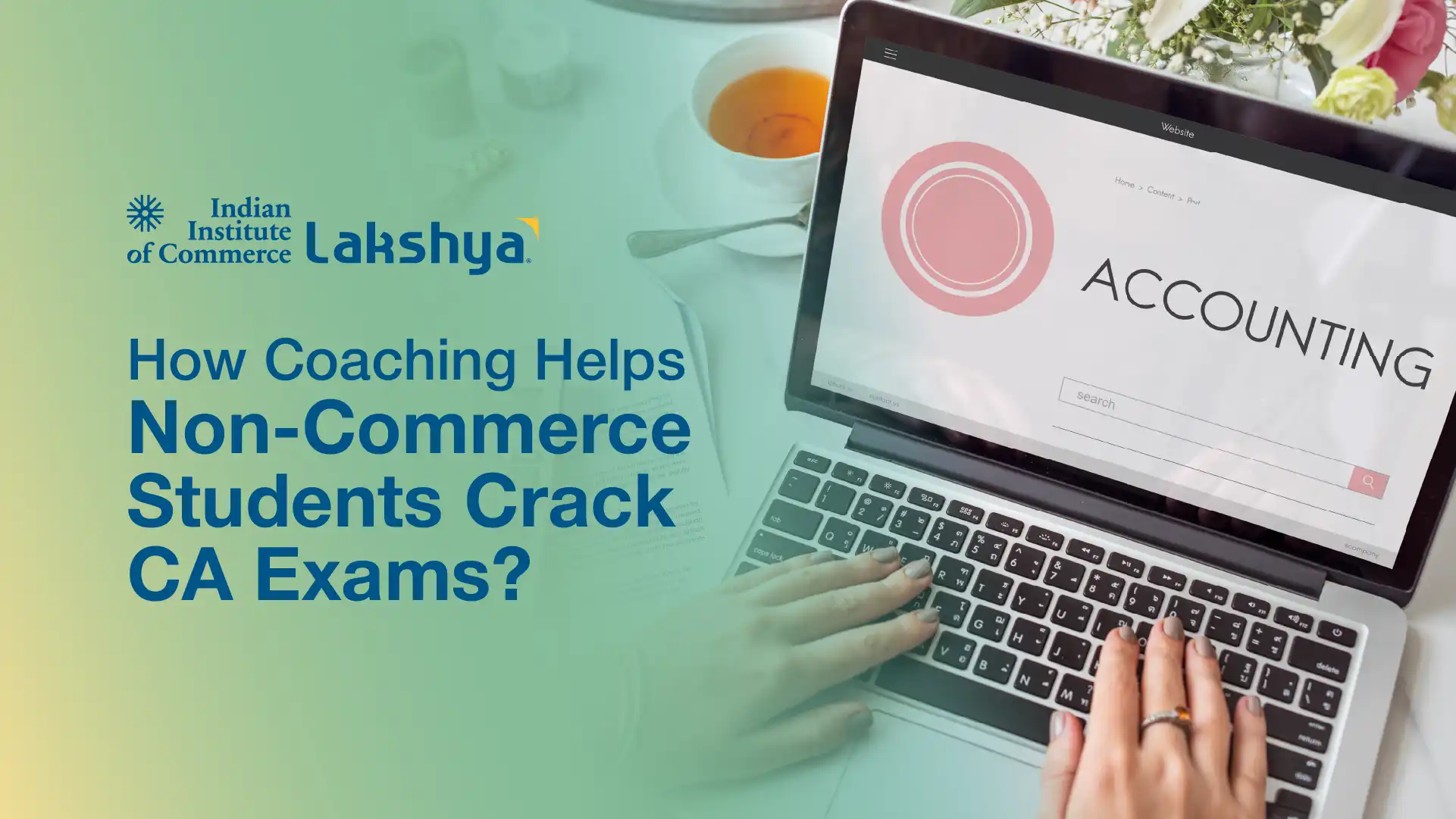
How coaching helps non-commerce students crack CA exams?
Last Updated On -30 Sep 2026
By Nishtha Singh
For many students from science, arts, or other non-commerce backgrounds, becoming a Chartered Accountant (CA) may seem like an impossible dream. The CA course is known for its rigorous syllabus, technical subjects, and demanding examinations, leading many to believe that only commerce students can succeed. However, this is far from the truth.
Every year, numerous students without a commerce background successfully clear the CA Foundation, Intermediate, and Final examinations. While they may initially face a steeper learning curve, the right coaching, consistent effort, and proper study strategy can help them build a strong foundation in accounting and finance.
Professional coaching plays an important role in making this transition smoother. By breaking down complex concepts, offering structured learning, and providing continuous academic support, coaching institutes help non-commerce students bridge the knowledge gap and prepare confidently for the CA examinations.
In this article, we'll explore how coaching supports non-commerce students throughout their CA journey and why expert guidance can make a significant difference.
Understanding the Challenges Faced by Non-Commerce Students
Students from non-commerce streams often begin the CA course without prior exposure to accounting, business laws, economics, or taxation. As a result, the initial months can feel overwhelming.
Some common challenges include:
- Learning accounting from scratch
- Understanding financial terminology
- Grasping business concepts
- Managing technical subjects
- Developing problem-solving skills
- Building confidence
- Balancing multiple subjects
- Adjusting to a new academic discipline
With proper guidance, these challenges gradually become manageable.
Structured Learning Makes the Transition Easier
One of the biggest advantages of joining a coaching institute is receiving a structured learning plan. Instead of trying to understand the syllabus independently, students follow a systematic approach that builds concepts step by step.
Structured coaching provides:
- Topic-wise learning plans
- Paper-wise study schedules
- Concept progression
- Weekly learning goals
- Planned revisions
- Progress tracking
- Regular assessments
- Academic discipline
This organised approach helps students avoid confusion and stay consistent.
Building Strong Fundamentals in Accounting
Accounting forms the backbone of the Chartered Accountancy course. Students without prior accounting knowledge need a strong conceptual foundation before moving to advanced topics.
Coaching helps students understand:
- Basic accounting principles
- Journal entries
- Ledger preparation
- Trial balance
- Financial statements
- Accounting standards
- Practical accounting problems
- Financial analysis
Strong fundamentals make higher-level CA subjects much easier to understand.
Simplifying Complex Subjects
The CA syllabus includes several technical subjects that may appear intimidating to beginners. Experienced faculty simplify these topics using practical examples and structured explanations.
Faculty support includes:
- Concept-based teaching
- Step-by-step explanations
- Real-life business examples
- Interactive classroom discussions
- Simplified legal concepts
- Practical problem-solving
- Regular doubt-clearing
- Continuous academic guidance
This approach makes complex topics easier to grasp.
Personalised Mentoring Boosts Confidence
Every student learns at a different pace. Some may need extra help with accounting, while others may struggle with taxation or business laws. Personalised mentoring ensures that students receive support based on their individual needs.
Mentoring includes:
- Individual study plans
- Performance reviews
- Academic counselling
- Progress monitoring
- Doubt-solving sessions
- Motivation and guidance
- Time management support
- Goal setting
Continuous mentoring helps students remain motivated throughout the course.
Regular Practice Improves Exam Readiness
Success in CA examinations depends not only on conceptual understanding but also on consistent practice. Coaching institutes encourage students to apply what they learn through regular assessments.
Preparation includes:
- Chapter-wise tests
- Practice questions
- Mock examinations
- Previous year papers
- Time-bound practice
- Answer writing practice
- Performance analysis
- Revision tests
Frequent practice improves both speed and accuracy.
Learning Effective Exam Strategies
Many first-time CA students focus entirely on completing the syllabus while overlooking exam techniques. Coaching institutes help students understand how to maximise marks during examinations.
Students learn:
- Time management
- Answer presentation
- Question selection
- Writing techniques
- Revision strategies
- Common examiner expectations
- Mistake analysis
- Stress management
These skills often improve overall exam performance.
Staying Consistent Throughout the CA Journey
The CA course requires long-term commitment. Without accountability, students may lose motivation or postpone their preparation.
Coaching helps maintain consistency through:
- Fixed study schedules
- Attendance tracking
- Faculty follow-ups
- Weekly targets
- Progress monitoring
- Regular revisions
- Academic support
- Continuous encouragement
Consistency is one of the key factors behind successful CA preparation.
Peer Learning Creates a Supportive Environment
Studying alongside students with similar goals creates motivation and encourages collaborative learning. Classroom discussions and group activities help students gain different perspectives on challenging topics.
Benefits of peer learning include:
- Group discussions
- Knowledge sharing
- Healthy competition
- Doubt-solving with classmates
- Collaborative revision
- Shared motivation
- Better engagement
- Improved confidence
A supportive learning environment makes the CA journey less overwhelming.
How Coaching Prepares Students for Long-Term Success
A good coaching institute focuses on much more than helping students pass examinations. It develops the technical knowledge, analytical skills, and professional mindset needed to succeed in the accounting profession.
Students gradually build:
- Financial knowledge
- Business awareness
- Analytical thinking
- Problem-solving skills
- Professional ethics
- Communication skills
- Decision-making ability
- Career readiness
These competencies remain valuable throughout their professional careers.
Why Non-Commerce Students Can Succeed in CA
A commerce background can certainly provide an initial advantage, but it is not a requirement for success in the Chartered Accountancy course. Many non-commerce students have proven that dedication, disciplined preparation, and expert guidance can overcome the lack of prior accounting knowledge.
At IIC Lakshya, we help students from diverse academic backgrounds build a strong foundation through structured coaching, experienced faculty, personalised mentoring, and continuous academic support. With the right learning environment and consistent effort, non-commerce students can confidently pursue the CA qualification and build successful careers in accounting, finance, taxation, and auditing.
Frequently Asked Questions (FAQs)
Can a non-commerce student become a Chartered Accountant?
Yes. Students from science, arts, and other non-commerce backgrounds are eligible to pursue the CA course, provided they meet the eligibility requirements set by ICAI.
Is CA difficult for non-commerce students?
The initial learning curve may be steeper because accounting concepts are new, but structured coaching, consistent study, and regular practice help students overcome these challenges.
Why is coaching important for non-commerce students?
Coaching provides structured learning, conceptual clarity, expert guidance, regular assessments, personalised mentoring, and exam strategies that help beginners build confidence and prepare effectively.
How long does it take for a non-commerce student to adapt to CA studies?
The adjustment period varies for each student, but with consistent effort and proper academic support, most students develop a strong understanding of accounting fundamentals within the first few months of preparation.
Related Blogs