

DipIFRS vs. MBA Finance - The ROI Comparison Every Finance Professional Needs to Read
Last Updated On -04 Aug 2026
By Sajith R S

If you're weighing an MBA Finance course against DipIFR, you're probably staring at two very different price tags and wondering which one actually pays off. One takes two years and a chunk of savings. The other takes a few months and a fraction of the cost. Both promise better jobs and better pay, but they don't get you there in the same way. This article breaks down what each qualification actually gives you, so you can stop guessing and start planning.
What Is MBA Finance?
An MBA Finance course is a full postgraduate management degree with a specialisation in finance. You're not just learning accounting or valuation. You're learning strategy, leadership, operations, and how a business runs as a whole, with finance as your core lens. It's built for people who want to sit in boardrooms, not just balance books eventually.
Most MBA Finance programmes in India run for two years, though one-year executive formats exist for working professionals. Admission usually requires CAT, XAT, or a similar entrance score, along with a bachelor's degree in any stream.
MBA Finance Syllabus and Subjects
A typical MBA Finance syllabus covers financial management, investment banking, corporate finance, risk management, financial modelling, and business analytics. Core management subjects like marketing, HR, and operations are included too, since that's the whole point of an MBA building a generalist manager with a finance specialisation.
Students pursuing a degree in commerce often assume an MBA will feel repetitive. For the most part, it doesn't. The finance content goes deeper, but the real shift is in how you're taught to think through case studies, group projects, and live business problems, not just theory papers.
What Is DipIFR (ACCA DipIFRS)?
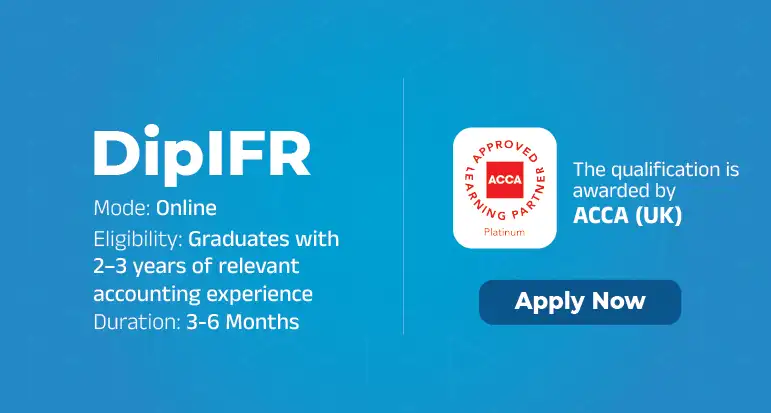
DipIFR, offered by ACCA, is a certification in International Financial Reporting Standards. It's not a degree. It's a focused, technical qualification for people who already work in accounting or finance and want to master IFRS reporting specifically. Think of it as depth over breadth.
The course usually takes four to six months of preparation, with one exam at the end. DipIFR eligibility is fairly broad for finance professionals; a professional accounting qualification such as CA, CMA, or ACCA, or a few years of relevant work experience, is generally enough. This makes ACCA DipIFR genuinely accessible to working finance professionals who don't have time for a two-year commitment.
DipIFR vs MBA Finance at a Glance
|
Factor |
MBA Finance |
DipIFR (ACCA DipIFRS) |
|
Duration |
1–2 years |
4–6 months |
|
Approx. Cost |
₹8–25 lakh (top colleges higher) |
₹40,000–₹80,000 |
|
Format |
Full-time/executive degree |
Single-paper certification |
|
Best For |
Career switchers, leadership roles |
Reporting and audit specialists |
|
Eligibility |
Graduate + entrance exam |
Accounting background or experience |
|
Global Recognition |
Depends on college brand |
Recognised wherever IFRS is used |
This table isn't meant to declare a winner. It's meant to show that you're really comparing two different tools for two different jobs.
Cost and Duration: Where Money Goes?
Here's where things get uncomfortable for a lot of families. A good MBA Finance college in India can cost anywhere between ₹8 lakh and ₹25 lakh, sometimes more at a top-tier B-school. DipIFR, by comparison, costs a fraction of that closer to what you'd spend on a decent laptop.
But cost alone doesn't tell the full story. An MBA gives you a brand name, a peer network, and placement support that DipIFR simply doesn't offer. DipIFR gives you speed and a very specific, in-demand skill without pulling you out of your job for two years. Neither is automatically “cheaper” in the way that matters; it depends on what you're buying.
Career Scope After MBA Finance
MBA Finance jobs typically open doors to investment banking, corporate finance, private equity, financial consulting, and management roles across industries. MBA Finance careers often begin in roles with a clear growth path attached; you're not just expected to do the work; you're also expected to develop towards leading teams.
Take Rohan, a commerce graduate from Pune who joined an MBA programme mainly because he wanted to move away from pure accounting work. Two years later, he's in a corporate strategy role at an FMCG company, earning almost twice his pre-MBA salary. That kind of jump is possible, though not guaranteed a lot depends on the college and how actively you network during placements.
Career Scope After DipIFR
Professionals who complete a DipIFRS course usually move into financial reporting, technical accounting, audit, and compliance roles, especially in MNCs and companies with international operations. If your work already involves IFRS or you're preparing statements for global stakeholders, this certification adds real, immediate credibility.
Consider Meera, a mid-level finance professional at a Bengaluru-based IT firm with four years of experience. She completed DipIFR alongside her job in six months and moved into a senior reporting role within a year no career break, no loan, and no relocation. For someone who is already employed and has financial responsibilities, that's a fairly efficient outcome.
Salary Expectations: Be Realistic
Salary jumps after an MBA Finance course vary hugely from 20% to more than 100%, depending largely on the college tier and your prior experience. Tier-1 institutes usually report stronger outcomes; a lesser-known college may not move the needle as much, and that's a limitation worth being honest about upfront.
DipIFR salary hikes tend to be more modest but steadier, often falling in the 15–30% range. They are usually layered on top of your existing role rather than requiring a complete career restart. DipIFR rewards depth in a niche skill rather than a broad leadership pivot.
Which One Should You Choose?
Honestly, this isn't a 'better or worse' question. It's a 'what do you actually want?' question.
-
If You're a Fresh Graduate
If you're early in your career and open to a broader shift into consulting, leadership, or a completely different industry an MBA Finance course probably makes more sense. You have the time and a longer window to recover your investment.
-
If You're Already Working
If you're already employed in accounting or finance and want a Finance Professional Certification that adds weight to your current role without uprooting your life, DipIFR is usually the more practical choice. It won't make you a general manager, and it isn't meant to.
Also Read
- ACCA Exemptions for MBA Finance in India
- What to Look for in a Dip IFRS Training Program in India?
- Why DipIFRS is Important for Global Finance Careers
- Highest Paying Finance Jobs in India
- 7 Objectives of IFRS: Significance, Features, and Objectives
Making the Right ROI Decision
If you ask us directly, we'd say an MBA only justifies its cost when you genuinely want the leadership route or a career switch, not just a résumé upgrade. DipIFR, on the other hand, is not a shortcut either. People who enrol expecting an easy pass often find the single exam tougher than they assumed.
Both paths can genuinely support finance career growth. What matters is matching the qualification to your career stage, finances, and actual goals rather than chasing whichever option sounds more prestigious. If you're still unsure, a proper one-on-one conversation with an academic mentor at IIC Lakshya can help you assess both options against your specific background before you commit money or time. For anyone building international finance qualification credentials or planning the next step in financial reporting, getting that clarity upfront can save a great deal of second-guessing later.
Related Blogs