

DipIFRS vs. CMA USA: Two Global Finance Credentials - Which Fits Your Career Better?
Last Updated On -04 Aug 2026
By Sajith R S

I still remember two graduates who walked in during the same week, both holding a BCom degree and both stuck on the same question: DipIFRS or CMA USA? One wanted to join a financial reporting team at a company that files under IFRS. The other could not stop talking about budgets, costing, and being part of actual business decisions. I told them what I would tell you: given what each of them wanted, they had no business choosing the same qualification.
That is really the heart of the DipIFRS vs. CMA USA debate. Both are well-regarded global finance certifications; there is no argument there, but they answer very different career questions. What should decide it for you is the role you are actually chasing, not which qualification sounds bigger. CMA USA provides fairly broad exposure to management accounting. A DipIFRS course does the opposite: it goes deep into international financial reporting standards and largely leaves everything else alone.
One small note on the name, since it confuses people constantly. ACCA’s official title is DipIFR, short for Diploma in International Financial Reporting. You will also see it written as DipIFRS, the IFRS diploma, or the ACCA DipIFR course. Do not overthink it; these names all refer to the same qualification.
What are DipIFRS and CMA USA?
DipIFRS (ACCA DipIFR)
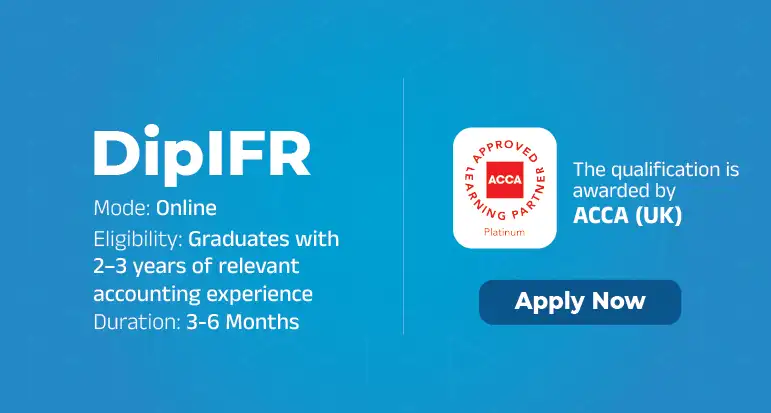
DipIFRS is a one-exam diploma from ACCA, the UK's global accountancy body. It covers a single area in real depth: applying IFRS to build and present financial statements, group accounts, and consolidation included. The 2026 syllabus has also added the newer ISSB sustainability standards, IFRS S1 and S2, a hint about where reporting work is heading. Our ACCA DipIFR exam guide breaks the paper down question by question.
The part institutes rarely say aloud: a DipIFRS course won't make you a chartered accountant. It certifies that you know IFRS properly, and that is deliberately all it does. For anyone already in accounts, that tight scope is the appeal.
CMA USA
CMA USA, short for Certified Management Accountant, comes from the IMA in the United States, and it casts a much wider net. Across two exam parts, the CMA USA course covers financial planning, performance management, costing, analytics, corporate finance, valuation, risk, and professional ethics. The CMA USA course details in one line: DipIFRS reports the numbers correctly; CMA USA uses them to steer a business.
Eligibility: Who can actually enrol?
Different people qualify for each, and CMA USA eligibility is where students most often misjudge the timing.
CMA USA asks for a bachelor's degree in any subject plus two continuous years of relevant work in management accounting or financial management. Helpfully, the experience needn't come first. You can clear both exams and finish the two years within seven years of passing, so a final-year student or recent graduate can start the CMA USA course now and complete the work part later.
DipIFRS eligibility flips that: a higher background bar, lighter paperwork. ACCA wants a professional accountancy qualification, or a relevant degree plus two to three years in accounting or finance, so qualified CAs, ACCA affiliates and CMAs clear it easily. That is why DipIFRS suits working professionals, not someone straight out of college. Without a finance base behind you it isn't your starting point, and rules vary slightly by country, so confirm yours on the ACCA site first.
Exam structure and pass percentage
DipIFRS is a single computer-based exam of three hours and fifteen minutes, held each June and December, with a 50% pass mark. Of its four compulsory questions, one is nearly always a consolidation, and the rest cover specific standards and a scenario. Across recent sittings, the ACCA DipIFR pass rate has run between 35% and 46%, so it is no walkover, though most people prepare in three to five months.
CMA USA splits into two parts of four hours each, marked out of 500 with 360 to pass. Each part currently mixes multiple-choice questions with essays, but the IMA is replacing those essays with case-based questions from September 2026, so check that your study material matches the newer pattern. The CMA USA pass percentage sits near 45 to 50% per part worldwide, and candidates usually finish in twelve to eighteen months. ACCA lists the official DipIFR exam dates and fees if you want to plan a sitting.
DipIFRS vs CMA USA at a glance
Money often settles the decision, and here the gap is wide. A DipIFRS course is far cheaper: the ACCA exam fee is about £147 (roughly ₹18,500), and with coaching the total usually lands between ₹40,000 and ₹1,20,000. CMA USA course fees run to about ₹1 lakh for students and ₹1.5 lakh for professionals before coaching, with rupee figures moving on the exchange rate.
|
Feature |
DipIFRS (ACCA DipIFR) |
CMA USA |
|
Awarding body |
ACCA (UK) |
IMA (USA) |
|
Focus |
IFRS reporting, deep and narrow |
Management accounting, broad |
|
Best suited to |
Working finance professionals |
Graduates and early-career staff |
|
Eligibility |
Accountancy qualification, or degree + 2–3 yrs experience |
Bachelor's degree + 2 yrs experience (allowed after exams) |
|
Exam |
1 paper, 3 hr 15 min, pass 50% |
2 parts, 4 hr each, 360/500 to pass |
|
Typical duration |
3–5 months |
12–18 months |
|
Approx. fees |
₹18,500 exam; ₹40k–1.2L all-in |
₹1L (student) to ₹1.5L (professional) |
|
Recent pass rate |
~35–46% |
~45–50% per part |
Career opportunities and salary
DipIFRS career opportunities gather around financial reporting: IFRS reporting teams, statutory reporting, audit support and consolidation work in multinationals, Big 4 firms and global capability centres. India's shift to IndAS, modelled closely on IFRS, keeps that need alive. On its own, a DipIFRS rarely hands you a new job; it sharpens the profile of someone already in accounts and opens the door to IFRS-heavy work or an overseas posting.
CMA USA career opportunities spread wider, into financial analysis, FP&A, costing, budgeting, business partnering, and finance-manager roles that shape decisions, not just record them. It also carries well into the Gulf, where many IIC Lakshya students head once certified. Among the international finance qualifications Indian graduates weigh up, it travels about as far as any.
Be sceptical of salary claims online. The IMA's global salary survey does show CMAs out-earning non-certified peers by a solid margin, though India numbers swing hard with role, city, and experience. Comparing CMA USA salary vs DipIFRS salary directly isn't fair anyway: one is a full career qualification, the other a focused skill added to a job you already hold. A CMA can change your designation; a DipIFRS changes the work people trust you with.
Also Read
- Benefits of a Diploma in IFRS
- Career After CMA USA
- How to Become an IFRS Consultant from an Accountant?
- What is the Eligibility for CMA USA?
- 7 Objectives of IFRS: Significance, Features, and Objectives
Which is better, CMA USA or DipIFRS?
Honestly, there is no outright winner, and whoever says otherwise probably has a course to sell. People still ask which is the best global finance certification for accountants, and the truthful reply comes back to that same width-versus-depth choice.
Go towards CMA USA when you are early on, want a broad qualification that unlocks management and analysis roles, and can give it a year or more. It is the safer bet while you are still deciding which corner of finance suits you.
Lean towards DipIFRS when you already work in accounting or audit, want something focused you can finish in a few months, and handle IFRS or IndAS routinely. For a professional who needs to prove one specific strength, it is the cheaper, sharper option and one of the quicker credentials to earn.
Some people do both: CMA USA for breadth, then the ACCA DipIFR course later for reporting depth. If you can't tell which fits, ten minutes with a mentor who knows the exams and the local hiring scene beats another article; the counselling team at IIC Lakshya sits with students on exactly this call, usually free. In the end, CMA USA or DipIFRS comes down to where you stand today, not someone else's ranking.
Related Blogs