
CPA Credential Evaluation for Indian Degrees: Complete Process
Last Updated On -28 Nov 2026
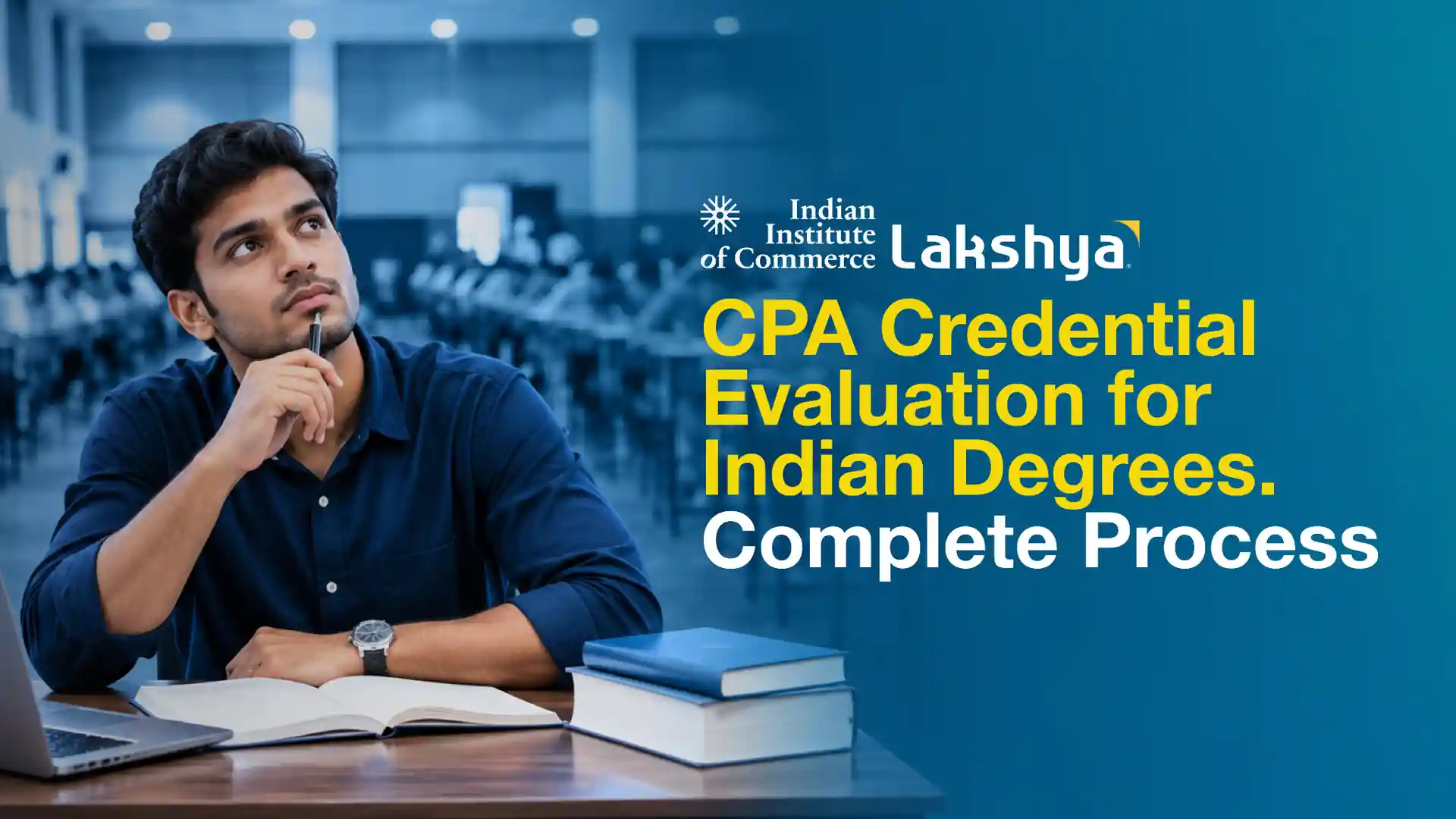
If you hold an Indian degree and want to qualify as a US CPA, your first formal step is a CPA credential evaluation not exam registration. A US state board cannot read an Indian transcript the way it reads an American one, so an approved agency must translate your education into US terms. This article explains how the evaluation works, what documents you need, and where Indian graduates most often hit a credit gap.
What is a CPA Credential Evaluation?
A credential evaluation is a formal report that converts your Indian education into US equivalents. It confirms three things: that your degree is genuine, that it equals a US bachelor's degree, and how your coursework maps to US semester credit hours.
Because each US state sets its own CPA registration requirements, the evaluation is not a one-size-fits-all certificate. The report goes to a specific Board of Accountancy, and that board decides whether your profile meets its CPA eligibility rules for the exam and, later, for the licence. In practice, a foreign credential evaluation for CPA purposes is the foundation of the entire CPA registration process in India-based applications route.
Keep one distinction in mind from the start. Clearing the Uniform CPA Exam is not the same as becoming a licensed CPA. Evaluation affects both stages, but the rules differ by state, and you should plan for both before you apply.
Are Indian Degrees Recognised in the USA?
Yes, Indian degrees are recognised in the USA for CPA purposes, provided the awarding institution is a recognised university and your documents are verified. The real question is not recognition but equivalence.
Here is where Indian graduates face the classic gap. Most US state boards require 120 semester credit hours for exam eligibility, and a US bachelor's degree typically carries those credits across four years Becker. A three-year Indian BCom, however, is commonly treated as roughly 90 US semester credits, although the final figure always rests with the evaluator, not with any fixed formula iPAS the CPA Exam. Whether an Indian degree equivalent in USA credit terms reaches 120 depends on your subjects, postgraduate study and professional qualifications.
This is why an Indian degree evaluation in USA board terms matters so much. The evaluator's report tells you plainly where you stand before you spend money on exam fees.
The Step-by-Step CPA Credential Evaluation Process
The cpa evaluation foreign credentials process follows a predictable sequence. Because documents come from Indian universities, build buffer time into each stage.
- Choose your state board first. Your board determines which evaluation agency you may use. Choosing the agency first is the most common sequencing mistake.
- Select an approved evaluator. Some boards accept only NASBA International Evaluation Services (NIES); others maintain their own approved lists or evaluate in-house. Check this before paying anyone.
- Submit the online application and fee. NIES, for example, operates an online-only application and charges $250 for an international credential evaluation covering CPA exam and licensure purposes.
- Arrange document submission. Your university must send official documents directly, and everything must reach the evaluator within 90 days of your application date or the application is denied and the fee forfeited NASBA NIES Requirements.
- Receive the report and apply for the exam. Once the board accepts the evaluation, you receive a Notice to Schedule and can book sections at a Prometric centre. India now has test centres, so most candidates complete US CPA eligibility for Indian students journeys without travelling to the US for the exam itself.
Document Checklist for Indian Applicants
Because Indian universities follow their own document-release procedures, this checklist deserves careful attention. NIES requires documentation for each year of post-secondary education, and a completed higher degree is not accepted as proof of prior study NASBA NIES Requirements.
- Official transcripts for every year of your bachelor's degree, sent in a sealed university envelope or electronically by the institution
- Degree certificate (provisional or consolidated documents may not suffice, confirm with your university)
- Copy of your passport or government-issued ID
- Certified English translations, if any document is in another language
- Mark sheets from a previous degree, if you are relying on an MCom or second qualification to add credits
- For Indian CA holders: ICAI certificates and examination records, which professional-body coursework is evaluated case by case NASBA NIES
One warning from the official guidance: submitting falsified documents leads to denial, forfeiture of fees and notification of the boards. Never route documents through agents who promise to "arrange" them.
Which Evaluator Does Your State Board Accept?
This is the decision that shapes everything else, and the three common patterns differ sharply.
|
Board pattern |
Examples |
What it means for you |
|
NIES is the sole approved evaluator |
Alabama, Arizona, Georgia, Illinois, Kansas, and around two dozen jurisdictions in total |
You must apply through NIES; no other agency report will be accepted |
|
Board-approved agency list |
California accepts evaluations only from services on its CBA-approved list, delivered in a sealed envelope or mailed directly by the agency |
Compare approved agencies on fees and turnaround; reports typically take three to six weeks |
|
Board evaluates in-house |
Texas runs evaluations through Board staff with the University of Texas at Austin, and does not accept external credential services |
Skip private agencies entirely; apply through the board's own process |
California adds a useful caution for Indian candidates: ACCA qualifications earned outside a degree-granting institution do not count toward its education requirements, though ACCA earned alongside a qualifying bachelor's degree and shown on an acceptable transcript can be considered. Also note that NIES does not handle New York licensure evaluations, so always confirm the current scope with your board.
Closing the Credit Gap: Your Main Planning Decision
For most Indian graduates, the evaluation raises one practical question: do I have enough credits, and if not, how do I add them?
- BCom plus MCom. A master's adds coursework, and many candidates cross the 120-hour line this way. The evaluator, not a rule of thumb, confirms the total.
- BCom plus Indian CA. Professional-body credits are evaluated case by case, so outcomes vary by board and by syllabus documentation you can supply.
- Supplementary US-style coursework. Some candidates take additional accounting and business courses to meet state-specific subject-hour rules, such as Texas's upper-level accounting requirements Texas TSBPA.
- The newer 120-credit licensure pathway. Several states, including Idaho, Iowa, Kansas, Mississippi, South Dakota and Utah, adopted pathways effective July 2026 that replace the older 150-hour model with a bachelor's degree plus defined experience. Because implementation details remain with each board, verify your state's current rules rather than assuming.
Plan your cpa education requirements for licensure, not just for the exam. A profile that clears exam eligibility may still fall short at the licensing stage in some states.
Final Takeaway
A CPA credential evaluation is not paperwork to rush through; it is the diagnostic test that tells you whether your Indian degree, plus any additions, supports your US CPA plan. Choose the state board first, match its approved evaluator, and read your report as a gap analysis. If you want help mapping your specific degree to state board options, IIC Lakshya's counselling team can walk through your profile with you before you commit to an application.
Frequently Asked Questions
Is a three-year Indian BCom valid for the US CPA exam?
Yes, it is valid as a recognised degree, but it often falls short of the 120 semester hours most states require. An evaluation report confirms your actual credit position, and many candidates close the gap with an MCom, CA credits or additional coursework.
How long does the CPA credential evaluation take?
Timelines vary by agency and by how quickly your university releases documents. California's approved evaluators typically take three to six weeks, and NIES applications lapse if documents are not received within 90 days, so start document collection early.
Can I choose any US state board as an Indian candidate?
No board restricts applicants by nationality, but each sets its own education rules and approved evaluators. Indian candidates usually pick a state after comparing its credit requirements, evaluator options and licensing rules.
Does an Indian CA qualification count toward CPA education?
It can, but not automatically. NIES evaluates professional-organisation coursework case by case, and boards such as California treat professional-body study separately from university degrees. Submit your ICAI certificates, syllabi and exam records with the evaluation.
What happens if my evaluation shows fewer credits than required?
You will receive a report showing the shortfall, which is exactly what it is for. You can then add credits through a master's degree, supplementary accounting courses, or by selecting a state whose pathway fits your profile.
Related Blogs