

CPA Core and Discipline Sections Explained
Last Updated On -27 Nov 2026
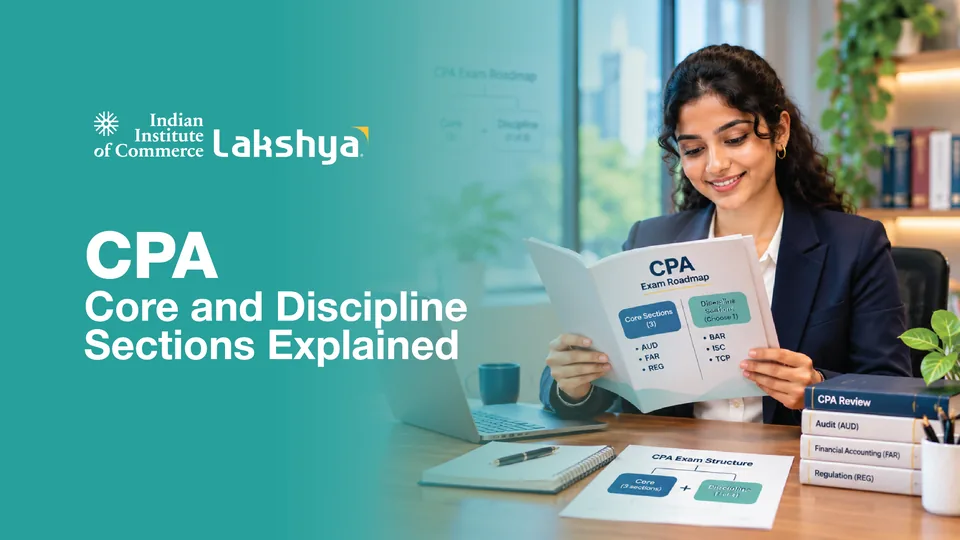
The US Certified Public Accountant (CPA) Exam follows a Core and Discipline structure designed to test both broad accounting knowledge and specialised professional skills. Candidates must pass three compulsory Core sections and select one of three Discipline sections. This structure ensures that every candidate demonstrates knowledge across essential accounting, auditing and taxation areas while developing deeper expertise in a field of their choice.
Understanding the difference between Core and Discipline sections helps candidates plan their preparation, select the right specialisation and manage their exam schedule. The choice of Discipline can be particularly important for candidates who already have experience in financial reporting, taxation, information systems or audit-related work.
What Are the Core and Discipline Sections of the CPA Exam?
The CPA Exam consists of three mandatory Core sections and one Discipline section selected from three available options. Candidates must pass all four sections to meet the examination requirement for CPA licensure.
The Core sections cover the fundamental knowledge expected of newly licensed CPAs, while the Discipline sections allow candidates to demonstrate deeper knowledge in a specialised area. Under this structure, candidates can choose a Discipline based on their academic background, professional interests and career goals.
The six sections are:
- Core sections: Auditing and Attestation (AUD), Financial Accounting and Reporting (FAR), and Taxation and Regulation (REG).
- Discipline sections: Business Analysis and Reporting (BAR), Information Systems and Controls (ISC), and Tax Compliance and Planning (TCP).
Each section has a four-hour examination. Candidates must earn a score of at least 75 on each section, and the examination order is flexible. Passing a particular Discipline does not create a different type of CPA licence; the qualification remains the same regardless of which Discipline a candidate passes.
CPA Core Sections Explained
The three Core sections test essential accounting and professional competencies that all CPA candidates must demonstrate. Candidates cannot skip any of these sections, regardless of their chosen Discipline or intended career specialisation.
1. AUD – Auditing and Attestation
AUD focuses on auditing procedures, attestation engagements, professional responsibilities and the evaluation of audit evidence. It assesses whether candidates can understand audit risks, evaluate internal controls and apply relevant standards when examining financial information.
Major areas covered include:
- Ethics, professional responsibilities and general auditing principles.
- Risk assessment and the development of audit responses.
- Obtaining and evaluating audit evidence.
- Reviewing audit findings and forming conclusions.
- Attestation engagements and related professional standards.
AUD is particularly relevant to candidates interested in external auditing, assurance, internal audit and risk-related roles. Candidates with audit experience may find some concepts familiar, but they must still understand the applicable standards and how to apply them to examination scenarios.
2. FAR – Financial Accounting and Reporting
FAR tests candidates' ability to understand, prepare and analyse financial statements under applicable accounting and reporting requirements. It covers a broad range of accounting concepts and requires candidates to apply technical knowledge to financial reporting situations.
Major areas covered include:
- Financial statement accounts and transactions.
- Financial reporting requirements and accounting standards.
- Recognition, measurement and presentation of financial information.
- Accounting for selected business transactions and entities.
- Not-for-profit accounting and other reporting topics included in the exam blueprint.
FAR is relevant to candidates pursuing financial accounting, financial reporting, controllership and technical accounting careers. Its broad coverage makes consistent practice important, particularly for candidates who need to strengthen their understanding of accounting treatments and reporting requirements.
3. REG – Taxation and Regulation
REG assesses candidates' understanding of taxation, business law and professional responsibilities associated with tax practice. The section requires candidates to apply relevant rules to tax situations and understand the legal and ethical obligations involved in professional work.
Major areas covered include:
- Federal taxation of individuals.
- Taxation of business entities and related transactions.
- Property transactions and tax implications.
- Business law concepts covered by the exam blueprint.
- Professional responsibilities and tax-related ethical requirements.
REG can be particularly relevant to candidates interested in tax compliance, tax advisory and related professional services. Candidates with taxation experience may recognise some concepts, but preparation must follow the US tax rules and examination requirements rather than relying on familiarity with another country's tax system.
CPA Discipline Sections Explained
The Discipline sections allow candidates to specialise in one of three areas: business analysis and reporting, information systems and controls, or tax compliance and planning. Candidates must choose and pass one Discipline, but they do not need to pass all three.
The best choice depends on the candidate's subject knowledge, interests and preferred area of professional development. Candidates should review the official exam blueprint for each option before making a decision.
1. BAR – Business Analysis and Reporting
BAR focuses on advanced financial reporting, financial analysis and related business reporting topics. It is suited to candidates who want to develop deeper knowledge of financial information and its use in evaluating organisational performance.
Major areas covered include:
- Financial statement analysis and interpretation.
- Technical accounting and advanced reporting topics.
- State and local government accounting.
- Financial planning, analysis and reporting concepts.
- Data-related concepts included in the BAR exam blueprint.
BAR may suit candidates interested in financial reporting, technical accounting, corporate finance analysis and financial planning and analysis (FP&A). It can also complement FAR preparation because the two sections include related financial reporting concepts, although BAR has its own distinct syllabus and examination requirements.
2. ISC – Information Systems and Controls
ISC focuses on information systems, IT-related controls, data management and technology-related assurance. It examines whether candidates understand how systems and controls support reliable information, protect data and help organisations manage technology-related risks.
Major areas covered include:
- Information systems and data management.
- IT governance and risk considerations.
- Information security, privacy and access controls.
- System and Organisation Controls (SOC) engagements.
- Technology-related risks and control evaluation.
ISC may be suitable for candidates interested in IT audit, systems assurance, technology risk, information security controls and related advisory roles. Candidates with experience in IT controls or systems auditing may find the subject familiar, but they should still prepare for the full scope of the exam blueprint.
3. TCP – Tax Compliance and Planning
TCP focuses on advanced tax compliance and planning, building on taxation concepts assessed in REG. It examines how tax rules apply to individuals and entities and how candidates evaluate tax-related decisions within the applicable legal framework.
Major areas covered include:
- Advanced individual taxation and tax planning.
- Tax compliance for business entities.
- Tax implications of business and property transactions.
- Tax planning strategies within applicable rules.
- Specialised tax situations included in the exam blueprint.
TCP may be a strong option for candidates interested in tax advisory, tax planning and specialised tax compliance. Candidates who take REG before TCP may find it useful to retain and build on recently studied taxation concepts, although the two sections test different levels and areas of knowledge.
CPA Core vs Discipline Sections: Key Differences
The main difference between Core and Discipline sections is their purpose: Core sections test essential competencies required of every candidate, while Discipline sections assess specialised knowledge in a chosen area.
| Feature | Core sections | Discipline sections |
|---|---|---|
| Number of sections required | All 3 | Any 1 of 3 |
| Sections included | AUD, FAR, REG | BAR, ISC, TCP |
| Main purpose | Test essential accounting competencies | Test specialised knowledge |
| Choice available | No | Yes |
| Exam duration | 4 hours per section | 4 hours per section |
| Passing score | 75 per section | 75 per section |
| Licence outcome | Same CPA licence | Same CPA licence |
Both types of sections are compulsory components of the overall examination pathway. The Discipline section does not replace a Core section, and candidates must meet all four examination requirements along with the applicable education, experience and other licensing requirements.
How to Choose the Right CPA Discipline Section?
Candidates should select a Discipline based on subject familiarity, professional interests and the type of work they want to pursue. The choice should reflect their ability to prepare for the syllabus rather than assumptions that one section is automatically easier than the others.
Choose BAR if You Prefer Financial Reporting and Analysis
BAR may suit candidates who enjoy financial statements, accounting standards, financial analysis and business performance evaluation. It is a relevant option for those considering technical accounting, reporting or FP&A-related career paths.
Candidates with a strong accounting background may find its subject areas familiar, particularly after studying FAR. However, they should review the BAR blueprint carefully to understand its specialised reporting and analysis requirements.
Choose ISC if You Prefer Technology and Controls
ISC may suit candidates who are interested in information systems, IT audit, technology risk and internal controls. It can be especially relevant to those who enjoy understanding how organisations protect information and maintain reliable systems.
Candidates do not necessarily need to be software developers to consider ISC. The key is to understand the subject matter covered by the blueprint and be comfortable learning about systems, security, controls and technology-related assurance.
Choose TCP if You Prefer Taxation
TCP may suit candidates who enjoy tax compliance, tax planning and analysing the tax consequences of financial decisions. It is a natural option for candidates who want to build specialised knowledge in tax-related services.
Candidates who are comfortable with REG's taxation topics may find the connection useful during preparation. However, TCP requires focused study of its own advanced content and should not be treated as a simple continuation of REG.
Do CPA Core and Discipline Sections Affect Your Career Options?
The Discipline section can help candidates build specialised knowledge, but it does not restrict the professional scope of the CPA licence by itself. Passing BAR, ISC or TCP does not mean that a candidate can only work in reporting, technology controls or taxation.
For example, a candidate who passes ISC may still pursue broader accounting or finance roles after obtaining the required licence and developing the relevant experience. Similarly, a candidate who selects TCP is not limited to tax-related work throughout their career.
Employers may consider a candidate's Discipline choice alongside work experience, technical skills, internships and career interests. The specialisation can help demonstrate subject knowledge, but career opportunities depend on a wider set of qualifications and capabilities.
For candidates planning a career in India or another country outside the United States, it is also important to distinguish passing the CPA Exam from obtaining a licence and meeting local professional requirements. The CPA qualification can support international accounting and finance careers, but local statutory practice rights depend on the applicable laws and regulations.
CPA Exam Preparation Strategy for Core and Discipline Sections
A well-planned CPA preparation strategy gives every section sufficient time while using relevant subject connections where possible. Candidates should plan around the four-hour format of each exam, their current knowledge and the credit period applicable to their licensing jurisdiction.
A practical approach includes:
- Begin with a realistic assessment: Review the official blueprints and identify topics that require the most preparation.
- Create a separate plan for each Core section: AUD, FAR and REG cover different subject areas and require dedicated study schedules.
- Select the Discipline early enough: Compare BAR, ISC and TCP before committing to a preparation plan.
- Use practice questions and simulations: Apply concepts to examination-style scenarios rather than relying only on reading or memorisation.
- Track progress with mock exams: Use results to identify weak areas and adjust revision time.
- Check exam scheduling rules: Core sections are generally available throughout the year, while Discipline sections follow designated testing windows. Confirm current dates and local scheduling requirements before booking.
- Monitor the examination credit period: The deadline for passing all four sections varies by jurisdiction, so candidates should verify the rules that apply to their application.
The objective is not simply to pass the Core sections first and leave the Discipline until the end. Candidates should create a sequence that supports consistent preparation and allows them to complete all four sections within the applicable timeframe.
Frequently Asked Questions
How many Core sections are there in the CPA Exam?
There are three Core sections: Auditing and Attestation (AUD), Financial Accounting and Reporting (FAR), and Taxation and Regulation (REG). Every CPA candidate must pass all three.
How many Discipline sections must I take?
Candidates must pass one Discipline section from BAR, ISC or TCP. They are not required to take all three Discipline examinations.
Can I choose any CPA Discipline section?
Yes, candidates can choose BAR, ISC or TCP, subject to the applicable examination rules. They should compare the syllabus, subject strengths and career interests before making their selection.
Is BAR harder than ISC or TCP?
There is no universally hardest Discipline section for every candidate. The level of difficulty depends on subject familiarity, preparation quality and individual strengths. Reviewing the official blueprints and sample questions is more useful than relying only on general difficulty rankings.
Does my CPA Discipline determine my licence?
No. Passing BAR, ISC or TCP leads to the same CPA licence, provided all examination and other licensing requirements are met. The Discipline does not independently restrict the professional scope of the licence.
Can I take a Discipline section before completing all Core sections?
Yes, candidates may take the Discipline section before or after the Core sections. They should confirm their eligibility and plan their examination schedule according to the applicable rules.
Is the CPA Exam the same for candidates in India and the United States?
The Uniform CPA Exam tests the same core examination framework for eligible candidates, but application, evaluation, scheduling and licensing arrangements can differ by jurisdiction. International candidates should check the requirements of the relevant US state board and the authorised examination process for their location.
Related Blogs