US CPA Admission 2026 for Indian Students: Eligibility, Fees & Application Process
Last Updated On -23 Sep 2026
By Sajith R S
Somewhere between finishing your degree and choosing your next move, the CPA Course starts turning up everywhere. A senior mentions it, a recruiter includes it in a job post, and the salary numbers are hard to ignore.
So what is it, really, and does it fit you?
That is what this CPA admission guide answers: What the US CPA is, who it suits, how admission and registration work when you apply from India, the fees to budget for in 2026, and the jobs it can lead to.
What is the CPA Course?
CPA is short for Certified Public Accountant. Think of it as one of the leading accounting licences in the United States, issued by US state boards. The Uniform CPA Exam is supported by the AICPA, NASBA, and Prometric. Anyone searching for CPA USA or the US CPA course usually means the same thing: the education, four exam sections, and licensing steps that lead towards becoming a CPA.
Why do employers care? US firms, the Big 4, and India’s growing number of Global Capability Centres all need professionals who understand US GAAP, audit, and taxation. A CPA certification provides clear evidence of that knowledge. While some qualifications continue through several levels, the CPA course is built around four exam sections.
Who Should Consider the CPA Course?
Not everyone needs a CPA. It earns its place when you see yourself working in an MNC, a GCC, or a Big 4 finance team. It suits CAs and CA Inter students looking for a global profile, as well as early-career professionals in audit, tax, or reporting who want to move into broader roles.
Here is the honest caveat. If your entire plan is to practise Indian statutory audit, the Indian CA still has the advantage because a US CPA cannot sign statutory audits in India. Decide which role you want first, and then let the credentials follow.
CPA Eligibility for Indian Students
Now for the part that confuses most applicants: credit hours. CPA eligibility for Indian students follows the American education system, where one year of study is generally treated as roughly 30 semester credits.
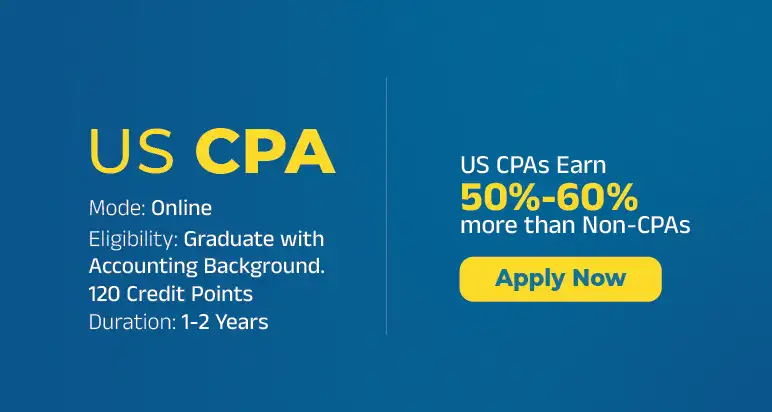
Two numbers still guide most applicants. About 120 credits are commonly required to sit for the CPA exam, while 150 credits remain part of the traditional licensure pathway. However, state rules are evolving, and some jurisdictions now recognise alternative routes to licensure. The current requirements of your chosen state board are what ultimately matter.
Your CPA eligibility is not only about the total count. Boards also examine the subjects listed on your transcript, often looking for around 24 accounting credits along with business credits in areas such as taxation, auditing, law, and economics. If a required subject is missing, a high overall credit total may not be enough. These subject-specific conditions are an important part of the CPA admission requirements.
You can explore the US CPA eligibility criteria in India before choosing a state board.
CPA Admission After BCom
A three-year B.Com in India is often evaluated at around 90 credits. That can leave you short of the common 120-credit exam requirement and below the traditional 150-credit licensure pathway. This catches many fresh graduates off guard.
The gap is usually manageable. An M.Com, MBA or recognised postgraduate diploma may help you reach the required credit level. Some boards may also allow you to sit the exam after meeting the examination requirement and complete the remaining education later.
So, CPA admission after BCom is possible. It simply requires you to understand your credit gap and choose the right additional qualification.
CPA Admission After CA
Already a CA? You may be in a strong position. Depending on the state board and credential evaluator, ICAI qualifications and training can add valuable academic credits. The syllabus overlap can also make parts of CPA preparation more familiar.
Many CAs—and some CA Inter holders with a degree may begin closer to the required credit threshold. This makes CPA admission after CA one of the smoother routes into the qualification, although your transcripts must still be evaluated individually.
The CPA Admission Process Step by Step
So, how do you apply for the CPA Course from India? The CPA admission process looks complicated on paper, but it comes down to four main steps. These are the basic steps to become a CPA.
- Pick your state board carefully. Each state board sets its own rules, so choose one that suits your educational background and licensing plans. Montana, Guam, Alaska, and Washington often appear in discussions among Indian applicants. Avoid boards that require a US Social Security Number if you do not have one.
- Send your credentials for evaluation. Submit your transcripts to an agency accepted by your chosen board, such as NASBA International Evaluation Services or WES, where applicable. The evaluator will calculate your total accounting and business credits.
- Register for the exam. Once your evaluation is approved, apply through the board, pay the required fees, and receive your Notice to Schedule, commonly called the NTS. This completes the main CPA exam registration stage.
- Book your exam seat. With the NTS in hand, schedule your chosen exam section through Prometric.
Candidates applying from India can take the CPA Exam at approved international testing centres after meeting the eligibility conditions and paying the applicable international administration fee.
Booking all four sections at once rarely goes exactly to plan. The CPA application process and the CPA registration process both reward patience. For many students, planning one section at a time creates a more realistic schedule.
For a closer look at each stage, read our guide on how to register for the CPA Exam.
Documents Required for CPA Admission
Gather these documents before you begin. The documents required for CPA admission are straightforward, but incomplete or inconsistent paperwork can delay the entire process.
- Year-wise marksheets and official transcripts
- Your degree certificate, along with CA documents if applicable
- A valid passport for identity verification
- Your course syllabus, if requested by the evaluation agency
Applications often stall because of mismatched names or a missing marksheet. Check these details early rather than trying to correct them after submission.
CPA Exam Structure and Course Duration
The exam changed in January 2024 under a model called CPA Evolution, and that structure continues in 2026. You must complete three compulsory Core sections and one Discipline section of your choice.
|
Type |
Sections |
|
Core—taken by every candidate |
AUD, FAR, and REG |
|
Discipline—choose one |
BAR, ISC, or TCP |
Each section lasts four hours, and a scaled score of 75 is required to pass. Core sections are generally available throughout the year, while Discipline sections are offered during set testing windows. In 2026, Discipline sections are scheduled during the first month of each quarter.
Once you pass your first section, your exam-credit window begins. Many boards now use a 30-month window rather than the older 18-month rule, but the exact policy depends on your jurisdiction. Confirm the rule with your chosen state board before finalising your exam plan.
For the CPA course duration, plan for around 12 to 18 months. Studying alongside a full-time job may place you towards the longer end, while full-time candidates may progress sooner.
CPA Course Fees for Indian Students
CPA course fees fall into two main categories: payments made to US bodies and the cost of coaching and study materials. The US portion is charged in dollars, so your final rupee amount will move with the exchange rate.
|
Component |
Rough cost |
|
Credential evaluation |
$225–$400, one time |
|
Exam fee per section |
About $260 |
|
International testing fee |
About $500 per section |
|
Licence application |
$50–$500 |
These amounts are estimates because examination, application, evaluation, and licensing charges differ by state board. International candidates must also pay an additional administration fee for each section taken at an overseas testing centre.
The international testing fee changed in 2026, so always check the live amount on NASBA before making a payment. With coaching and study materials included, many Indian candidates budget between ₹3.5 lakh and ₹6 lakh overall. If you need to retake a section, your CPA fees will increase because the relevant examination and testing charges must be paid again.
Our detailed CPA course fees guide explains the cost components further.
Career Scope and Salary After the CPA
Once you clear the exams and meet the relevant licensing requirements, the strongest opportunities are usually found in the Big 4, Global Capability Centres, and MNC finance teams. Common areas include US GAAP reporting, audit support, taxation, controllership, and advisory services.
Deloitte, PwC, EY, and KPMG recruit professionals for many of these functions, alongside the finance divisions of major technology, consulting, and banking organisations.
When looking at CPA salary figures, remain cautious about headline numbers. Pay varies by employer, city, role, prior qualification, and work experience. A reasonable starting benchmark for freshers is around ₹7 lakh to ₹12 lakh per year, while professionals with relevant experience may earn considerably more.
Treat these numbers as broad estimates, not promised outcomes. Our guide to CPA salary in India and abroad offers a more detailed comparison by role and location.
Also Read
- What is CPA Course?
- CPA USA for Finance Managers - How Mid-Career Professionals Are Using It to Break the Ceiling?
- Career Benefits of Doing CPA
- CPA USA for IT and Non-Finance Professionals Moving Into Accounting Roles
- How to Clear CPA in First Attempt?
Is the CPA Course Right for You?
Cut through the noise, and the CPA Course remains one of the most respected accounting credentials for professionals interested in US accounting, audit, taxation, and global finance roles. It is also more accessible to Indian candidates now that the complete exam can be taken at authorised centres in India.
What separates students who finish from those who stall is often planning, not ability. The right state board, an honest assessment of your credits, and a study timeline you can maintain will usually serve you better than rushing into every section.
Not sure where your qualifications leave you? That is normal, and it is worth checking before you register. Mentors at IIC Lakshya offer free counselling to review your CPA eligibility and help map a section plan around your weekly schedule.
Get the groundwork right, and the CPA stops feeling like a gamble. It becomes a clear, manageable professional pathway.
Related Blogs