

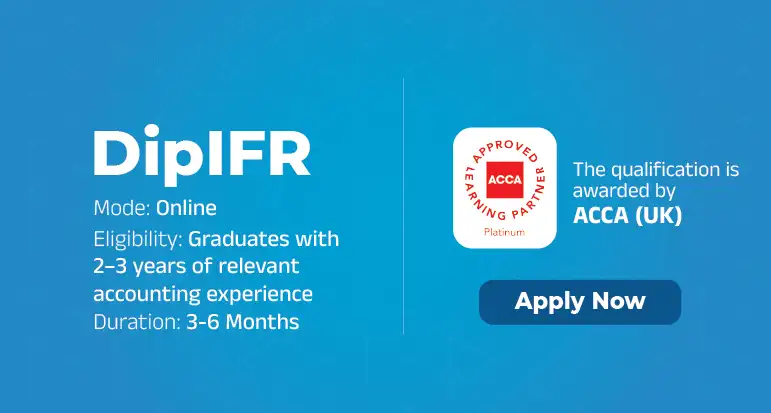
DipIFRS vs. ACCA SBR
Last Updated On -18 Sep 2026
By Nishtha Singh

Professionals looking to specialise in international financial reporting often compare the ACCA Diploma in International Financial Reporting (DipIFRS) with ACCA Strategic Business Reporting (SBR). Both qualifications develop knowledge of IFRS and financial reporting, but they are designed for different audiences and sit at different levels of professional development. DipIFRS is a specialised qualification focused on international financial reporting, while SBR is an advanced ACCA Strategic Professional examination that develops broader reporting, analysis, professional judgement, and strategic skills.
The better choice therefore depends on your current qualification, experience, career goals, and whether you want a standalone IFRS credential or are progressing through the complete ACCA qualification.
What Is DipIFRS?
The ACCA Diploma in International Financial Reporting, commonly known as DipIFRS, is a specialised qualification designed to develop practical knowledge of International Financial Reporting Standards. It can be particularly useful for accountants, auditors, finance professionals, and other professionals who want to strengthen their IFRS expertise without completing the entire ACCA qualification.
DipIFRS focuses heavily on:
-
IFRS principles
-
Financial reporting
-
Recognition and measurement
-
Group accounting
-
Presentation and disclosure
-
Practical application of IFRS
-
Financial reporting scenarios
-
Professional judgement
It is therefore particularly relevant for professionals whose current or planned role involves financial reporting.
What Is ACCA SBR?
Strategic Business Reporting (SBR) is one of the Strategic Professional examinations within the ACCA qualification. It builds on the financial reporting knowledge developed earlier in the ACCA journey and expects candidates to apply that knowledge at a more advanced level.
SBR places greater emphasis on:
-
Complex financial reporting
-
Professional judgement
-
Ethical considerations
-
Interpretation of reporting requirements
-
Analysis of financial reporting issues
-
Stakeholder perspectives
-
Corporate reporting
-
Strategic decision-making
SBR is therefore not simply an IFRS knowledge paper. It forms part of a broader professional qualification designed to develop accountants for senior and strategic roles.
DipIFRS vs SBR: The Key Difference
The biggest difference is the purpose of the two qualifications. DipIFRS is a specialised IFRS qualification, while SBR is an advanced component of the ACCA professional qualification.
In simple terms:
| Area | DipIFRS | ACCA SBR |
|---|---|---|
| Qualification type | Specialised IFRS diploma | ACCA Strategic Professional exam |
| Main focus | International financial reporting | Strategic business reporting |
| Target audience | Finance and accounting professionals | ACCA students |
| IFRS emphasis | High | High |
| Strategic emphasis | More limited | Strong |
| Professional judgement | Important | Very important |
| Career scope | Reporting and IFRS-focused | Broader senior accounting careers |
| Part of ACCA qualification | No | Yes |
| Best suited for | IFRS specialisation | Full ACCA progression |
This difference is important when deciding which qualification provides greater value for your specific career path.
Which Is Harder: DipIFRS or SBR?
There is no universal answer because difficulty depends on the candidate's accounting background and professional experience. However, SBR is generally considered the more advanced qualification because it sits at the Strategic Professional level of the ACCA pathway and requires candidates to demonstrate broader professional judgement and application skills.
DipIFRS can still be challenging because it requires candidates to understand and apply a wide range of IFRS requirements. Candidates without strong financial reporting experience may find topics such as group accounting, financial instruments, leases, impairment, and income taxes particularly demanding.
SBR can feel harder because candidates are expected to:
-
Analyse complex reporting issues
-
Apply IFRS in unfamiliar situations
-
Demonstrate professional judgement
-
Consider ethical implications
-
Evaluate alternatives
-
Communicate conclusions professionally
-
Consider the needs of different stakeholders
How Difficult Is DipIFRS?
DipIFRS requires candidates to move beyond memorising IFRS standards. The examination expects candidates to apply reporting requirements to practical scenarios, which means strong conceptual understanding and question practice are important.
Topics that can require substantial preparation include:
-
Group accounting
-
IFRS 9
-
IFRS 15
-
IFRS 16
-
IAS 12
-
IAS 36
-
IAS 37
-
Foreign currency transactions
-
Financial statement presentation
Candidates with previous financial reporting experience may find the qualification more manageable, while professionals who have not worked extensively with IFRS may require a longer preparation period.
How Difficult Is ACCA SBR?
SBR takes financial reporting to a more advanced level. Candidates are expected to understand the technical requirements but also demonstrate why a particular treatment is appropriate and how financial reporting decisions affect stakeholders.
The difficulty comes from the need to combine:
-
Technical IFRS knowledge
-
Scenario analysis
-
Professional judgement
-
Ethics
-
Communication
-
Interpretation
-
Evaluation
-
Strategic thinking
This means that simply memorising accounting standards is unlikely to be sufficient for strong SBR performance.
Which Qualification Has More IFRS Focus?
DipIFRS has a very direct IFRS focus because international financial reporting is the central purpose of the qualification. Candidates who want a dedicated credential demonstrating knowledge of IFRS may therefore find DipIFRS particularly relevant.
SBR also has a strong IFRS component, but it places that knowledge within a wider professional and strategic context. The objective is not merely to test whether candidates know an accounting standard but whether they can apply it appropriately in complex business circumstances.
If your primary goal is IFRS specialisation, DipIFRS can be a focused option. If your goal is advanced ACCA-level professional development, SBR provides a broader pathway.
Which One Gives Better Career Value?
Career value depends heavily on what you want to do. A qualification does not automatically provide greater career value simply because it is more difficult. Employers consider your experience, technical skills, professional qualifications, job responsibilities, and the relevance of the qualification to the position.
DipIFRS can be valuable for professionals targeting:
-
Financial reporting
-
IFRS reporting
-
Accounting roles
-
Audit
-
Financial control
-
Reporting advisory
-
Finance operations
-
IFRS implementation
SBR can provide broader value for candidates progressing through ACCA towards roles such as:
-
Finance manager
-
Financial controller
-
Reporting manager
-
Audit manager
-
Finance business partner
-
Senior accountant
-
Corporate reporting professional
-
Finance leadership roles
Is DipIFRS Better for Working Professionals?
For an experienced working professional who does not need the full ACCA qualification, DipIFRS can be a practical way to strengthen IFRS expertise. The qualification allows professionals to focus specifically on international financial reporting rather than completing an entire professional qualification.
It can be particularly relevant when a professional wants to:
-
Strengthen existing accounting knowledge
-
Move into IFRS reporting
-
Work with multinational organisations
-
Improve financial reporting expertise
-
Support international reporting projects
-
Add an IFRS-focused credential to existing qualifications
The value is strongest when the qualification complements relevant accounting or finance experience.
Is SBR Better for ACCA Students?
For ACCA students, SBR is the natural choice because it is part of the Strategic Professional level. Passing SBR contributes directly towards completion of the ACCA qualification, subject to the other ACCA requirements.
SBR is particularly relevant if your long-term objective is to become an ACCA member and build a broader professional accounting career.
It can support progression towards roles involving:
-
Financial reporting
-
Audit
-
Accounting advisory
-
Finance management
-
Corporate reporting
-
Business analysis
-
Strategic finance
Which Is Better for IFRS Careers?
If your career objective is specifically centred around IFRS, both qualifications can be useful, but they serve different purposes. DipIFRS offers a specialised qualification that directly signals an interest and competence in international financial reporting. SBR provides advanced financial reporting knowledge as part of a much broader professional qualification.
For someone already qualified or experienced in accounting, DipIFRS can provide targeted IFRS specialisation. For an ACCA student, completing SBR is more strategically relevant because it contributes to the overall ACCA qualification.
Which Is Better for Audit Professionals?
Both can be relevant to audit professionals because understanding IFRS is essential when auditing financial statements prepared under IFRS. The appropriate choice depends on the individual's existing qualifications and career stage.
DipIFRS may be useful for an auditor who wants to strengthen their IFRS knowledge without pursuing the complete ACCA qualification. SBR may be more valuable for an ACCA student or professional progressing towards senior audit and assurance positions.
For senior audit roles, however, qualification alone is not enough. Practical audit experience, technical research skills, professional judgement, and knowledge of auditing standards are also important.
Which Is Better for Financial Reporting Professionals?
For professionals working specifically in financial reporting, DipIFRS can be a highly relevant specialisation because the qualification is directly focused on international financial reporting. It can help reinforce technical knowledge that is useful when preparing or reviewing IFRS financial statements.
SBR can provide additional value when the professional is progressing towards broader management responsibilities because it combines reporting knowledge with professional judgement and wider business considerations.
The better choice depends on whether your priority is specialisation or broader professional progression.
DipIFRS vs SBR: Which One Should You Choose?
Your decision should begin with your current career stage rather than simply comparing the difficulty of the examinations.
Choose DipIFRS if:
-
You want a focused IFRS qualification
-
You already work in accounting or finance
-
You want to specialise in financial reporting
-
You do not necessarily want to complete ACCA
-
You need practical IFRS knowledge for your current role
Choose SBR if:
-
You are pursuing the ACCA qualification
-
You want an advanced professional accounting qualification
-
You want broader career opportunities
-
You are preparing for senior finance or accounting roles
-
You want to develop professional judgement alongside IFRS expertise
Can DipIFRS and SBR Be Useful Together?
Yes. The two qualifications can complement each other when pursued at different stages of a finance career. DipIFRS provides concentrated exposure to international financial reporting, while SBR develops more advanced reporting and professional skills within the ACCA framework.
However, pursuing both is not automatically necessary. Candidates should consider whether the additional qualification adds meaningful value to their career objectives, rather than collecting credentials without a clear professional purpose.
Which Qualification Is Better for Career Growth?
For long-term career growth, SBR generally has broader value when it is part of completing the ACCA qualification. ACCA provides a wider professional framework covering financial management, taxation, audit, performance management, reporting, and strategic skills.
DipIFRS can provide strong targeted value when the candidate's career specifically requires IFRS expertise. It can therefore work particularly well as a specialisation alongside an existing accounting qualification or professional background.
A useful way to think about the difference is:
DipIFRS = IFRS specialisation
SBR = Advanced reporting + professional judgement + ACCA progression
How Coaching Can Help With DipIFRS Preparation
Choosing between the ACCA Diploma in International Financial Reporting (DipIFR) and ACCA Strategic Business Reporting (SBR) depends on your current academic standing and long-term professional objectives. DipIFR serves as a standalone, specialized credential designed for qualified accountants and experienced finance professionals who need deep, targeted mastery of IFRS and complex consolidation mechanics. Conversely, SBR sits at the Strategic Professional level of the full ACCA qualification, integrating advanced IFRS technical knowledge with ethical evaluation, strategic management, and multi-stakeholder reporting. To streamline your exam preparation and maximize performance on scenario-based papers, enrolling at IIC Lakshya an ACCA Approved Platinum Learning Partner provides structured mentoring, official study resources, and targeted revision support.
Frequently Asked Questions (FAQs)
Is DipIFRS easier than ACCA SBR?
DipIFRS and SBR are designed for different purposes, so difficulty varies by candidate. SBR is generally more advanced because it is a Strategic Professional-level ACCA examination and requires broader professional judgement and application.
Is DipIFRS equivalent to ACCA SBR?
No. DipIFRS and ACCA SBR are separate qualifications with different purposes. DipIFRS is a specialised international financial reporting qualification, while SBR is an advanced examination within the ACCA qualification.
Which is better for an IFRS career?
DipIFRS can be particularly suitable for professionals seeking focused IFRS specialisation. SBR can be more valuable for ACCA students who want advanced reporting knowledge as part of a broader professional accounting qualification.
Can I take DipIFRS without doing ACCA?
Yes. DipIFRS is a standalone qualification and does not require you to complete the entire ACCA qualification.
Is SBR useful for financial reporting jobs?
Yes. SBR develops advanced financial reporting knowledge, professional judgement, and communication skills that can be relevant to financial reporting, accounting, audit, and finance management roles.
Should an ACCA student choose DipIFRS instead of SBR?
If you are already pursuing ACCA, SBR is generally the more logical choice because it forms part of the ACCA qualification. DipIFRS may be more appropriate as a specialised IFRS qualification for professionals who are not pursuing the complete ACCA pathway.
Related Blogs