
How Lakshya is helping CPA Coaching with One-to-One Mentoring for Working Professionals?
Last Updated On -04 Nov 2026
Preparing for the US CPA exam alongside a full-time job takes more than access to study materials. You need a study plan that fits your schedule, clear guidance when concepts get difficult, and support to stay consistent through busy weeks at work.
The right CPA coaching brings these elements together. At IIC Lakshya, one on one mentoring gives working professionals personal guidance on planning their preparation, addressing weaker areas and adjusting their study targets as work demands change.
This guide explains how that support works, along with the exam structure, eligibility requirements and career opportunities you should understand before starting your US CPA course.
Why CPA Coaching Needs a Mentor for Working Professionals
The US CPA exam calls for consistent preparation. According to the AICPA, full-year 2025 pass rates were 42% for FAR and 48% for AUD. The AICPA also points out that pass rates reflect how prepared candidates are, not just how hard a section is.
For someone with a full-time job, preparation often breaks down for practical reasons rather than academic ones. In our counselling sessions, we hear the same concerns again and again:
- Unpredictable work hours: Audit season, quarter-end closes and client deadlines wipe out planned study weeks.
- Studying alone: Recorded lectures are useful, but nobody notices when you skip three days in a row.
- Losing momentum after a failed section: Many candidates pause for months after one low score.
- The credit clock: Once you pass your first section, you have a fixed window to clear the rest.
- Doubts that pile up: Small gaps in US GAAP or US tax concepts turn into bigger problems in task-based simulations.
A one on one mentoring model addresses these issues directly. Your mentor tracks your progress, adjusts your plan when work gets heavy, and helps you stay accountable without adding unnecessary pressure. For a working professional, that support can make it easier to keep going when preparation becomes difficult.
CPA Exam Structure in 2026 at a Glance
The CPA exam has four sections of four hours each. You must pass all three Core sections and one Discipline section of your choice. Any Discipline leads to the same CPA license.
|
Section |
Type |
What it tests |
Duration |
|
AUD: Auditing and Attestation |
Core |
Audit process, risk assessment, ethics |
4 hours |
|
FAR: Financial Accounting and Reporting |
Core |
US GAAP financial reporting |
4 hours |
|
REG: Taxation and Regulation |
Core |
US federal tax, business law, ethics |
4 hours |
|
BAR: Business Analysis and Reporting |
Discipline |
Advanced reporting and data analysis |
4 hours |
|
ISC: Information Systems and Controls |
Discipline |
IT systems, controls, data security |
4 hours |
|
TCP: Tax Compliance and Planning |
Discipline |
Individual and entity tax planning |
4 hours |
A few exam realities every working candidate should plan around:
- Format: Each section has two testlets of multiple-choice questions and three of task-based simulations. The passing score is 75 on a 0 to 99 scale.
- Testing dates: Core sections are available year-round. Discipline sections run in quarterly windows, with scores generally released about six weeks after each window closes.
- Credit window: NASBA recommends 30 months to pass all four sections after your first pass. Each state board sets its own rule, so confirm yours.
- Tax updates: From 1 July 2026, REG and TCP test eligible provisions of the H.R. 1 tax law. Check that your notes reflect the applicable updates.
- Testing in India: NASBA lists India as an international test location, with an extra administration fee of US$460 per section. Candidates can book through Prometric, subject to centre and appointment availability.
CPA Eligibility for Indian Working Professionals
Eligibility works in two stages: the rules to sit for the exam, and the rules to get licensed. Both are set by the US state board you apply through, not by a central body.
To sit for the exam:
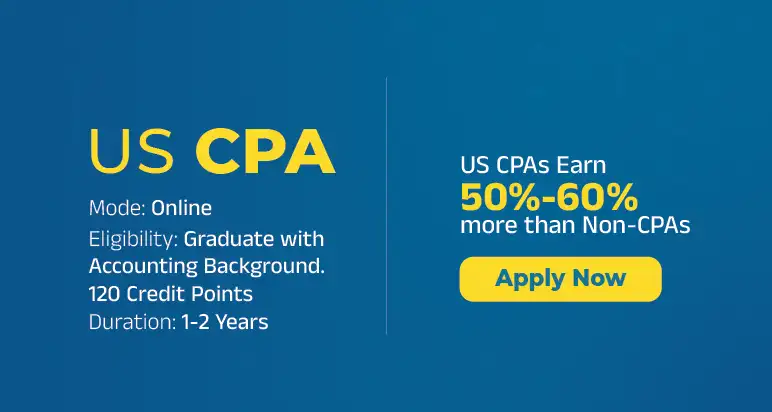
- Most state boards look for around 120 semester credits with a set number of accounting and business subjects.
- Indian degrees need a credential evaluation to determine their US credit equivalence.
- A three-year B.Com may fall short of the required credits on its own. Many candidates add an M.Com, an MBA or a professional qualification such as CA, depending on what their chosen board and evaluating agency accept.
To get licensed: The model law now recognises three pathways, all requiring the relevant accounting concentration and a pass on the CPA exam:
- A master's degree plus one year of experience
- A bachelor's degree with 150 credits plus one year of experience
- A bachelor's degree with 120 credits plus two years of experience
Individual states must adopt these pathways before candidates can use them, and implementation dates vary.
The third pathway may offer more flexibility for working professionals. If you already work in accounting, audit or tax, your current job may count towards the experience requirement, provided it meets your state's rules for qualifying work and verification. Since rules differ by state and by evaluating agency, review your likely credit count with a mentor and confirm the board's requirements before you pay any application fees.
How Lakshya's One-to-One Mentoring Programme Works?
At IIC Lakshya, the one-to-one mentoring programme is built around a simple idea: your study plan should fit your job, not the other way round. Here is how the process usually runs for a working professional:
- Profile and eligibility review: Your mentor looks at your degree, likely credit count, target state and weekly work pattern before you register for anything.
- Section order planning: Together, you decide which section to take first. An audit associate may start with AUD, while someone in a reporting role may prefer FAR.
- A personal weekly study plan: The plan uses the hours you actually have. Lighter targets go into audit season or quarter-end, and heavier ones into quieter months.
- Regular one-on-one check-ins: Short review calls cover what you finished, where you got stuck and what needs to change next week.
- Doubt clearing on demand: You get support on the topics holding you back, alongside your regular lectures.
- Mock exams with feedback: Your mentor reviews full-length mocks, with extra focus on task-based simulations and time management.
- Retake and credit window planning: If a section does not go your way, the plan is adjusted promptly with your remaining credit window in mind.
These sessions run alongside CPA online coaching, so you can attend from home or office. Mentoring also supports your career planning. As part of a career mentoring program, it helps you link your Discipline choice and study timeline to the roles you want next.
Group CPA Review Classes vs One-to-One Mentoring
Group CPA review classes and one-to-one mentoring work well together. Most candidates benefit from good content plus personal guidance. The table shows where each one helps.
|
Factor |
Group CPA review classes |
One-to-one mentoring |
|
Study plan |
Same schedule for the whole batch |
Built around your job and section order |
|
Pace |
Fixed by the batch |
Adjusted week by week |
|
Doubt clearing |
During or after class |
Personal sessions on your weak areas |
|
Accountability |
Mostly self-driven |
Regular check-ins with your mentor |
|
Busy-season changes |
Can be hard to catch up on missed classes |
Plan is reset around work peaks |
|
Best suited for |
Students with free, regular hours |
Working professionals with changing schedules |
If you have predictable evenings and strong self-discipline, CPA exam prep courses with group classes may be enough. If your calendar changes every month, mentoring can help you avoid gaps in preparation that lead to delays or retakes.
Common CPA Exam Preparation Mistakes to Avoid
A failed attempt does not necessarily mean you struggled with the subject. Often, the preparation plan needs attention. These are the mistakes our mentors see most often in CPA exam preparation:
- Booking a section before you have a plan: A fixed exam date with no weekly plan behind it can create more pressure than progress.
- Choosing a Discipline by pass rate alone: Pick BAR, ISC or TCP based on your job and career goals. The AICPA itself warns against reading too much into pass rates.
- Skipping simulations: Task-based simulations carry around half the score in most sections. Practising only MCQs leaves you underprepared.
- Studying from outdated material: With new tax provisions tested from July 2026, older REG notes can mislead you.
- Ignoring the credit clock: Keep track of when your first section credit expires so you can plan the remaining sections in time.
- Going quiet after a low score: A long break after a failed section can make it harder to return to a steady study routine.
- Leaving evaluation to the end: Finding a credit shortfall after months of study is avoidable with an early check.
Career Scope, Jobs and Salary After CPA in India
A US CPA can open doors to roles that serve US clients and US-listed companies from India. Common opportunities for CPAs in India include:
- Big 4 and mid-size audit firms: US audit, SOX and advisory teams
- Global capability centres (GCCs): Finance and controllership teams of US and multinational companies
- Outsourced accounting and tax firms: Bookkeeping, reporting and tax work for American clients
- Indian companies with US links: Finance teams handling US operations or US listings
Your Discipline choice can also support the path you want to pursue:
- BAR: Financial reporting, technical accounting and FP&A roles
- ISC: IT audit, SOX compliance, risk and controls
- TCP: US tax preparation, review and planning
Salary realities: Pay varies widely by employer, city and the experience you bring, so we avoid quoting fixed packages. The CPA is most useful when you can pair it with relevant experience. A candidate with two to four years in audit or reporting may receive a stronger response from recruiters than a fresher with the same credential. Treat the CPA as a career accelerator, not a guarantee of a particular salary.
Future prospects: US finance work handled by teams in India creates opportunities for professionals who understand US GAAP, US auditing standards and US tax. The focus on data and technology in BAR and ISC also reflects the skills increasingly relevant to finance roles.
How to Choose the Best CPA Coaching in India?
Many CPA certification courses look alike on paper. Before you join any CPA institute in India, ask these questions:
- Will I have a named mentor? Ask how often you will speak with them and how quickly they reply to doubts.
- Is the material current? It should follow the latest AICPA blueprints and the applicable tax provisions in REG and TCP.
- How much simulation practice is included? Look for regular task-based simulation practice and full-length mocks.
- Do they help with eligibility? Good CPA coaching in India covers guidance on credential evaluation, state board selection and the application process.
- Does the schedule suit a job? Evening, weekend and CPA online coaching options matter when your work hours change.
- Are results and fees clear? Ask for verifiable results and a full fee breakdown, including exam and evaluation costs.
- What happens after the exam? Ask what licensing support and career guidance are available, and what each includes.
You can also review US CPA course fees and duration before you decide.
Also Read
- Why Should You Do CPA? Complete Career Benefits Guide
- Best CPA Study Materials
- CPA Exam Memory Tips
- What Is AICPA? Role in the CPA Exam & Accounting Profession
- How to Become a CPA in India in 2026?
Choosing CPA Coaching That Fits Your Job
Passing the US CPA while working full-time is realistic, but it takes careful planning. You need a plan that respects your work calendar, steady practice on simulations, and someone who notices when you start to slip. That is the real value of CPA coaching with one on one mentoring.
Before you commit to a course, get clarity on three things: your eligibility, your section order and the weekly hours you can realistically give. If you would like help with that, the academic mentors at IIC Lakshya offer a free counselling session to review your profile and discuss a realistic CPA timeline. You can book one through our free career counselling page.
Related Blogs