
CBE Exams in FIA
Last Updated On -17 Sep 2026
By Nishtha Singh
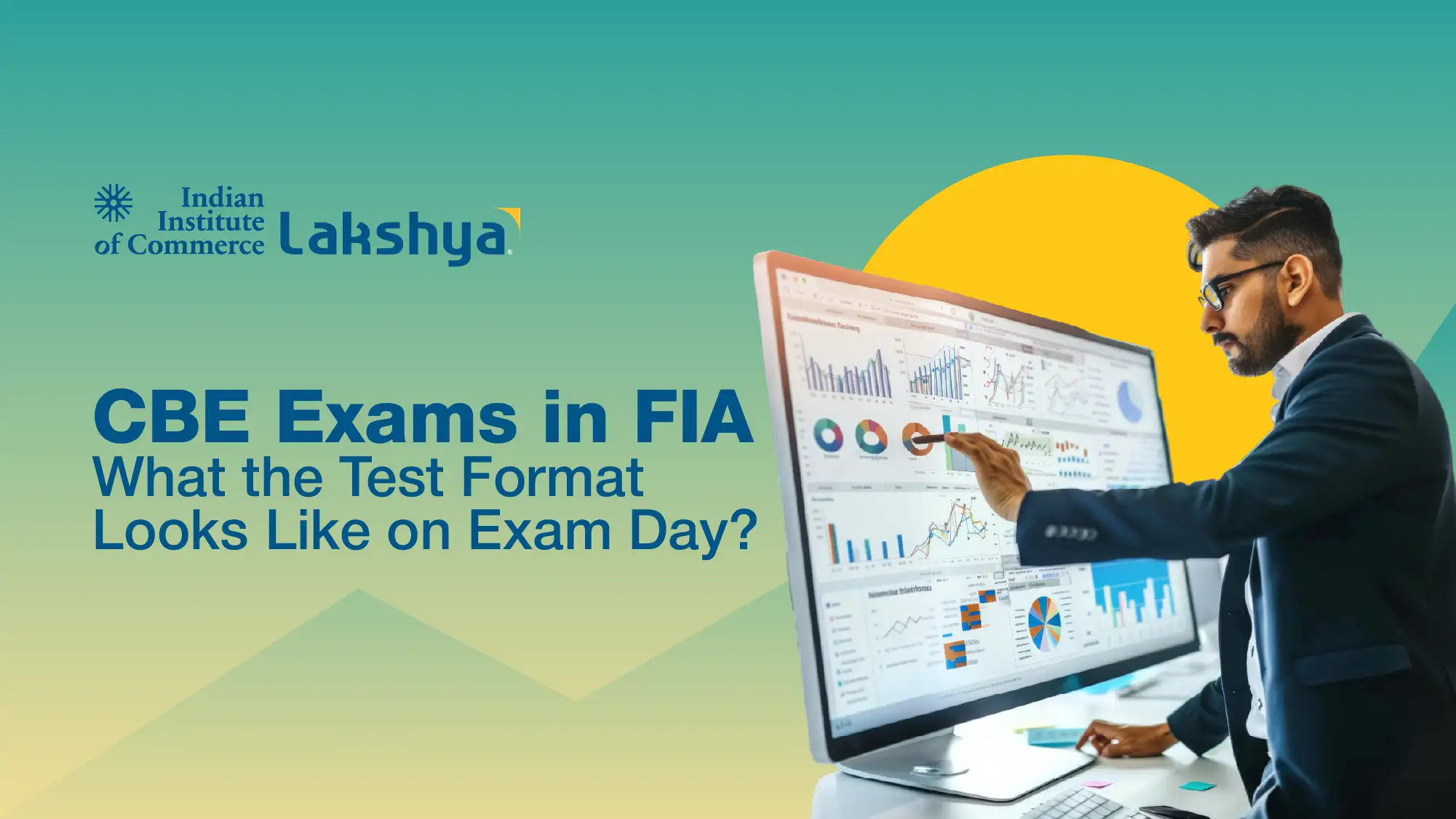
If you're preparing for your first Foundations in Accountancy (FIA) exam, one of the biggest concerns is often "What actually happens on exam day?" Unlike traditional paper-based examinations, FIA exams are conducted as Computer-Based Exams (CBEs), allowing students to answer questions digitally at an approved ACCA CBE centre. The computer-based format not only makes the examination process faster but also reflects the technology-driven environment used by modern accounting professionals.
Many students are comfortable with the syllabus but feel nervous simply because they have never taken a computer-based professional exam before. Understanding how the exam works—from booking your exam to receiving your results—can help reduce anxiety and allow you to focus on demonstrating your knowledge.
This guide explains exactly what to expect during an FIA CBE, including the exam structure, question types, marking process, and useful tips to help you perform confidently.
What is an FIA Computer-Based Exam (CBE)?
A Computer-Based Exam (CBE) is an examination that is completed entirely on a computer rather than using pen and paper. Students answer objective questions directly on the exam screen, and the system automatically records their responses.
The FIA qualification uses on-demand CBEs, meaning students can schedule their exams throughout the year at approved ACCA examination centres instead of waiting for fixed examination sessions. For most FIA papers, results are displayed immediately after the exam, making the process quicker and more flexible.
Which FIA Papers Are Computer-Based?
The FIA qualification is delivered through computer-based examinations, making the learning and assessment process consistent throughout the programme.
The on-demand FIA CBE papers include:
- FA1 – Recording Financial Transactions
- MA1 – Management Information
- FA2 – Maintaining Financial Records
- MA2 – Managing Costs and Finance
- FBT – Foundations in Business and Technology
- FMA – Foundations in Management Accounting
- FFA – Foundations in Financial Accounting
These papers are available throughout the year at licensed ACCA CBE centres.
Why Does ACCA Use Computer-Based Exams?
ACCA introduced computer-based exams to provide students with greater flexibility while improving the assessment experience. Since accounting professionals increasingly use digital systems in the workplace, CBEs also help students become comfortable working in a technology-enabled environment.
Some benefits include:
- Flexible exam scheduling
- Faster result processing
- Improved exam security
- Modern testing experience
- Immediate scoring for most objective exams
- Consistent assessment standards
- Reduced paperwork
- Better accessibility for students worldwide
The computer-based format also allows ACCA to include a wider variety of objective question types.
How to Book an FIA CBE
Booking an FIA CBE is straightforward. Instead of registering for a fixed national examination session, students contact an approved ACCA CBE centre and choose an available date and time.
The general process includes:
- Register as an ACCA/FIA student.
- Find an approved ACCA CBE centre.
- Contact the centre to schedule your preferred exam date.
- Pay the examination fee to the exam centre.
- Receive confirmation of your booking.
- Attend the exam on the scheduled date.
Since the exams are on demand, students have much greater flexibility in planning their studies.
What Happens on Exam Day?
Knowing the exam-day process helps reduce unnecessary stress. The procedure is designed to ensure fairness, security, and a smooth testing experience for every candidate.
On exam day, you can generally expect to:
- Arrive at the examination centre before your scheduled time.
- Complete identity verification.
- Receive instructions from the invigilator.
- Be assigned a computer workstation.
- Read the on-screen exam instructions carefully.
- Begin the exam once authorised.
- Submit your answers electronically at the end of the exam.
Throughout the examination, invigilators monitor the room to ensure compliance with ACCA examination regulations.
What Does the Exam Interface Look Like?
The FIA exam interface is designed to be simple and easy to navigate. Even students with limited experience of computer-based exams usually find it straightforward after a short practice session.
The exam screen generally allows you to:
- Read each question clearly
- Select or enter answers
- Move between questions
- Flag questions for review
- View remaining exam time
- Submit the exam electronically
Practising with ACCA specimen exams before the actual examination can help you become familiar with the interface.
Types of Questions in FIA CBEs
Unlike traditional written examinations, FIA CBEs use objective question formats that assess both knowledge and application of concepts.
Depending on the paper, you may encounter:
- Multiple-choice questions
- Multiple-response questions
- Number-entry questions
- Matching questions
- Fill-in-the-blank questions
- Scenario-based objective questions
Each question is designed to test practical understanding rather than simple memorization.
Exam Duration and Pass Mark
Understanding the exam structure helps students manage their time more effectively during the examination.
For most FIA Diploma-level on-demand CBEs:
- Duration: Approximately 2 hours
- Pass mark: 50%
- Questions are objective-based
- Marks are awarded electronically for correct answers
Students should always check the latest ACCA guidance for their specific paper before booking an exam, as formats may be updated over time.
How Are FIA CBEs Marked?
One advantage of objective computer-based examinations is that marking is largely automated. Since answers are submitted electronically, the system evaluates responses immediately after the exam for on-demand papers.
This means:
- Answers are marked electronically.
- Human marking is generally not required for objective questions.
- Results are displayed immediately after completion for on-demand exams.
- Results are typically uploaded to the student's ACCA account within 72 hours.
This rapid feedback allows students to plan their next paper without waiting weeks for results.
Tips to Perform Well in an FIA CBE
Success in an FIA CBE depends not only on subject knowledge but also on familiarity with the computer-based format. Proper preparation can make the experience much more comfortable.
Useful tips include:
- Practise using ACCA specimen exams.
- Read every question carefully.
- Manage your time effectively.
- Avoid spending too long on one question.
- Review flagged questions before submitting.
- Stay calm if you encounter difficult questions.
- Double-check numerical entries.
- Arrive at the exam centre early.
- Carry valid identification.
- Get adequate rest before the exam.
Regular practice under timed conditions can significantly improve confidence.
Common Mistakes to Avoid
Many students lose marks because of avoidable errors rather than a lack of knowledge. Being aware of these mistakes can improve your overall performance.
Some common mistakes include:
- Rushing through questions
- Misreading instructions
- Forgetting to review flagged questions
- Poor time management
- Guessing without eliminating incorrect options
- Entering incorrect numerical values
- Ignoring specimen exam practice
- Arriving late on exam day
Avoiding these mistakes can make a noticeable difference in your final score.
Why Understanding the CBE Format Matters
Many students worry more about the examination process than the syllabus itself. Becoming familiar with the CBE format helps reduce uncertainty and allows you to concentrate on answering questions accurately.
Understanding the exam interface, navigation tools, question types, and marking process also builds confidence for future ACCA papers, many of which are also delivered in computer-based formats. Developing these digital examination skills early can make your progression through the ACCA Qualification much smoother.
Master the Computer-Based Test Format
Preparing for your first Foundations in Accountancy (FIA) Computer-Based Exam (CBE) involves mastering both the syllabus and the digital examination platform. Navigating the on-screen interface, managing time across 2-hour objective tests, and understanding question formats are essential steps toward achieving a passing score of 50% or higher. At IIC Lakshya an ACCA Approved Platinum Learning Partner students receive comprehensive exam preparation, access to official specimen software, and hands-on guidance within an official licensed ACCA CBE environment.
Frequently Asked Questions (FAQs)
Are FIA exams computer-based?
Yes. All FIA papers are conducted as Computer-Based Exams (CBEs) at approved ACCA examination centres, with on-demand scheduling available for eligible papers.
How long is an FIA CBE?
Most FIA Diploma-level computer-based exams are approximately 2 hours long, although students should confirm the format for their specific paper before booking.
When do I receive my FIA exam result?
For on-demand FIA CBEs, your result is usually displayed immediately after completing the exam and is normally uploaded to your ACCA account within 72 hours.
How can I prepare for an FIA Computer-Based Exam?
The best preparation includes studying the syllabus thoroughly, practising ACCA specimen CBEs, improving time management, and becoming familiar with the computer-based exam interface before exam day.
Related Blogs