

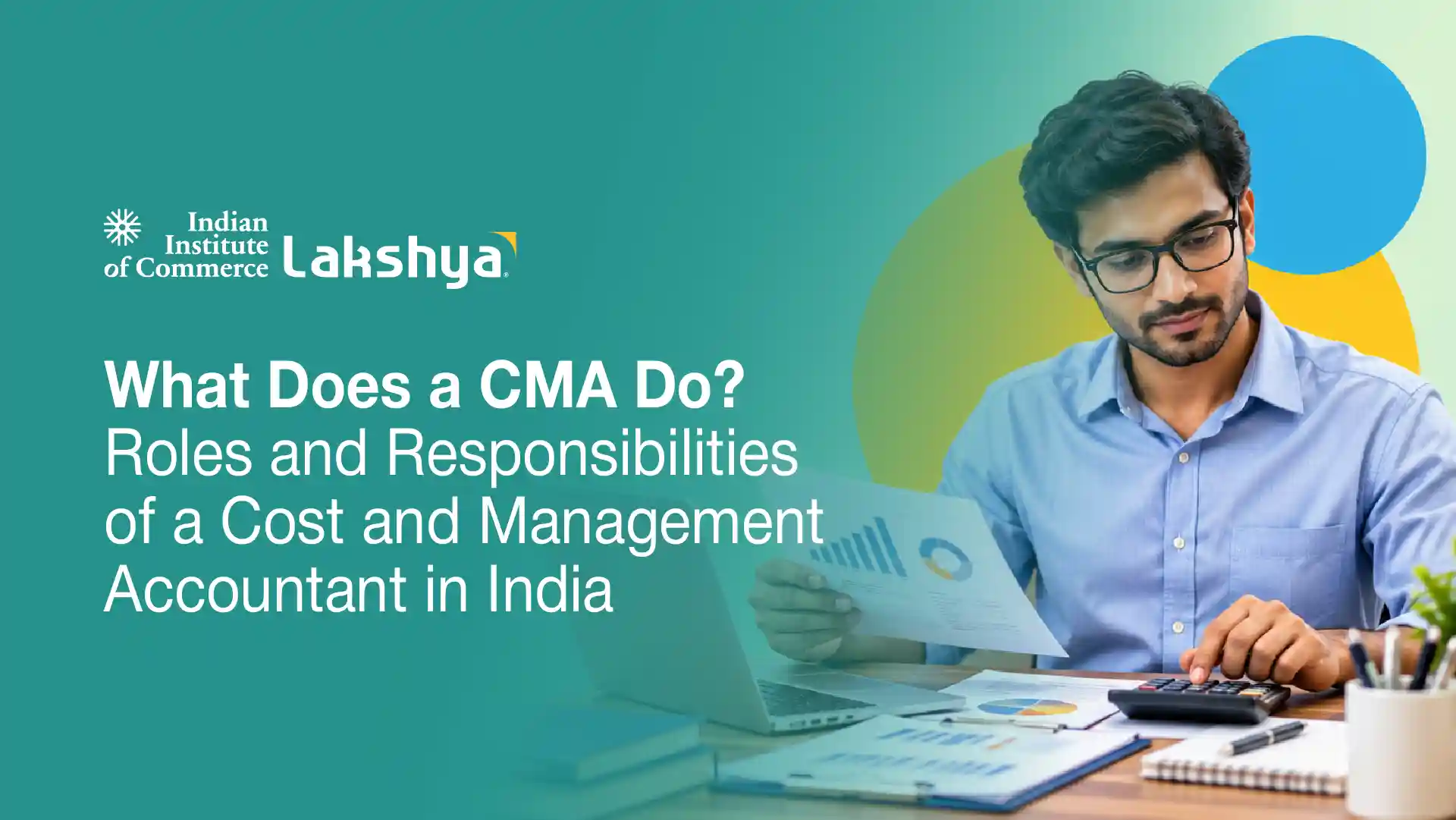
What Does a CMA Do? Roles and Responsibilities of a Cost and Management Accountant in India
Last Updated On -23 Nov 2026
You may have studied cost sheets in B.Com and wondered who actually uses them at work. A factory deciding its selling price does. So does a business checking whether a large customer order will leave enough profit.
The role of cost accountant involves answering these questions with reliable figures. When expenses rise, someone has to work out where the extra money went and whether the business can do anything about it.
That work can look quite different across employers. In a manufacturing company, you might discuss material wastage with a production supervisor. In a corporate finance team, you could spend more time preparing forecasts and reviewing department budgets.
Before choosing the CMA India course, it helps to understand what these responsibilities involve. Here, we look at the daily work, skills, entry requirements, jobs and salary expectations. For students and graduates planning their next step, the aim is to connect the qualification with the work they could eventually do.
What Is the Role of Cost Accountant?
A cost accountant calculates business costs, investigates changes in spending and helps managers make decisions about prices, resources and profitability.
The work commonly involves these tasks:
- Calculate the cost of producing goods or delivering services.
- Compare actual spending with the budget.
- Find the reasons for waste, losses or falling margins.
- Estimate how a proposed business decision could affect profit.
- Maintain cost information for reporting and compliance.
Cost accounting concentrates on costs. Management accounting brings this information together with sales, cash flow and operating data to support wider decisions. An employer may combine both within one position.
CMA India refers to the qualification offered by the Institute of Cost Accountants of India (ICMAI). The CMA USA qualification follows a separate route. Check which qualification a course or vacancy refers to.
Management Accountant Roles and Responsibilities
The responsibilities of a management accountant vary across businesses. A bakery needs product costing; a service company may analyse project costs.
1. Work Out What a Product or Service Costs
Consider a bakery calculating the cost of a cake. Ingredients are easy to identify, but staff time, electricity, packaging and equipment also contribute to the cost.
A cost accountant decides how to include these expenses fairly. Shared costs need particular care: the bakery’s electricity bill covers several products.
Their tasks may include:
- Prepare cost sheets using material, labour and overhead expenses.
- Update estimates when supplier prices or production methods change.
- Check whether shared expenses follow a reasonable allocation method.
2. Prepare Budgets and Update Forecasts
A budget records what the business plans to earn and spend. A forecast reflects what now looks likely, taking newer information into account.
Management accountants gather estimates from different departments and check whether the figures fit together. If sales expects more orders, production may need extra staff or materials.
The accountant examines the spending and cash requirements behind that plan.
3. Investigate Why Actual Costs Differ
Suppose a company expects to spend ₹100 per unit but ends up spending ₹112. Reporting the difference takes little time. Explaining it takes more work.
The accountant may check purchase prices, material usage, overtime and rejected units.
This investigation is called variance analysis. Once the cause becomes clear, managers can decide whether to renegotiate purchases, review production or revise the budget.
4. Help Managers Assess Business Decisions
The duties and responsibilities of a management accountant also include examining the financial effect of proposed decisions.
For example, they may:
- Assess whether a discounted order covers the costs it adds.
- Compare making a component internally with buying it.
- Work out which products make better use of limited capacity.
- Estimate the costs and returns of new equipment.
Managers also weigh quality, supplier reliability and delivery commitments before acting.
5. Review Stock, Cash and Spending Controls
A company can report a profit while struggling to pay its bills. Too much money may sit in unsold stock or unpaid customer invoices.
Depending on the position, a CMA may review inventory, track slow-moving goods or investigate differences in stock records. They may also check unusual purchases and missing approvals.
The work requires conversations with colleagues in stores, purchasing and operations. A spreadsheet alone may not explain what happened.
6. Maintain Cost Records and Support Audits
Some CMAs prepare cost records, supporting schedules and explanations for auditors. Statutory cost audit applies to specified companies under the relevant rules.
Preparing information for an audit is different from signing the audit report. Independent professional practice requires the appropriate ICMAI membership, Certificate of Practice and compliance with appointment requirements. Passing the examinations alone does not provide that authority.
Reading a CMA Job Description
Read a cost and management accountant job description for its duties, reporting manager and required experience.
|
Job title |
Work you may handle |
Preparation that helps |
|
Cost accountant |
Prepare cost sheets and review production variances. |
Practise costing, inventory analysis and Excel. |
|
Management accountant |
Prepare budgets, forecasts and management reports. |
Learn to explain financial results clearly. |
|
Analyse financial plans and business scenarios. |
Practise financial modelling and presentations. |
|
|
Plant finance executive |
Review factory costs, stock and operating results. |
Understand production processes and accounting systems. |
FP&A stands for financial planning and analysis.
A cost accountant job description may also include month-end reporting and reconciliations. During an interview, ask how the team divides routine reporting and analytical work.
How to Become a CMA in India
CMA India has Foundation, Intermediate and Final stages. Your existing qualification determines where you can enter.
- After Class 12: Students generally begin through the Foundation route.
- After B.Com: Eligible graduates can register directly for Intermediate under ICMAI rules.
- With another qualification: Check the accepted entry routes and exemptions before applying.
Some degree disciplines fall outside the general graduate entry provision. Use ICMAI’s eligibility criteria to confirm your route.
Your plan also needs to account for prescribed training and membership requirements. Leave enough time for revision and written practice alongside classes. Understanding a worked solution and completing it independently under exam conditions are different tasks.
Qualities of a Management Accountant
The qualities of a management accountant become clearer when you consider what happens after a calculation.
Can you spot an unlikely figure? Explain a cost increase? Tell a manager that the available data does not support their assumption?
Build these habits alongside your studies:
- Check your work. Trace figures back to their source and review formulas.
- Ask useful questions. Understand how the business buys, produces and sells.
- Explain findings plainly. Colleagues need to understand the issue and their options.
- Report honestly. Keep unfavourable findings visible and protect confidential information.
- Practise with tools. Learn Excel and become familiar with enterprise resource planning systems.
For interview practice, prepare a small budget-versus-actual report and talk through one difference. Explain what you would investigate before recommending action.
Management Accountant Jobs and Career Progression
Search for management accountant jobs under related titles, too. Costing executive, finance analyst and commercial finance executive vacancies may include relevant responsibilities.
A management accountant career path can progress from trainee or analyst to senior analyst, manager and financial controller. The pace depends on the responsibilities you handle and the experience you build.
When comparing early opportunities, check:
- Whether the work includes costing, budgets or business analysis.
- Who will review your work and guide you.
- Which systems and processes you will learn.
- Whether the location and workload suit your circumstances.
CMA Salary Expectations and Workplace Realities
ICMAI’s April–May 2026 campus placement brochure reports average annual CTC of ₹12–13 lakh. This is a campus recruitment figure, not a salary promise or an average covering every CMA in India.
Offers depend on the employer, role, location, experience and selection process. Check the salary breakup: CTC differs from take-home pay.
Compare fixed pay, variable components, joining bonuses and relocation expenses. Also consider what the job will teach you.
Month-end reporting and budget deadlines can bring pressure. Missing data and conflicting explanations may take longer to resolve than the calculations themselves. As software handles more routine reporting, practise checking its outputs and explaining what the results mean.
Is This the Right Career for You?
The role of cost accountant may suit you if you enjoy investigating figures and understanding how a business works. Expect detailed checking, discussions with other departments and deadlines alongside the analytical work.
Before enrolling, review the syllabus and try a few costing problems. For help planning your entry route and study commitments, contact IIC Lakshya’s academic guidance team. Choose a path you can commit to, with a clear picture of both the examinations and the job.
Related Blogs