
CA Foundation Previous Year Question Papers
Last Updated On -05 Sep 2026
By Nishtha Singh
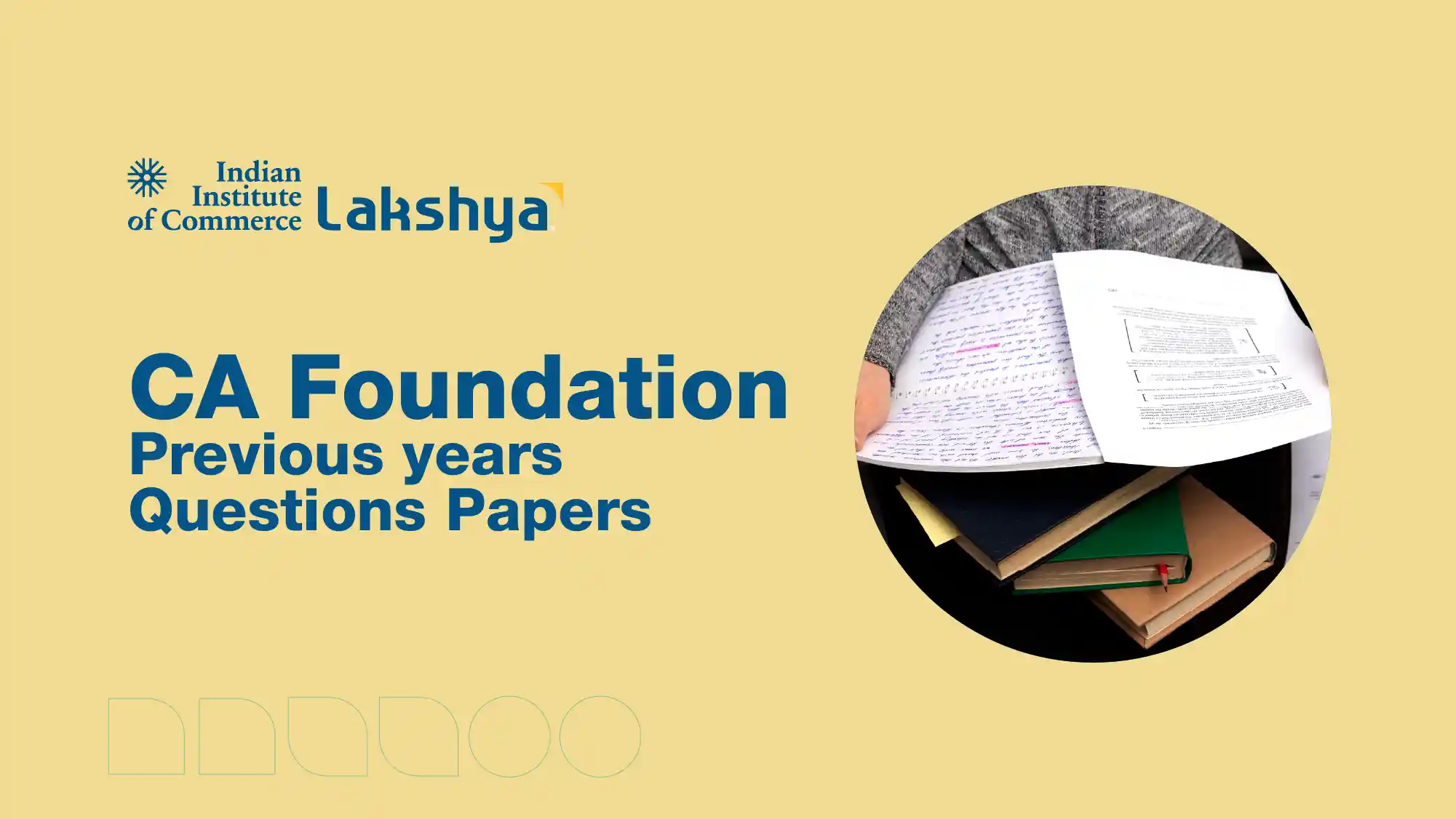
CA Foundation previous year question papers are among the most useful resources for students preparing for the Chartered Accountancy entrance-level examination. Solving past papers helps students understand how questions are framed, identify frequently tested concepts, improve time management, and become familiar with the examination pattern.
CA Foundation currently consists of four papers: Accounting, Business Laws, Quantitative Aptitude, and Business Economics. ICAI also publishes revision test papers, mock test papers, and examination-related question material that students can use alongside previous examination papers.
For students preparing for an upcoming attempt, previous year papers should not be treated simply as practice tests. They can be used as a structured tool to understand the syllabus, assess preparation levels, and identify topics that need more revision.
What Are CA Foundation Previous Year Question Papers?
CA Foundation previous year question papers are the question papers used in earlier ICAI Foundation examinations. They allow students to see the types of questions asked in actual examinations and understand how concepts from the syllabus are tested.
These papers can help candidates become familiar with the wording, difficulty level, calculation requirements, conceptual questions, and distribution of questions across different topics.
ICAI also maintains examination archives covering previous examination sessions, making past examination information available to students.
CA Foundation Previous Year Papers for All Four Subjects
The CA Foundation course currently has four papers:
-
Paper 1 – Accounting
-
Paper 2 – Business Laws
-
Paper 3 – Quantitative Aptitude
-
Paper 4 – Business Economics
ICAI's current Board of Studies information confirms these four subjects for the Foundation course.
Students should practise previous questions from all four papers instead of concentrating only on Accounting or Quantitative Aptitude. Each paper tests a different type of knowledge and requires a different preparation approach.
CA Foundation Accounting Previous Year Question Papers
Accounting is Paper 1 of the CA Foundation course. The paper requires students to understand accounting concepts and apply them to numerical and practical problems.
Previous year Accounting papers are particularly useful because they show students how accounting concepts are converted into examination questions. By solving multiple papers, candidates can identify areas where they frequently make calculation or conceptual errors.
Students should pay particular attention to:
-
Accounting fundamentals
-
Journal and ledger
-
Trial balance
-
Bank reconciliation
-
Depreciation
-
Inventories
-
Financial statements
-
Partnership accounts
-
Company accounts
-
Accounting concepts and principles
Students should first solve questions topic-wise and then attempt complete previous papers under examination conditions.
CA Foundation Business Laws Previous Year Question Papers
Business Laws is Paper 2 of the Foundation course. Unlike Accounting, this paper requires students to develop a strong understanding of legal concepts and present their answers appropriately.
Previous year papers can help candidates understand how legal provisions are converted into practical situations and scenario-based questions.
While practising, students should focus on:
-
Identifying the relevant legal provision
-
Understanding the facts of the question
-
Applying the provision to the situation
-
Reaching a logical conclusion
-
Presenting the answer clearly
Reading the law alone is not enough. Students should practise writing answers because presentation and application are important parts of preparing for a law examination.
CA Foundation Quantitative Aptitude Previous Year Papers
Paper 3 covers Business Mathematics, Logical Reasoning and Statistics. ICAI's Foundation examination material identifies these three areas under Quantitative Aptitude.
Previous year papers are particularly useful for Quantitative Aptitude because they allow students to practise calculations under time pressure.
Candidates should use previous papers to improve:
-
Calculation speed
-
Formula recall
-
Question selection
-
Accuracy
-
Time management
-
Logical reasoning
-
Statistical problem-solving
After completing a question, students should review the method used rather than simply checking whether the final answer is correct.
CA Foundation Business Economics Previous Year Papers
Business Economics is Paper 4 of the CA Foundation course. Previous papers can help students understand how economic concepts are tested through objective questions.
Students can use past papers to revise topics such as:
-
Demand and supply
-
Consumer behaviour
-
Production
-
Cost concepts
-
Market structures
-
National income
-
Money and banking
-
International trade
-
Indian economy
ICAI's published Foundation examination material identifies Business Economics as Paper 4.
Why Should You Solve CA Foundation Previous Year Papers?
Previous year question papers provide something that ordinary study material cannot: exposure to actual examination questions.
They help students understand:
-
The way ICAI frames questions
-
The level of conceptual understanding required
-
Common question formats
-
The balance between different topics
-
The time required for different sections
-
Areas where preparation is weak
-
How well concepts can be applied under pressure
Repeated practice also reduces examination anxiety because students become familiar with the experience of completing a complete paper within a fixed time.
How Many Years of CA Foundation Papers Should You Solve?
There is no fixed number of previous years that every student must solve. A good strategy is to work through as many relevant and syllabus-compatible papers as possible.
However, students should not blindly solve very old papers if the syllabus, examination pattern, or applicable provisions have changed.
A practical approach is to prioritise:
-
The most recent examination papers
-
Recent mock and revision test papers
-
Older papers covering the current syllabus
-
Topic-wise questions from previous examinations
This approach gives students practice that is more closely aligned with the examination they are preparing for.
CA Foundation Previous Papers vs Revision Test Papers
Previous examination papers and Revision Test Papers (RTPs) serve different purposes.
A previous year examination paper shows how ICAI actually tested candidates in an earlier examination.
An RTP, on the other hand, is designed as an additional preparation and revision resource for a particular examination session.
ICAI publishes Foundation Revision Test Papers for individual examination sessions. For example, the Institute's May 2026 Foundation material includes RTPs for Accounting, Business Laws, Quantitative Aptitude and Business Economics.
Students should therefore use both rather than choosing one over the other.
CA Foundation Previous Papers vs Mock Test Papers
Mock tests are designed to simulate examination conditions and help students evaluate their preparation before the actual examination.
ICAI also conducts and publishes mock test material for Foundation students. Its Board of Studies announced Mock Test Paper Series I and II for students appearing for the September 2026 Foundation examination.
A useful preparation sequence is:
Study material → Topic practice → Previous year questions → RTPs → Mock tests → Final revision
This allows students to move gradually from learning concepts to applying them under examination conditions.
How to Solve CA Foundation Previous Year Question Papers
Simply reading previous papers is not enough. Students should actually attempt them.
Start by solving individual questions after completing the corresponding chapter. Once a significant portion of the syllabus has been completed, move to full-paper practice.
For full-paper practice:
-
Select a recent examination paper.
-
Keep the required examination duration.
-
Avoid referring to notes while solving.
-
Attempt the paper in one sitting.
-
Check your answers afterward.
-
Identify mistakes.
-
Categorise the mistakes by topic.
-
Revise the relevant concepts.
-
Attempt similar questions again.
This turns each previous paper into a diagnostic tool rather than just another practice exercise.
How to Analyse Your Performance After Solving a Paper
The analysis after completing a paper can be more valuable than simply checking the score.
Divide your mistakes into categories:
Conceptual mistake: You did not understand the underlying concept.
Memory mistake: You knew the concept but could not recall the required provision, formula, or information.
Calculation mistake: The approach was correct but an arithmetic or calculation error affected the answer.
Application mistake: You understood the concept but could not apply it correctly to the question.
Time-management mistake: You knew how to solve the question but could not complete it within the available time.
This classification tells you exactly what needs to improve.
How Previous Papers Help Identify Important Topics
Previous year papers can help students recognise topics that have been tested repeatedly or in different formats.
However, students should not assume that a topic will appear simply because it has appeared several times before. ICAI can test any relevant area of the applicable syllabus.
The better strategy is to use past papers to understand question trends and application patterns, while still preparing the complete syllabus.
Should You Memorise Answers From Previous Papers?
Memorising complete answers is generally less useful than understanding the concepts behind them.
For Accounting and Quantitative Aptitude, students should understand the calculation process.
For Business Laws, students should understand the relevant legal principle and learn how to apply it to facts.
For Business Economics, students should understand the underlying economic concept rather than memorising isolated answers.
Previous papers should therefore be used to develop examination skills rather than create a collection of answers to memorise.
How to Use Previous Papers During the Last Month
Previous papers become particularly valuable during the final phase of preparation.
A student can use the last month to:
-
Attempt recent papers
-
Complete RTPs
-
Attempt mock examinations
-
Analyse mistakes
-
Revise weak chapters
-
Practise difficult calculations
-
Review important legal concepts
-
Strengthen economic concepts
-
Improve examination speed
At this stage, the objective should gradually shift from learning new concepts to improving accuracy and examination performance.
How to Use CA Foundation Previous Papers for Time Management
Time management is one of the biggest benefits of solving complete papers.
Students often know the subject but lose marks because they spend too much time on difficult questions. Practising full papers teaches candidates how to distribute their available examination time.
During practice, track:
-
Time spent per question
-
Time spent on difficult questions
-
Questions left unanswered
-
Calculation time
-
Revision time
-
Number of avoidable errors
Over several papers, students can develop a more effective examination strategy.
Are CA Foundation Previous Year Papers Enough for Preparation?
No. Previous year papers are an important preparation resource, but they should not replace the ICAI study material.
Students should build their preparation around the current syllabus and applicable study material and then use previous papers, RTPs, mock tests, and other practice resources to strengthen their preparation.
ICAI publishes examination-specific study material and updates. For example, its Foundation Paper 1 page distinguishes material applicable to different examination periods, demonstrating why students should use material relevant to their particular attempt.
Where Can You Find CA Foundation Previous Year Question Papers?
Students should preferably obtain previous examination papers and preparation resources from official ICAI sources or other reliable academic resources.
ICAI's Examination Services Archives contain information relating to multiple past examination sessions, including Foundation examinations.
ICAI also publishes question booklets and answer keys for relevant objective papers. For example, the Institute published the January 2026 Foundation MCQ booklets and answer keys for Quantitative Aptitude and Business Economics.
How Coaching Can Help With CA Foundation Question Paper Practice
Solving previous year papers becomes more effective when students have guidance on how to analyse their performance. Faculty can help identify whether a student's problem is conceptual understanding, question interpretation, calculation accuracy, answer presentation, or time management.
At IIC Lakshya, CA Foundation students can receive structured preparation, faculty guidance, regular question practice, revision support, and mock-test preparation. Combining classroom learning with previous year papers can help students approach the examination with stronger conceptual understanding and greater confidence.
Frequently Asked Questions (FAQs)
Where can I get CA Foundation previous year question papers?
Students can access previous examination information and question-related resources through ICAI's official examination and Board of Studies platforms. ICAI also maintains examination archives covering previous sessions.
How many previous year papers should I solve for CA Foundation?
There is no fixed number that guarantees success. Students should prioritise recent papers that match the current syllabus and supplement them with RTPs and mock tests.
Are CA Foundation previous papers enough to pass?
No. Previous papers should be used alongside the current ICAI study material, revision test papers, mock tests, and regular revision.
Are CA Foundation previous year papers useful for Accounting?
Yes. They help students understand how accounting concepts are tested and provide practice with numerical and practical questions.
Are previous year papers useful for CA Foundation Business Laws?
Yes. They help students understand how legal provisions are applied to practical situations and improve answer-writing skills.
Should I solve RTPs or previous year papers first?
Ideally, use both. Previous papers help you understand actual examination questions, while RTPs provide examination-specific revision and additional practice. ICAI publishes RTPs for Foundation subjects for individual examination sessions.
Should I solve CA Foundation papers under a time limit?
Yes. Once you have completed sufficient syllabus coverage, attempting full papers under examination conditions can improve time management, accuracy and confidence.
Can old CA Foundation papers still be used?
Yes, but they should be used carefully. If the syllabus, laws, regulations, or examination pattern has changed, older questions may not reflect the requirements of your current attempt. Always prioritise recent papers and the latest applicable ICAI material.
Related Blogs