
How to Become an IFRS Expert After CA or ACCA?
Last Updated On -16 Sep 2026
By Sagnika Sinha

To become an Association of Chartered Certified Accountants (ACCA) member or Chartered Accountant (CA), you have to develop a stronger foundation in finance, accounting, taxation, consulting, and reporting. However, becoming an IFRS expert takes your career one step further.
When accounting rules are applied by an IFRS specialist, they interpret principles, ensure compliance with global accounting standards, advise businesses on accounting treatments, and expand professional practices. As a 12th student or a finance working professional, develop and learn about how you can expand your career from CA or ACCA to an IFRS expert. On this path, you are prepared and move towards a rewarding global career.
The Mindset Shift: From Rules to Principles
One of the biggest changes you will face when you shift from ACCA or CA to IFRS specialization is how you view and practice accounting. IFRS is less about details related to accounting, it is about the application of professional accounting and judgement leading to the economic substance of transactions. The use of IFRS helps professionals develop expertise and integrate growth in business operations.
Local GAAP
The Generally Accepted Accounting Principles (GAAP) are local standards that provide detailed rules and regulations for specific accounting situations. Professionals who are trained under the local GAAP focus on the following aspects:
- Compliance with national accounting standards
- Detailed regulatory requirements
- Rule-based accounting treatments
- Local reporting frameworks
Instead of integrating only predefined procedures, professionals should also learn about economic reality, as business transactions are complex.
IFRS
When IFRS is implemented, a principle-based approach relies on detailed rules and regulations. For every transaction in a business, professionals help in evaluating the commercial substance leading to accounting treatment. Here are some of the work-life balance tips for preparing for DipIFRS, which also includes the transition from CA and ACCA.
As an IFRS expert, finance statements represent business performance. The economic impact of the transactions is evaluated based on their analytical thinking and business understanding derived from IFRS practices, knowledge, and practical approach.
Deep Dives into Complex Standards
We have to move into the IFRS history and development specialization to learn about the complex standards, as expertise needs to be developed. Professionals need to learn and develop expertise in the advanced accounting standards so that multinational companies can hire them.
Financial Instruments (IFRS 9)
It is particularly important in banking, financial services, and large corporate organizations. Professionals working with IFRS 9 focus on:
- Classification of financial assets
- Measurement of investments
- Expected Credit Loss (ECL) calculations
- Impairment testing
- Hedge accounting
- Financial disclosures
Revenue from Contracts with Customers (IFRS 15)
One of the most significant areas of financial reporting is revenue recognition. With the implementation of IFRS 15, it is a five-step model that helps in determining the reasons why businesses can recognize revenue. IFRS professionals evaluate:
- Customer contracts
- Performance obligations
- Transaction prices
- Revenue allocation
- Timing of revenue recognition
Leases (IFRS 16)
Instead of treating many leases as operating expenses, companies now recognize:
- Right-of-use assets
- Lease liabilities
- Interest expenses
- Depreciation expenses
IFRS specialists help organizations:
- Review lease agreements
- Calculate lease liabilities
- Determine discount rates
- Ensure ongoing compliance
- Prepare financial disclosures
With this standard, professionals will be able to bring change in the industries because leasing offices, vehicles, equipment, machinery, and warehouses are a common element in the business market.
Business Combinations (IFRS 3)
The IFRS 3 helps in providing guidance on accounting for various business combinations. With the integration of mergers and acquisitions in businesses, companies, and professionals will need to learn and implement IFRS 3, so that they know accounting becomes increasingly important and complex.
The role of IFRS in performance management and financial control enhances the growth of the business and overall integration. Below are some of the significant activities that are performed by professionals with technical skills and knowledge.
- Purchase price allocation
- Fair value measurement
- Goodwill calculation
- Identification of intangible assets
- Post-acquisition reporting
- Acquisition accounting
Industries like corporate finance, mergers and acquisitions (M&A), transaction advisory, and consulting hire these professionals.
Consolidation and Group Reporting
IFRS experts prepare financial statements, and consolidation reporting combines financial results in a corporate group. There are multiple subsidiaries of large companies across the globe. Here are the significant responsibilities:
- Eliminating intercompany transactions
- Foreign currency translation
- Minority interest calculations
- Preparing consolidated balance sheets
- Consolidated profit and loss statements
- Group reporting under IFRS
Disclosure and Communication
Companies, when performing financial reporting, will require more than preparing financial statements. They can explain financial statements, performance, and regulations to investors and stakeholders, thus maintaining transparency.
With significantly strong communication skills, IFRS professionals and experts help businesses grow effectively. Several countries use IFRS, the Global Accounting Standards, which help businesses to perform effectively.
IFRS 18 (Presentation and Disclosure)
Professionals must learn about the following aspects:
- New presentation requirements
- Income statement structure
- Enhanced financial disclosures
- Improved comparability
- Investor-focused reporting
These changes help businesses provide clearer financial information to users of financial statements. The IFRS objectives also explain why the regulations are significant for the smooth operations of businesses across the world.
Management Performance Measures (MPMs)
Many organizations report additional performance measures alongside traditional financial statements. IFRS specialists evaluate and disclose these Management Performance Measures (MPMs) appropriately. Here are the examples:
- EBITDA
- Adjusted operating profit
- Normalized earnings
- Free cash flow
- Core operating performance
Validating Your IFRS Expertise
Practical knowledge integrated by IFRS also helps professionals develop their skills. After aspirants go through the whole process of how to become an IFRS specialist, they must validate their expertise. If you pursue the following aspects, your profile will become quite strong and ready for future professional opportunities and a higher salary.
- Practical financial reporting experience
- ERP implementation exposure
- Financial statement preparation projects
- Advanced IFRS certifications
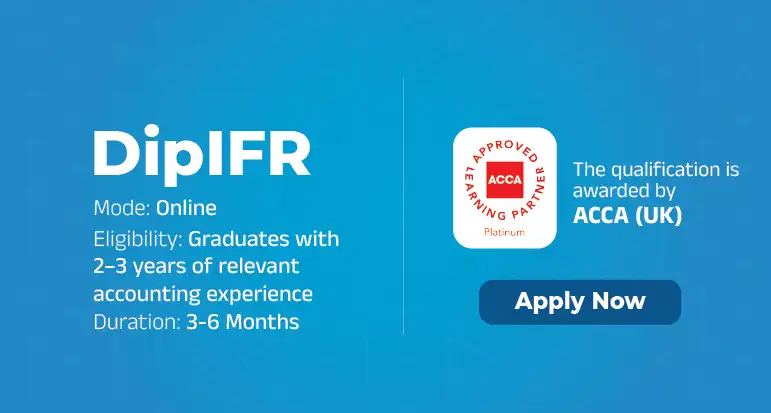
- Diploma in IFRS (DipIFR)
- Continuous Professional Development (CPD)
Wrapping Up!
Transitioning from a traditional CA or ACCA qualification into a dedicated IFRS specialisation moves your career from routine compliance to global financial strategy. While CA and ACCA build strong foundational knowledge in auditing, taxation, and financial management, mastering IFRS shifts your mindset from local rule-based accounting standards to international principle-based frameworks applied across 140+ jurisdictions. As an ACCA Approved Platinum Learning Partner, IIC Lakshya supports finance professionals and commerce graduates through specialized IFRS diploma programs, hands-on reporting practice, and expert guidance empowering candidates to master complex standards like IFRS 9, 15, and 16 and step into high-paying global corporate roles.
Read More
- AI in IFRS Accounting: Functions, Benefits, and Limitations
- What is the Effect of AI in IFRS: Benefits, Risks & Future
- Diploma in IFRS ACCA Exam: Meaning, Features & Eligibility
- GAAP vs IFRS: Definitions, Differences & Purposes
- How to Pass IFRS Certification Exam with 1 Month Left?
Frequently Asked Questions
Is becoming an IFRS expert worth it?
Definitely, becoming an IFRS expert is worth it because it enhances technical skills and accounting knowledge. It improves global employability, creating leadership opportunities in financial advisory, reporting, banking, insurance, multinational finance, and consulting.
Which certifications can strengthen an IFRS career?
Certifications that strengthen an IFRS career are CPA, CMA, specialized IFRS training programs, and Diploma in IFRS (DipIFR).
Which industries hire IFRS experts?
Industries that hire IFRS experts are manufacturing, banking, healthcare, consulting, oil, gas, insurance, retail, technology, telecommunications, aviation, and multinational corporations.
Why are consolidation skills important for IFRS professionals?
Consolidation skills are significant for IFRS professionals because it creates significant job opportunities in multinational companies. Consolidation of financial statements, eliminating intercompany transactions, and ensuring accurate group reporting are significant areas of professional expertise.
Why is the mindset shift from rules to principles important?
The mindset needs to shift from rules to principles because it is only about relying on and depending on accounting rules. It is also about the judgment of the professionals and how they apply it to determine the accounting transaction, management, and treatment of the business.
Related Blogs