
ACCA Exemptions After B.Com, MBA, CA & CMA
Last Updated On -06 Nov 2026
Are you planning to build a career in accounting, finance, or business management? The ACCA qualification can help you develop internationally relevant accounting and finance skills. But did you know that your existing academic or professional qualifications may help you complete ACCA faster?
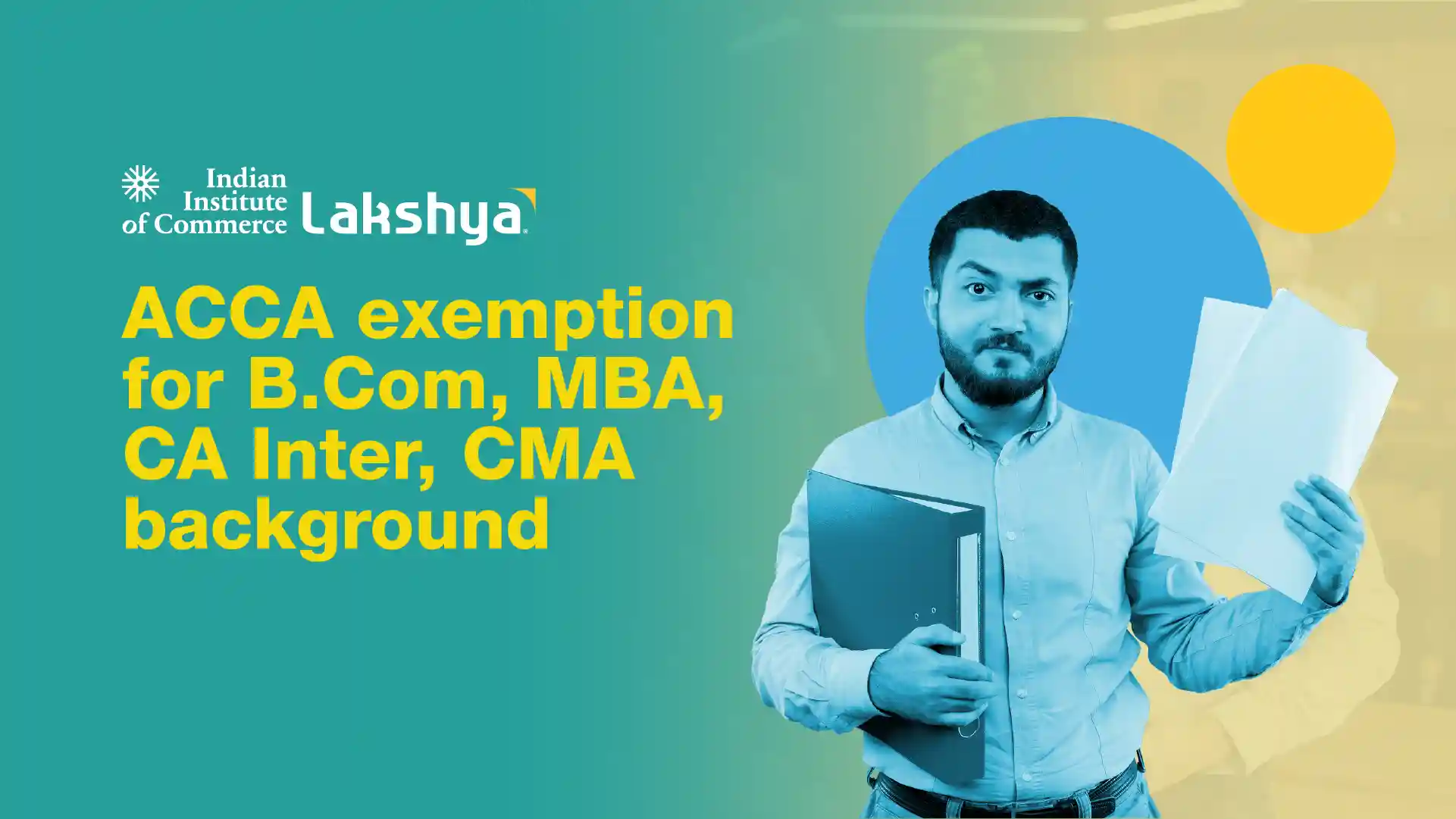
Whether you have completed B.Com, pursued an MBA in Finance, cleared CA Intermediate, qualified as an Indian CA, or hold a CMA qualification, you may be eligible for ACCA exemptions. Learn about the best courses for ACCA exemptions, which will help you qualify effectively.
These exemptions allow eligible students to skip certain ACCA examinations based on their previous learning. However, the number of exemptions depends on your qualification, university, subjects, and graduation year. Let's explore how ACCA exemptions work for different educational and professional backgrounds.
Exemption Overview by Background
ACCA offers exemptions to candidates whose previous qualifications cover learning outcomes equivalent to certain ACCA examinations. The ACCA Qualification has three main examination levels:
- Applied Knowledge
- Applied Skills
- Strategic Professional
You may receive exemptions from the first two levels. However, ACCA does not grant exemptions from Strategic Professional examinations. You must complete these papers through ACCA.
The maximum exemption available is nine examinations across Applied Knowledge and Applied Skills. Let's understand the possibilities for different backgrounds. Before you enrol in ACCA, you need to learn about the fees, exams, and exemptions.
BCom (General/ Honours/ University Standard)
A Bachelor of Commerce degree gives students a strong foundation in accounting, taxation, business law, economics, and finance. If you have completed B.Com General or B.Com Honours, you may qualify for exemptions from selected ACCA papers.
However, your university and course structure matter. ACCA checks whether your subjects match its examination syllabus. For example, a student who has studied financial accounting, business law, taxation, and management accounting may have relevant prior learning.
What should you check?
- Your university's recognition and accreditation status.
- Your graduation year.
- Your B.Com specialisation.
- The subjects listed on your academic transcript.
Do not assume that every B.Com graduate receives the same exemptions. Even students from the same university may receive different results if their courses or graduation years differ.
MBA (Finance/ Accounting)
Have you completed an MBA in Finance or Accounting? Your postgraduate qualification may help you claim exemptions from relevant ACCA examinations.
MBA programmes often cover financial management, corporate finance, accounting, taxation, and business strategy. However, an MBA does not automatically qualify you for exemptions from all these subjects.
ACCA evaluates your university, programme, modules, and graduation year. Your MBA specialisation also plays an important role. If you hold an MBA in Marketing, Human Resources, or Operations, your eligibility may differ from that of an MBA Finance graduate.
Pro tip: Keep your MBA degree certificate and semester-wise transcripts ready before checking your exemption eligibility.
CA Intermediate (ICAI)
Have you cleared CA Intermediate but not completed the CA Final examination? You can still explore the ACCA pathway. Your CA Intermediate studies cover several areas that overlap with ACCA, including accounting, taxation, auditing, and financial management.
Depending on your examination results and qualifications, you may qualify for exemptions. However, clearing CA Intermediate does not guarantee a fixed number of exemptions. ACCA must assess your completed papers and supporting documents.
If you have also completed B.Com, check how ACCA evaluates your combined academic and professional qualifications. This is how you get to learn how to apply for ACCA Exemptions and learn about the requirements.
CA (Qualified/ ICAI Member)
Qualified Chartered Accountants from the Institute of Chartered Accountants of India (ICAI) have extensive knowledge of accounting, auditing, taxation, and financial reporting. This professional background can make them eligible for substantial ACCA exemptions.
A qualified Indian CA may receive exemptions from up to nine Applied Knowledge and Applied Skills examinations, subject to ACCA's eligibility assessment. This can significantly reduce the number of examinations you need to complete.
However, remember that ACCA membership and ICAI membership are separate professional credentials. ACCA membership does not automatically grant an Indian CA membership or statutory audit signing rights in India.
CMA (Indian - ICMAI/ US CMA)
Cost and management accounting professionals can also explore ACCA exemptions. Both Indian CMA and US CMA qualifications provide valuable knowledge of costing, budgeting, performance management, and financial decision-making.
However, the two qualifications follow different awarding systems. ACCA assesses them separately. Let's look at each route.
Qualified Indian CMA (ICMAI)
The Institute of Cost Accountants of India (ICMAI) awards the Indian CMA qualification. Qualified Indian CMAs have studied cost accounting, financial management, taxation, auditing, and business strategy.
This knowledge may help them qualify for ACCA exemptions. However, the exact exemption award depends on the qualification status, examination route, relevant documents, and ACCA's current assessment criteria.
If you are an ICMAI finalist or an associate or fellow member, check your precise status in the official exemption calculator. Do not rely only on a coaching institute's exemption chart or ACCA Exemption calculator to develop insight on eligible papers.
US CMA
The US CMA qualification, awarded by the Institute of Management Accountants (IMA), focuses on financial planning, performance management, analytics, and strategic financial management.
These subjects complement several areas of the ACCA syllabus. However, holding a US CMA qualification does not automatically mean you will receive ACCA exemptions.
ACCA must assess the qualification against its exemption framework. Your education history may also influence the result. If you hold both US CMA and a commerce degree, submit the relevant details for an official assessment.
Key Rules to Keep in Mind
Before applying for ACCA exemptions, understand these important rules. Let’s go through these rules carefully.
No Multiple Degrees in Mind
Do not assume that holding several degrees automatically increases your exemption count. For example, having B.Com, MBA, and CA Intermediate qualifications does not mean ACCA will simply add exemptions from all three.
ACCA evaluates your qualifications and the learning they represent. Overlapping subjects do not create additional exemptions for the same examination. Submit all relevant qualifications and let ACCA determine your eligibility.
Strategic Professional Level
This is one rule every ACCA student should remember. ACCA does not grant exemptions from Strategic Professional examinations, regardless of your academic or professional background. You must also decide whether you will get ACCA Exemptions or retake exams.
You must complete the Strategic Professional examinations as part of your ACCA journey. This ensures that every ACCA member demonstrates the advanced knowledge and professional skills required at this level.
Exemption Fees Apply
Exemptions can save preparation time, but they are not free. ACCA charges an exemption fee for each examination exemption awarded. The applicable amount depends on the current ACCA fee structure.
Before accepting exemptions, compare the cost with the time and preparation you would save. Also consider whether you still remember the subjects covered by your earlier qualification.
Check via Official Tool
Never finalise your ACCA study plan based on assumptions or third-party exemption charts. Visit the official ACCA Exemptions Calculator and enter:
- Your awarding institution.
- Your qualification.
- Your graduation year or last year of study.
- Your course and relevant modules.
The calculator will display the exemptions you may be eligible to claim. You may also need to submit certificates, transcripts, and other supporting documents for ACCA's assessment.
Wait for official confirmation before purchasing study materials or committing to an examination plan.
Wrapping Up!
Your previous education can give you a valuable head start in your ACCA journey. Whether you are a Class 12 commerce student planning your professional future, a B.Com graduate exploring international opportunities, an MBA professional seeking career growth, or a CA or CMA looking to expand your global credentials, ACCA offers a structured pathway.
However, remember that exemptions depend on your actual qualifications and ACCA's assessment. They are not automatically granted based on a degree title. Start by checking your eligibility through the official ACCA Exemptions Calculator. Understand the fees, review the syllabus, and choose a study plan that supports your long-term career goals.
Your career in global accounting and finance can start with one informed decision. Why not explore your ACCA exemption eligibility today?
Read More
- ACCA Exemptions for MBA Finance in India
- ACCA for Audit & Finance Professionals: Who Gains Most?
- ACCA vs Executive MBA: Which Career Path Fits You?
- MBA + ACCA Jobs: Finance Roles & Career Paths
- Best ACCA Study Method for Professionals with Only One Hour a Day
Frequently Asked Questions
Can I get ACCA exemptions after B.Com General?
Yes. B.Com General graduates can explore ACCA exemptions. ACCA evaluates the subjects covered in their degree and the institution that awarded it.
Can an MBA Finance graduate claim ACCA exemptions?
Yes. MBA Finance graduates may qualify for exemptions if their programme covers relevant ACCA examination topics. The university, modules, and graduation year influence the assessment.
Does an MBA in Marketing qualify for ACCA exemptions?
An MBA in Marketing does not automatically qualify for accounting-related exemptions. However, ACCA may assess relevant subjects covered in the programme.
Can a qualified Indian CA get all nine ACCA exemptions?
A qualified ICAI Chartered Accountant may qualify for exemptions from all nine Applied Knowledge and Applied Skills examinations. ACCA must confirm the award based on the candidate's qualifications and documents.
Can I combine my B.Com and MBA qualifications to get more ACCA exemptions?
You can submit both qualifications for assessment. However, ACCA does not simply add exemptions from multiple degrees. It assesses the relevant prior learning and avoids duplicate credit for equivalent examinations.
Related Blogs